





High-Quality Rotary Tablet Press Manufacturing in India
To explore the pharmaceutical engineering landscape in India and identify the leading regions responsible for manufacturing high-performance compression technology. This article examines the various types of machinery available, from research-scale units to mass-production systems, focusing on quality and innovation. It further highlights how Indian manufacturers in key industrial hubs adhere to global standards to ensure precision and reliability. By analyzing different machine configurations, the content provides a comprehensive guide for selecting superior tableting solutions within the Indian market.
India has emerged as a global powerhouse in the pharmaceutical sector, not just in drug formulation but also in the engineering of sophisticated processing equipment. When discussing which company manufactures high-quality rotary tablet presses in India, one must look at the synergy between precision engineering and the stringent requirements of international pharmacopoeias. The industry in India is characterized by its ability to provide robust, reliable and technologically advanced solutions that cater to both domestic needs and the rigorous demands of the global export market.
The manufacturing landscape for a Tablet Press in India is concentrated in specific industrial clusters that have fostered innovation for decades. These hubs provide the necessary infrastructure, skilled labor and supply chains required to build machines that can handle the complexities of modern material science. From the initial design phase to the final assembly of complex Tableting Machines, Indian manufacturers prioritize compliance with Current Good Manufacturing Practices to ensure that the equipment is suitable for high-stakes pharmaceutical environments.
Tablet Press Machine Manufacturer expertise in Indian Industrial Hubs
When exploring the centers of excellence for machinery, Ahmedabad stands out as the primary heart of the industry. As a leading Tablet Press Machine Manufacturer, Ahmedabad houses numerous legacy companies that have perfected the art of tablet compression. The city’s industrial estates are filled with engineering firms that specialize in the fabrication of turrets, cam tracks and feeding systems that define the performance of a modern press. These manufacturers often collaborate with global pharmaceutical giants, refining their designs to meet evolving regulatory standards.
Mumbai also plays a critical role as a strategic Tablet Press Machine Supplier. Given its status as a financial and commercial gateway, Mumbai-based companies often bridge the gap between advanced R&D and large-scale distribution. The suppliers in this region are known for their comprehensive after-sales support and their ability to integrate sophisticated automation into the compression process. Similarly, Hyderabad, has a growing presence of machinery manufacturers who work closely with the city’s vast array of biotech and pharmaceutical formulation plants to develop specialized equipment.
Rotary Tablet Press Machine innovations for modern pharmacy
The transition from manual processes to the use of a Rotary Tablet Press Machine marked a significant leap in production efficiency. In the current market, the focus has shifted toward enhancing the user interface and the precision of the weight control systems. A high-quality Rotary Tablet Press produced in India today is likely to feature a fully enclosed compression zone, often with stainless steel contact parts to prevent contamination. The engineering focuses on reducing noise levels and vibration, which not only extends the life of the machine but also improves the consistency of the final product.
The versatility of these Tablet Press Machines is another hallmark of Indian manufacturing. Designers ensure that the equipment can handle various types of powders, including those with challenging flow properties. By optimizing the feeder geometry and the dwell time during the compression cycle, manufacturers ensure that every tablet meets the required hardness and disintegration profiles. This attention to detail is what allows Indian-made equipment to compete with European and American counterparts on the international stage.
Single Sided Rotary Tablet Press Machine Applications
For facilities focused on small-batch production or research and development, the Single Sided Rotary Tablet Press Machine remains an indispensable tool. These machines are designed for flexibility, allowing for quick changeovers between different products. In cities like Pune and Bangalore, where research institutes and pilot plants are prevalent, the demand for these machines is high. The focus here is on the accuracy of the instrumentation, enabling scientists to gather data on the compressibility of new formulations without the need for massive material quantities.
Our Other Machine
F360 R High Speed Double Rotary Tablet Press Machine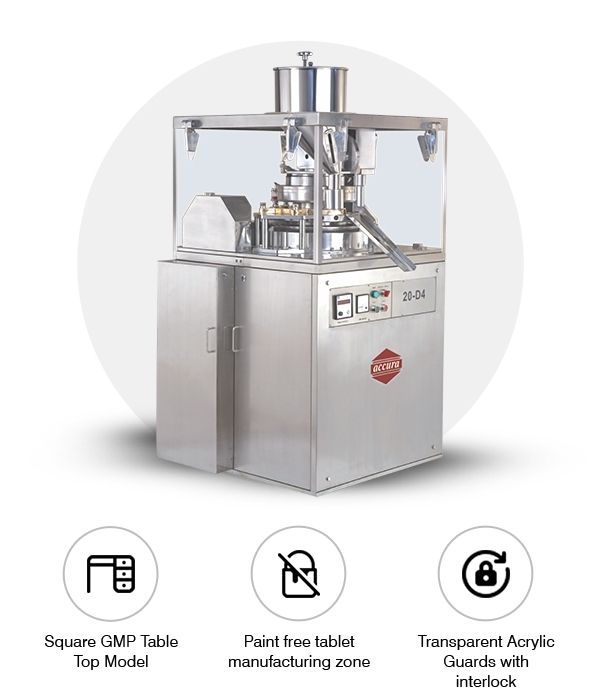
Even in a smaller footprint, a Single Rotary Tablet Press Machine must maintain the same level of structural integrity as its larger counterparts. Indian engineers often utilize SG iron for the turrets and hardened steel for the cam tracks to ensure durability. The integration of variable frequency drives allows operators to fine-tune the speed of the turret, which is essential when dealing with sensitive or heat-reactive ingredients.
Double Rotary Tablet Press systems for high-volume output
When the goal shifts to mass production, the Double Rotary Tablet Press becomes the industry standard. This configuration allows for the production of two tablets per station for every revolution of the turret, effectively doubling the output without a massive increase in the machine's physical footprint. Manufacturers in Gujarat and Maharashtra have mastered the balance required to run these machines at high speeds while maintaining uniform tablet weight across all stations.
A Double-Sided Rotary Tablet Press Machine is often equipped with advanced lubrication systems that ensure the punches and dies operate smoothly over long production runs. The engineering challenge in these machines is to manage the heat generated by the increased friction, a task Indian manufacturers solve through innovative cooling designs and the use of high-performance alloys. This makes them ideal for the continuous manufacturing environments found in the massive production plants of Hyderabad and Chennai.
High Speed Double Rotary Tablet Press and the push for efficiency
The pinnacle of compression technology is often found in the High Speed Double Rotary Tablet Press. These machines are built for the most demanding environments where millions of tablets are produced daily. To achieve such high throughput, the machines utilize sophisticated PLC systems that monitor compression forces in real-time. If a tablet falls outside the specified tolerance, the system can automatically reject it or adjust the fill depth to correct the issue.
The development of the Double Rotary High Speed Tablet Press in India has been driven by the need for cost-effective mass production. By reducing the need for manual intervention and minimizing downtime through modular designs, these machines provide a significant return on investment. The focus is on "total cost of ownership," where the durability of the components and the ease of maintenance are just as important as the initial purchase price.
High-Speed Single Rotary Tablet Press for specialized manufacturing
While double-sided machines offer the highest volume, a High-Speed Single Rotary Tablet Press offers a unique blend of speed and precision for specific applications. These are often used when the formulation requires a longer dwell time or when the physical characteristics of the tablet require a more controlled compression cycle. Indian manufacturers provide these machines with pre-compression capabilities, which help in de-aerating the powder before the final compression, reducing the risk of common defects like capping or lamination.
In the industrial zones of Vadodara and Vapi, companies continue to refine the Single Rotary Tablet Press Machine to include features like automated weight adjustment and integrated de-dusting. These enhancements ensure that the machine is not just a stand-alone unit but a part of a sophisticated, clean-room compatible production line. The emphasis on ergonomics and ease of cleaning also reflects the industry’s commitment to operator safety and hygiene.
Quality benchmarks and the future of Indian tableting machinery
Determining which company stands at the top of the industry often depends on the specific needs of the pharmaceutical manufacturer. However, the collective growth of the Tablet Press Machine Manufacturer sector in India is undeniable. By focusing on international quality standards such as ISO and CE certification, Indian companies have proven their ability to deliver world-class technology. The integration of Pharma 4.0 concepts, including data connectivity and remote monitoring, is the next frontier for these machines.
The growth in cities like Indore and Chandigarh also highlights the decentralization of expertise, ensuring that pharmaceutical companies across the country have access to high-quality Tableting Machines and technical support. As the industry moves forward, the emphasis will remain on sustainability, energy efficiency and the ability to handle increasingly complex drug delivery systems. The Indian machinery sector is well-positioned to continue its trajectory as a leader in the global pharmaceutical landscape.
Our Other Machine
F7200 High Speed Double Rotary Tablet Compression MachineConclusion
The best equipment is met with a diverse range of answers, each reflecting a commitment to engineering excellence. Whether it is a Double Rotary Tablet Press for high-volume generics or a specialized Single Rotary Tablet Press Machine for innovative new drugs, the Indian manufacturing sector provides the reliability and precision necessary to fuel the global health industry.