





Best Tablet Press Machines for Pharmaceutical Manufacturing
Choosing the right equipment for pharmaceutical production is a critical decision that influences efficiency, compliance and product quality. Below is a comprehensive guide to understanding and selecting the best compression technology for modern manufacturing.
Navigating Modern Pharmaceutical Compression Technology
The core objective of this article is to provide an in-depth exploration of the various types of tablet compression machinery available today. By examining the technical nuances between different models, manufacturers can better understand how to align their production goals with the right equipment. This discussion focuses on the operational advantages, structural differences and the specific roles that various machines play in ensuring consistent oral solid dosage forms.
Tablet Press Machine Manufacturer Selection for Global Compliance
Selecting a reliable tablet press machine manufacturer is the first step toward establishing a robust production line. The pharmaceutical industry operates under stringent regulatory frameworks, requiring equipment that not only performs at high speeds but also adheres to Current Good Manufacturing Practice standards. A reputable manufacturer provides more than just hardware; they offer the engineering expertise necessary to handle complex formulations and sensitive active ingredients.
When evaluating a tablet press machine supplier, it is essential to look for partners who offer comprehensive after-sales support and precision-engineered components. The quality of the turret, the durability of the cam tracks and the sophistication of the control systems are all indicators of a machine’s longevity. Suppliers that prioritize innovation often integrate features like automated weight control and real-time monitoring, which are indispensable for maintaining the integrity of the final product in a high-stakes environment.
Read Our Article
Advanced Tablet Press Machines and Their UsesUnderstanding the Role of Tablet Press Machines in Scalability
The landscape of pharmaceutical manufacturing is diverse, ranging from small-scale clinical trials to massive commercial batches. Tablet press machines are designed to bridge these gaps through varied configurations. For those just beginning their journey in formulation development, smaller, more compact units are often utilized to test the flowability and compressibility of powders. However, as a product moves toward market release, the focus shifts toward efficiency and volume.
Modern tableting machines have evolved to minimize human error and maximize output. The integration of advanced human-machine interfaces (HMI) allows operators to fine-tune compression forces and fill depths with incredible precision. This level of control is vital for ensuring that every tablet produced contains the exact dosage of medication required, maintaining therapeutic efficacy across thousands of units.
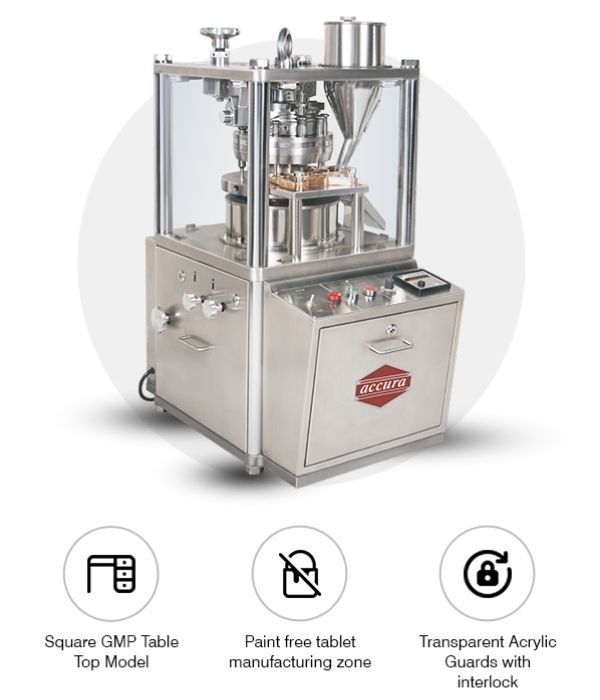
Rotary Tablet Press Machine Dynamics and Efficiency
In the world of mass production, the rotary tablet press machine is the undisputed workhorse. Unlike single-punch presses that operate with a simple up-and-down motion for a single station, rotary systems utilize a rotating turret equipped with multiple sets of punches and dies. This design allows for a continuous, high-speed compression process where several tablets are in different stages of formation at any given moment.
The efficiency of a rotary tablet press lies in its ability to manage large quantities of material with minimal downtime. The movement of the turret is synchronized with a feeding system that ensures uniform die filling, which is a prerequisite for weight consistency. Furthermore, the rotary motion is naturally smoother than the reciprocating motion of smaller presses, reducing the mechanical stress on the components and allowing for longer production runs without frequent maintenance.
Our Other Machine
F360 R High Speed Double Rotary Tablet Press MachineHigh Speed Tablet Press Innovations for Large Scale Production
As demand for generic medications and over-the-counter supplements grows, the need for a high speed tablet press becomes more pronounced. These machines are engineered to operate at incredible velocities, often producing hundreds of thousands of units per hour. To handle such speeds, these presses are equipped with advanced vibration-dampening technology and heavy-duty frames that maintain stability even under maximum compression forces.
The development of the high speed single rotary tablet press has allowed manufacturers to achieve impressive throughput while maintaining a relatively simple machine layout. By optimizing the turret diameter and the number of stations, these machines can push the boundaries of single-sided production. They are particularly favored for products that require high precision but may not need the massive volume of a double-sided configuration.
Double Rotary Tablet Press and the Power of Dual Compression
For the highest levels of output, the double rotary tablet press stands as the ultimate solution. This machine features two sets of feeding and compression stations around a single turret. In essence, it completes two full production cycles for every single rotation of the turret. This design effectively doubles the output capacity without requiring twice the floor space, making it a highly efficient choice for high-volume facilities.
The double sided rotary tablet press machine is also uniquely suited for producing multi-layer tablets. Because it has two distinct filling and compression stages, it can deposit one layer of powder, lightly compress it and then add a second layer before the final compression. This is essential for combination therapies where two active ingredients must remain separate to prevent chemical interactions or to provide different release profiles.
Technical Advantages of the Double Rotary High Speed Tablet Press
When speed and dual-sided functionality converge, the result is the double rotary high speed tablet press. These units represent the pinnacle of tableting technology, combining rapid turret rotation with dual discharge points. The engineering required for such a machine is immense, as it must manage dual sets of pre-compression and main compression rollers, all while ensuring that the powder is fed evenly to both sides of the turret.
A high speed double rotary tablet press typically includes sophisticated sensors that monitor the compression force at every station. If a tablet falls outside of the pre-set weight or hardness parameters, a rejection gate is triggered, removing the faulty unit without stopping the machine. This level of automation is what allows pharmaceutical giants to maintain 24/7 production cycles while guaranteeing that every pill that reaches a patient is safe and effective.
Single Sided Rotary Tablet Press Machine Applications
While high-volume machines get much of the attention, the single sided rotary tablet press machine remains a vital tool for many manufacturers. These machines are often more versatile and easier to clean than their double-sided counterparts, making them ideal for facilities that produce a variety of different products in medium-sized batches. The single discharge point simplifies the integration of peripheral equipment like dedusters and metal detectors.
Even within the single-sided category, there is a push toward higher performance. The single rotary tablet press machine of today is far more advanced than those of a decade ago. They now feature interchangeable turrets, allowing a single machine to switch between different tooling types, such as B-tooling for smaller tablets and D-tooling for larger ones. This flexibility is a key advantage for contract manufacturers who must adapt to the varying needs of different clients.
Structural Integrity in Tablet Press Machines
The longevity of tablet press machines depends heavily on their structural design. Most modern units are built with a "clean-in-place" philosophy, using high-grade stainless steel and specialized seals to prevent powder from entering the mechanical areas. This not only protects the machine from wear but also prevents cross-contamination between different drug batches.
The internal components, such as the cam tracks, are often treated with specialized coatings to reduce friction. In a rotary tablet press, the punches follow these tracks to move up and down through the filling, weight adjustment, compression and ejection phases. Any deviation in the track can lead to variations in tablet thickness or weight. Therefore, precision machining of these tracks is a hallmark of a high-quality manufacturer.
Our Other Machine
F3000 Single Rotary Tablet PressOpportunities for Improvement in Tablet Production
Even with the best technology, there are always opportunities to enhance the tableting process. One area of focus is the "dwell time" - the amount of time the punches are at maximum pressure during compression. Increasing the dwell time can often help in forming stronger tablets from difficult-to-compress powders. Modern tableting machines achieve this through the use of larger compression rollers or specialized punch head designs.
Another opportunity lies in the digitalization of the production floor. Integrating tablet press machines into a centralized data management system allows for better tracking of batch records and easier compliance with electronic signature regulations. This connectivity enables predictive maintenance, where the machine can alert operators to potential issues before they cause a breakdown, further reducing costs and improving reliability.
Formatting and Operational Guidance for Success
To get the most out of any tablet press, proper setup and maintenance are non-negotiable. This begins with ensuring that the granules being fed into the machine have the correct particle size distribution and moisture content. Poorly prepared material can lead to issues like "capping" or "lamination," where the tablet splits apart after ejection.
Regular inspection of the tooling is also vital. Punches and dies are subject to immense pressure and can wear down over time, leading to burrs on the edges of the tablets. By implementing a strict tooling management program, manufacturers can ensure that their high speed double rotary tablet press continues to produce aesthetically perfect and functionally sound tablets.
Conclusion
The choice of a tablet press is a multi-faceted decision that depends on the specific needs of the pharmaceutical product and the desired scale of manufacturing. Whether a facility requires the focused precision of a single rotary tablet press machine or the massive output of a double rotary high speed tablet press, the goal remains the same: to produce high-quality medication that meets the highest safety standards. By partnering with a top-tier tablet press machine manufacturer and understanding the technical nuances of the equipment, pharmaceutical companies can ensure long-term success in an ever-evolving market.