





AI Summary
- A pharmaceutical vibro sifter separates powders and granules according to the aperture of an installed screen.
- Controlled vibration distributes material across the screen while oversized particles and foreign matter are retained.
- Vibro sifter mesh size must be selected according to the material, screening objective, applicable screen standard and downstream process.
- A sifter may be positioned before blending, after granulation or milling, or before tablet compression.
- GMP suitability depends on hygienic construction, cleanability, documented procedures, screen integrity and contamination control.
- Fluid Pack supplies ACCURA tablet presses and related pharmaceutical equipment for integrated tablet-manufacturing lines.
Role of a Vibro Sifter Machine in the Pharmaceutical Industry
A vibro sifter machine is used to screen pharmaceutical powders and granules before they move to the next manufacturing stage. Also described as a pharmaceutical sifter machine or powder sieving machine, it separates material according to the openings in an installed screen. It is not intended to reduce particle size in the same way as a mill. The equipment can retain oversized particles, remove visible foreign matter, separate selected size fractions and break loose agglomerates where the material permits.
Understanding the vibro sifter working principle is important when selecting tablet manufacturing equipment because screening performance is influenced by more than mesh number alone. Particle shape, bulk density, moisture content, cohesiveness, static charge, feed rate and screen loading all affect how material passes through a screen. A vibratory sifter machine used for pharmaceutical powder screening must therefore be selected for the actual formulation and process rather than from a general capacity figure.
Within a tablet production line, a vibro sifter for tablet manufacturing serves as a material-preparation and protective screening step. It can help prevent oversized material from reaching a blender, granulator, mill or tablet press feeder. However, screening alone cannot ensure content uniformity, powder flow, tablet hardness or consistent tablet weight. These outcomes also depend on formulation design, blending, lubrication, tooling condition and compression settings.

Vibro Sifter Working Principle
Powder or granulated material enters through the charging port and falls onto the installed screen. A motor-driven vibration mechanism creates controlled movement that may combine vertical, horizontal and tangential motion. This movement spreads material across the available screening area and encourages smaller particles to pass through the apertures.
Accepted material exits through the lower discharge outlet, while oversized particles remain above the screen and leave through a separate outlet. The efficiency of a vibro screen machine depends on the relationship between vibration settings, screen area, feed rate, material-bed depth and powder characteristics. Excessive feeding can create a deep bed that limits particle contact with the screen, while unsuitable vibration may reduce throughput or damage fragile granules.
Vibro Sifter Mesh Size and Aperture Selection
Mesh count, aperture and particle size are connected but are not interchangeable measurements. Mesh count generally indicates the number of openings per linear inch. The actual aperture also depends on wire diameter and the applicable sieve standard. Therefore, two screens described by the same mesh number may not necessarily have identical openings.
The following values are indicative references rather than universal pharmaceutical recommendations:
| Indicative Mesh | Approximate Aperture* | Possible Screening Purpose |
|---|---|---|
| 10 mesh | 2.00 mm | Coarse lumps or large granules |
| 20 mesh | 850 microns | Coarse pharmaceutical granules |
| 40 mesh | 425 microns | Intermediate powder screening |
| 60 mesh | 250 microns | Finer powder screening |
| 80 mesh | 180 microns | Fine powder applications |
| 100 mesh | 150 microns | Very fine screening |
*Approximate values only. Actual aperture depends on wire diameter and the ASTM, ISO or other applicable screen standard.
The appropriate vibro sifter mesh size depends on the incoming particle-size distribution, required cut point, amount of acceptable fines, oversized-material limit and requirements of the next production stage. Particle shape must also be considered because elongated particles may pass through an opening in one orientation but remain above the screen in another. Material trials are advisable when screen selection cannot be determined reliably from existing process data.
Our Other Machine
F45 R Tooling Tablet Press MachineSelecting a Pharmaceutical Sieving Machine
Selection should begin by defining what the screening operation must accomplish. Safety screening is used to retain foreign matter or occasional oversized particles. Deagglomeration addresses loose clumps created during storage or transfer. Classification separates material into defined size fractions, while protective screening helps prevent unsuitable material from entering downstream equipment.
Material behavior is equally important. Hygroscopic or moisture-sensitive powders may clump and blind the screen. Cohesive powders may resist even distribution, while electrostatically charged material can attach to surfaces or reduce passage through fine apertures. Fragile granules require gentler handling to prevent the screening operation from creating unwanted fines. Required throughput should consequently be confirmed through representative material trials rather than estimated only from screen diameter.
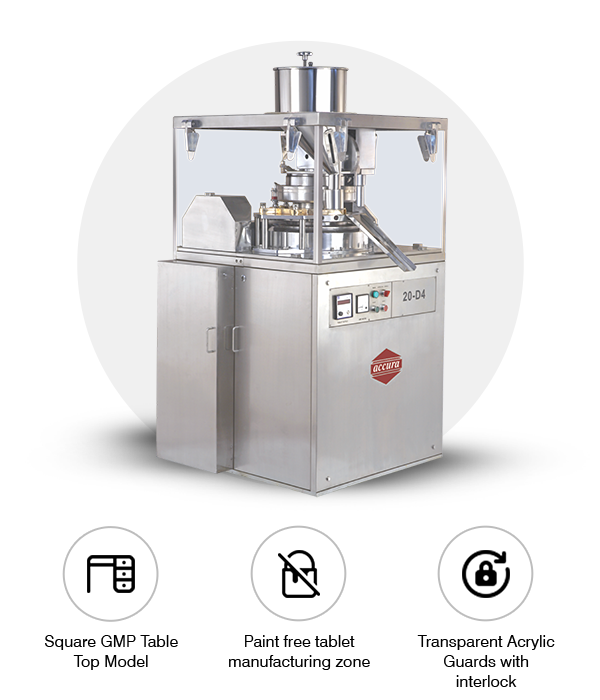
How a Vibro Sifter Fits into a Tablet Production Line
A solid-dose production process may include dispensing, initial screening, granulation where required, milling, blending, lubrication, compression, dedusting, coating, inspection and packaging. The exact sequence depends on the formulation and validated manufacturing process, and not every tablet requires granulation or screening at every stage.
Raw-material screening can retain foreign matter and oversized lumps before blending or granulation. This operation protects downstream equipment but does not replace material identification, sampling or particle-size testing. After granulation or milling, screening can help separate oversized granules and control the size range delivered to the blender. A sifter does not create granules; it separates them after the granulation or sizing operation.
Pre-compression screening may retain abnormal agglomerates and protect the tablet press feeder. However, rescreening a lubricated blend must be evaluated carefully because additional handling can influence segregation or lubricant distribution. Screening also cannot independently prevent capping, lamination, sticking, picking or tablet-weight variation when those problems originate from formulation, tooling or compression parameters.
Vibro Sifter Compared with Related Pharmaceutical Equipment
| Equipment | Primary Function | Typical Position | Main Result |
|---|---|---|---|
| Vibro sifter | Separates material by screen aperture | Before or between processing stages | Retains oversized material |
| Multi mill | Mechanically reduces particle size | Commonly after granulation | More controlled particle size |
| Oscillating granulator | Sizes wet or dry granulated material through a screen | During or after granulation | More uniform granules |
| Tablet deduster | Removes loose powder and burrs | After tablet compression | Cleaner tablet surfaces |
Throughput and Deck Configuration
Practical throughput depends on screen area, aperture, feed rate, vibration settings, bulk density, cohesiveness, oversized-material percentage and cleaning frequency. Maximum rated capacity should not be treated as guaranteed production output because actual capacity can change significantly between formulations.
A single-deck sifter separates material against one aperture. Double-deck and multiple-deck configurations can produce two or more fractions during one pass. Additional decks increase the number of separations but may also increase equipment height, cleaning time and process complexity. The number of decks should therefore match the required fractions rather than being selected only for potential flexibility.
Common Vibro Sifter Problems and Corrective Checks
| Problem | Factors to Investigate |
|---|---|
| Screen blinding | Moisture, cohesive powder, static charge, fine particles or excessive feeding |
| Low throughput | Incorrect aperture, blocked screen, poor flow or unsuitable vibration |
| Powder leakage | Damaged gasket, loose clamp, incorrect assembly or worn seal |
| Screen damage | Incorrect tension, fatigue, abrasive material or mechanical impact |
| Excessive fines | Fragile granules, aggressive vibration or unnecessary handling |
| Material segregation | Particle differences or unsuitable transfer after screening |
Troubleshooting should consider the formulation, screen condition, machine settings and operating records together. Increasing vibration or changing mesh without identifying the actual cause can create another problem instead of improving performance.
GMP Vibro Sifter Design and Cleaning Requirements
A GMP vibro sifter is not compliant merely because it is manufactured from stainless steel. GMP suitability depends on hygienic equipment design, appropriate product-contact materials, accessible cleaning surfaces, controlled joints, suitable seals and construction that minimizes areas where powder can accumulate.
Screens and gaskets should be identifiable and inspected before and after production. Screen-integrity checks help detect broken wires, damaged apertures or incorrect tension that could affect product quality. Cleaning procedures must explain dismantling, washing, drying, inspection and controlled reassembly. Cleaning verification or validation should be applied according to product risk and facility requirements.
Dust-tight covers, secure clamps, suitable gaskets, controlled charging and closed discharge can reduce product loss and environmental contamination. Potent, sensitizing or hazardous materials may require engineered containment beyond a standard sifter configuration. Routine maintenance should cover screen condition, motor performance, gasket wear, clamp security and unusual vibration or noise.
Information Required Before Requesting a Quotation
A useful enquiry should state the material type, powder or granule characteristics, particle-size distribution, screening objective, required aperture, applicable screen standard, batch size, desired throughput and permitted oversized fraction. Buyers should also identify moisture sensitivity, number of required fractions, preferred deck configuration, product-contact material, cleaning method, available installation space and containment expectations.
Sharing representative material for testing can provide a more reliable equipment recommendation than choosing a pharmaceutical vibro sifter solely from catalogue capacity.

Fluid Pack Equipment for Tablet Manufacturing Lines
Fluid Pack has manufactured pharmaceutical machinery under the ACCURA brand since 1983. Its portfolio includes tablet press machines, roll compactor machines, pharmaceutical allied equipment, and punches and dies for pharmaceutical and nutraceutical applications.
A screening operation may be connected to equipment such as a multi-mill, oscillating granulator, tablet press, and tablet deduster, depending on the validated manufacturing sequence. Fluid Pack’s tablet press machine range supports the compression stage, while its pharmaceutical-allied equipment supports related production requirements.
Fluid Pack’s Tablet Deburring and Dedusting Vibro Machine should not be confused with a powder-screening vibro sifter. The dedusting machine operates after compression to remove loose powder and burrs from finished tablets. Manufacturers should confirm the current availability and specifications of vibro-sifters directly with Fluid Pack before selecting equipment.
Key Takeaways
Selecting a vibro sifter machine requires evaluation of the screening objective, powder behavior, aperture standard, throughput, deck configuration, cleaning requirements and downstream process. No single screen or machine configuration is suitable for every pharmaceutical formulation. A technically complete enquiry and representative material trial can help identify a more appropriate solution for the intended tablet production line.
Vibro Sifter Machine FAQs
Mesh count generally indicates the number of openings per linear inch. Aperture is the actual opening between the wires and depends on wire diameter and the applicable screen standard.
No. It separates material according to screen aperture. A mill uses mechanical action to reduce particle size, although a sifter may separate or loosen weak agglomerates.
Depending on the validated process, it may be used for raw-material screening, after granulation or milling, or before tablet compression.
Potentially, provided the correct screen is installed, and cleaning, cross-contamination control and product-change procedures meet validated requirements.
Blinding occurs when particles, moisture or cohesive material block apertures. This reduces the effective screening area and limits the amount of material that can pass through.
No. GMP suitability also depends on hygienic design, surface accessibility, component identification, documented cleaning, screen integrity, maintenance and the validated manufacturing process.