





AI Summary
- Rotary tablet compression machines almost always have an odd number of punches or stations, and this is not a random design choice. It is a deliberate engineering decision rooted in the physics of dynamic balancing.
- In a double rotary tablet press machine, the turret passes through two compression zones per revolution. An even number of stations would cause two opposite punches to hit both rollers simultaneously, creating mechanical resonance and imbalance.
- An odd number of stations ensures that no two punches are ever in the exact same phase at both compression points at the same time, distributing the load evenly and preventing destructive vibration.
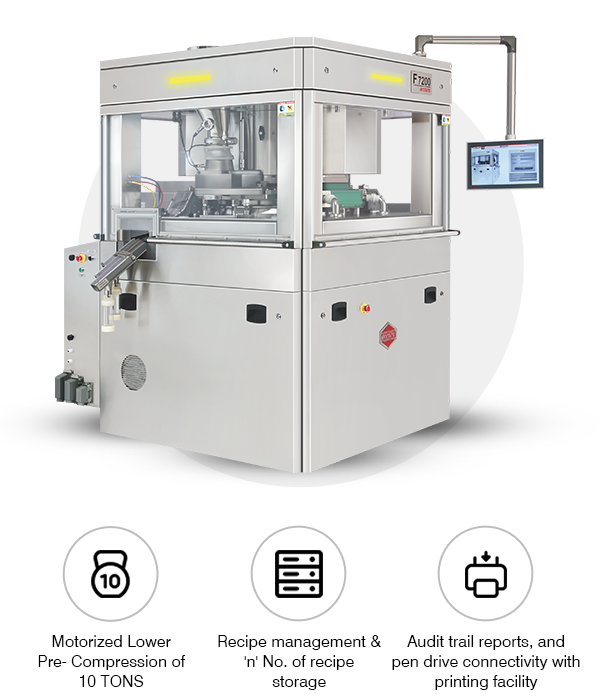
- This principle explains why machines like Fluidpack's F7200 are built with 51 station D tooling, 65 station B tooling, 77 station Bb, and 81 station Bbs configurations, all of which are odd numbers.
Introduction: A Question That Puzzles Every Pharma Production Professional
If you have spent any time working with rotary tablet compression machines, you have almost certainly noticed something consistent: the number of punches or stations is almost always an odd number. Common configurations include 27, 35, 37, 51, 55, 61, 65, 75, 77, and 81 stations. You rarely see 50, 60, or 80.
This is not a manufacturing limitation or a coincidence. It is a precise engineering decision that goes to the heart of how a double rotary tablet press machine works. Understanding it will make you a better buyer, a better operator, and someone who can evaluate tablet compression machine specifications with real technical depth.
This article explains the reason completely, in plain language, starting from first principles.

Understanding the Two Types of Rotary Compression Machines
To understand why punch count matters, you first need to understand the difference between a single feed rotary tablet press and a double feed rotary tablet press machine, because the odd number rule applies primarily to the double rotary design.
Single Feed Rotary Tablet Press
In a single rotary tablet press machine, the turret rotates and each station passes through one compression zone per revolution. There is one set of compression rollers, one pre-compression point, and one main compression point. The machine produces one tablet per station per revolution.
In a single rotary press, you can technically have an even number of stations without significant mechanical problems. The compression load is more evenly distributed because each punch passes through only one compression event per cycle.
Double Rotary Tablet Compression Machine
In a double rotary tablet press machine, the turret passes through two compression zones per revolution. As the turret rotates 360 degrees, each station compresses two tablets, one on each side of the turret. This is why double rotary machines achieve dramatically higher output. The Fluidpack F7200, for example, reaches up to 7,77,600 tablets per hour precisely because of this dual compression design.
It is in the double rotary configuration that the odd number of stations becomes not just preferable but mechanically necessary.
The Dynamic Balancing Principle: Why Odd Numbers Are Essential
Here is the core engineering reason. In a double rotary tablet compression machine, there are two sets of compression rollers positioned at two points around the circumference of the turret. As the turret spins, punches pass through these two compression points in sequence.
Now consider what happens with an even number of stations, say 50. Because 50 is divisible by 2, there will always be a punch positioned at compression point A at exactly the same moment that another punch is positioned at compression point B. Both rollers are applying maximum compression force simultaneously to punches that are directly opposite each other.
This creates a condition called dynamic resonance. Two equal and opposite forces are applied to the turret simultaneously, causing mechanical vibration. At high speeds, this vibration compounds. The turret begins to oscillate. Tablet weight variation increases. Mechanical wear accelerates. In extreme cases, the machine can suffer structural damage.
Now consider an odd number of stations, say 51. Because 51 is not evenly divisible by 2, it is impossible for two punches to be in identical positions at both compression points simultaneously. When one punch is at compression point A, no punch is at exactly compression point B at the same phase. The compression loads are offset from each other, distributing the mechanical force unevenly around the turret in a way that prevents resonance.
This is dynamic balancing. The odd number of stations ensures the compression events are always slightly out of phase with each other, so they cancel vibration rather than amplifying it. The machine runs smoother, faster, and with greater precision across the entire production run.
What This Means for Tablet Quality and Machine Performance
Dynamic imbalance in a tablet compression machine is not just a mechanical problem. It directly affects the quality of every tablet produced. When the turret vibrates during compression, the punch pressure becomes inconsistent from one station to the next. Some tablets are compressed with slightly more force, others with slightly less. The result is tablet weight variation, which is one of the most critical quality parameters in pharmaceutical manufacturing.
A machine with properly odd-numbered stations runs with consistent compression force across all stations. The turret speed can be increased without amplifying vibration. The punches last longer because they are not subjected to shock loading. And tablet weight consistency is maintained throughout long production runs, which is essential for meeting pharmacopoeial specifications and regulatory batch release requirements.
Our Other Machine
F-290R High Speed Double Rotary Tablet PressCommon Station Counts and What They Mean
You will encounter several standard station counts when evaluating rotary tablet press machines. Each configuration reflects a balance between turret diameter, punch size, compression speed, and output requirements.
The 27 station configuration is common in medium speed rotary press machines and pilot scale tablet press machines. It is suitable for medium batch sizes where flexibility matters more than peak output. The 35 and 37 station machines are the next tier, offering higher output while maintaining a manageable turret size for B tooling configurations.
The 51 station D tooling configuration is used for larger tablets, including bolus and high-dose pharmaceutical tablets, where the D tooling punch diameter requires more space between stations. The 65 station B tooling configuration is the workhorse of high speed rotary tablet press machines, offering a balance of output and flexibility. The 77 station Bb and 81 station Bbs configurations are for smaller tablets where maximum output per revolution is the priority, and both numbers are odd for the same dynamic balancing reasons.
Fluidpack's F7200 High Speed Double Rotary Tablet Compression Machine is available in all four of these configurations with an interchangeable turret, allowing manufacturers to switch between tablet formats without changing the entire machine.
Does the Odd Number Rule Apply to Single Rotary Machines?
In a single rotary tablet press, the even or odd station count matters less from a dynamic balancing perspective because there is only one compression zone. The compression event happens once per revolution per punch, and there is no opposing force to create resonance.
This is why you will occasionally see single rotary tablet press machines with even station counts, particularly in older or simpler designs. However, many single rotary machines still use odd numbers as a design convention, and some manufacturers apply the principle regardless of machine type as a general standard for smoother mechanical operation.
For any double rotary tablet press machine, the odd station count is non-negotiable for proper dynamic balancing.
Why This Matters When You Are Buying a Tablet Press Machine
When evaluating a tablet compression machine for your pharmaceutical manufacturing facility, station count is one of the first specifications you should review, but it should not be evaluated in isolation. You need to understand the relationship between station count, tooling type, tablet size, and output requirement together.
A machine with 65 station B tooling will produce more tablets per hour than a 51 station D tooling machine at the same turret speed, because more stations pass through the compression zone per revolution. But if your tablet requires D tooling due to its size or formulation characteristics, the station count comparison is irrelevant. Your tooling type drives your station count choice, and your tablet specification drives your tooling type.
For manufacturers producing a range of tablet sizes and formulations, an interchangeable turret configuration as offered by Fluidpack provides the flexibility to use the optimal station count for each product without investing in multiple machines.

Conclusion: The Odd Number of Punches Is Engineering Precision in Action
The next time you see a double rotary tablet compression machine specification listing 51, 65, 77, or 81 stations, you now know exactly why those numbers were chosen. It is not convention. It is not coincidence. It is the application of dynamic balancing principles that keep the turret running smoothly at high speed, protect the mechanical integrity of the machine, and ensure consistent tablet quality across every batch.
For pharmaceutical manufacturers evaluating tablet press machines, this understanding translates directly into better purchasing decisions, better machine operation, and better tablet quality outcomes.