





AI Summary
- B tooling and D tooling are the two primary international standards for tablet press punches and dies, and choosing the wrong type for your machine or product can result in compatibility failures, tablet defects, and regulatory complications.
- D tooling has a larger barrel diameter and is designed for bigger tablets requiring greater fill depth, while B tooling is the most widely used global standard, covering the majority of pharmaceutical tablet production worldwide.
- The two tooling types are not interchangeable on the same machine without a turret change, making tooling selection one of the most consequential decisions in tablet manufacturing equipment procurement.
- Fluidpack manufactures and supplies punches and dies in B tooling, D tooling, BB tooling, and Bbs tooling for all major tablet press machines, with configurations available for the ACCURA F7200 and the full ACCURA range.
Introduction: Why Tooling Choice Defines Your Tablet Manufacturing Capability
When pharmaceutical manufacturers evaluate a tablet press machine, the focus often falls on output, speed, automation level, and compliance features. Tooling type is sometimes treated as a detail to be resolved later. In reality, the choice between B tooling and D tooling in a tablet compression machine is one of the most fundamental decisions in the entire equipment procurement process, because it determines what tablets you can make, at what output, and with what level of flexibility.
This article gives you a complete, practical comparison of B tooling and D tooling, covering dimensions, applications, interchangeability, output implications, and how to choose the right type for your specific production requirements.

What Is Tablet Press Tooling?
Tablet press tooling refers to the set of punches and dies that compress powder or granules into tablets inside a rotary tablet compression machine. Each tooling station consists of an upper punch, a lower punch, and a die. The die defines the outer shape of the tablet. The punches define the face shape, any embossing or debossing, and together with the die determine the tablet's thickness and weight.
Tooling is manufactured to international standards so that punches and dies from different suppliers can be used on machines from different manufacturers, provided both comply with the same standard. The two dominant international standards are the TSM standard, developed by the American Pharmacists Association and used primarily in North America, and the EU standard, used widely in Europe and most other international markets including India. Within these standards, the most important distinction is between B tooling and D tooling.
B Tooling: The Global Standard for Pharmaceutical Tablet Manufacturing
B tooling is the most widely used tooling configuration in pharmaceutical tablet manufacturing worldwide. It is the default choice for the majority of conventional tablet production, from standard round tablets to a wide variety of shapes and sizes.
B Tooling Key Dimensions
The barrel diameter of a B tooling punch is 0.75 inches or 19 millimetres. The head diameter is 1.00 inch or 25.4 millimetres. The overall punch length is 5.25 inches or 133.35 millimetres. The maximum die outside diameter is 30.16 millimetres.
These dimensions mean that B tooling punches are slender enough to allow a high number of stations on a turret of given diameter. A standard high speed double rotary tablet press in B tooling configuration can accommodate 65 stations, delivering significantly higher output per revolution compared to D tooling.
What B Tooling Is Best For
B tooling is the right choice for standard pharmaceutical tablets in sizes up to approximately 16 millimetres in diameter for round tablets. It covers the majority of solid dose products including coated tablets, film coated tablets, direct compression tablets, and most granulated formulations. B tooling is also the most readily available tooling type globally, which is important for procurement continuity and spare parts availability.
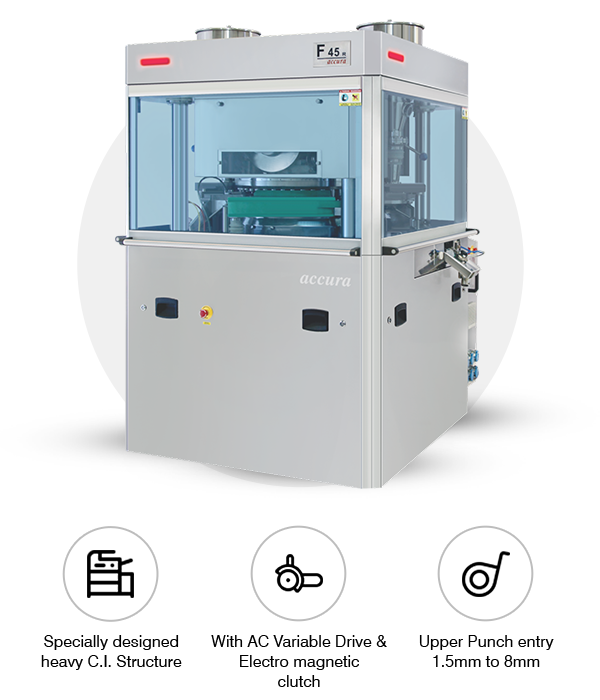
For manufacturers running high volume production of standard sized tablets, B tooling in a double rotary tablet compression machine delivers the highest output per machine investment. The Fluidpack ACCURA F7200 in 65 station B tooling configuration is a leading example of this, producing up to 7,77,600 tablets per hour.
Our Other Machine
Single Rotary High Speed Tablet Press(ATX)D Tooling: Built for Larger Tablets and Higher Doses
D tooling, sometimes called European tooling in older references, is designed for larger tablets that require more punch tip area and greater die fill depth. It is the correct choice when your tablet size, shape, or formulation exceeds the capability of B tooling.
D Tooling Key Dimensions
The barrel diameter of a D tooling punch is 1.00 inch or 25.4 millimetres. The head diameter is 1.25 inches or 31.75 millimetres. The overall punch length is 5.25 inches or 133.35 millimetres. The maximum die outside diameter is 38.10 millimetres.
The larger barrel diameter of D tooling means that fewer stations can fit on a turret of the same circumference. A high speed double rotary tablet press in D tooling configuration typically accommodates 51 stations rather than 65, which results in lower tablets per revolution but allows for significantly larger tablet formats.
What D Tooling Is Best For
D tooling is the correct choice for tablets larger than 16 millimetres in diameter, high dose formulations requiring deep die fill, bolus tablets for veterinary applications, and any product where the tip area needed for embossing or debossing exceeds what B tooling can accommodate. D tooling is also commonly used for effervescent tablets, chewable tablets, and other large format solid dose products.
Manufacturers producing oncology drugs, high dose nutritional supplements, and specialty pharmaceutical products often require D tooling because the active ingredient dose cannot be compacted into the smaller volume available in a B tooling die.
BB Tooling and Bbs Tooling: The Higher Station Variants
Beyond the standard B and D configurations, two additional tooling variants are widely used in high speed tablet production: BB tooling and Bbs tooling.
BB tooling uses the same barrel diameter as standard B tooling, 0.75 inches, but with a shorter lower punch length. This allows even more stations to be fitted to a turret of given circumference. A double rotary tablet compression machine in BB tooling can accommodate 77 stations. BB tooling is used for smaller tablets where maximum output is the priority.
Bbs tooling takes this further, allowing 81 stations on the same turret. It is used for the smallest standard tablet formats, typically mini tablets, where the production volume requirement is extremely high. The Fluidpack ACCURA F7200 supports all four tooling types through an interchangeable turret, making it one of the most flexible high speed tablet press machines available from an Indian manufacturer.
The Critical Difference: B and D Tooling Are Not Interchangeable
One of the most important practical points about B tooling and D tooling is that they cannot be used on the same turret. The barrel diameter difference, 19 millimetres for B versus 25.4 millimetres for D, means that the punch bores in the turret are machined to different dimensions for each tooling type. A B tooling punch will not fit in a D tooling turret, and a D tooling punch will not fit correctly in a B tooling turret.
This means that if you want to run both B tooling and D tooling products on the same machine, you need an interchangeable turret design that allows you to swap the entire turret between B and D configurations. This is exactly what Fluidpack offers with the ACCURA F7200, where the interchangeable turret allows the same machine to be converted between 51 station D, 65 station B, 77 station BB, and 81 station Bbs configurations.
For manufacturers with single product lines, the choice is straightforward: select the tooling type that matches your tablet size and dose. For multi-product facilities, the interchangeable turret is a significant value consideration.
TSM vs EU Tooling Standards: What Is the Difference?
Both B tooling and D tooling exist in two international standard variants: TSM and EU. The TSM standard is the Tableting Specification Manual standard developed by the American Pharmacists Association for the North American market. The EU standard is the European norm used across Europe, India, and most other international markets.
The core dimensions of the punch barrel diameter are the same between TSM and EU standards for both B and D tooling. The differences lie in punch head angle, punch head thickness, and overall punch length. TSM tooling is typically about 0.010 inches shorter than EU tooling in overall length. The head angle for B tooling is 37 degrees in TSM and differs slightly in EU specification.
In practice, TSM and EU tooling of the same type are not interchangeable without careful verification, even though they appear similar. Indian pharmaceutical manufacturers typically use EU standard tooling, which is also the standard adopted by Fluidpack for their punches and dies range.

How to Choose Between B Tooling and D Tooling for Your Tablet Press
The choice between B tooling and D tooling for your tablet compression machine should be driven by three primary factors: tablet size, production output requirement, and product range.
If your tablet diameter is 16 millimetres or less and you are producing standard pharmaceutical tablets in high volumes, B tooling is almost certainly the right choice. It delivers higher station count, higher output, and is more readily available for replacement and spare parts. If your tablet diameter exceeds 16 millimetres, or if your formulation requires a deep die fill due to high bulk density, D tooling is required regardless of output considerations.
For multi-product facilities producing both large and standard format tablets, the interchangeable turret approach allows you to use B tooling for your high volume standard products and switch to D tooling for your larger format products on the same machine, eliminating the need for separate machines for each tooling type.
Conclusion: Tooling Selection Is a Strategic Decision, Not a Technical Detail
The choice between B tooling and D tooling in a tablet compression machine is not a minor specification detail. It determines your output capacity, the tablet sizes and formulations you can produce, your flexibility for future products, and your compatibility with the global tooling supply chain. Make this decision based on your current product requirements and your planned product portfolio, and ensure your machine supports interchangeable turrets if you need flexibility across both tooling types.