




Essential Guide to Tablet Production Technology
The objective of this article is to provide a comprehensive exploration of the technical features, operational advantages and selection criteria for modern pharmaceutical solid-dosage manufacturing systems. By examining the diverse types of machinery available, from laboratory-scale units to high-volume industrial solutions, this guide aims to assist manufacturers in identifying the specific attributes - such as automation, speed and structural design - that ensure the production of high-quality, consistent tablets while adhering to stringent global regulatory standards.
Understanding the Landscape of Modern Tablet Compressing Machine Technology
The process of transforming granulated powder into a finished, solid dosage form is a cornerstone of the pharmaceutical industry. Selecting the right equipment is a multi-faceted decision that influences not only the speed of production but also the chemical stability and physical integrity of the final product. A high-quality tablet compressing machine serves as the heart of a manufacturing line, where mechanical precision meets material science. Whether you are a startup looking for a compact unit or a large-scale manufacturer requiring a pharmaceutical tablet compression machine, understanding the fundamental mechanics of how these systems operate is the first step toward a successful investment.
The core function of these machines is to apply a specific amount of force to a set volume of powder, held within a die cavity, using upper and lower punches. However, the sophistication of a modern tablet compression system goes far beyond simple pressure. Today’s systems integrate advanced electronics, load cells and software interfaces that monitor every single tablet produced. This ensures that variables such as weight, thickness and hardness remain within extremely tight tolerances, which is critical for drug efficacy and patient safety.
Read Our Article
Types of Tablet Compression Machines and Their ApplicationsTablet Compression Machines and the Evolution of Production Speed
In the early days of pharmacy, tableting was a manual, slow process. Today, the demand for millions of doses has led to the development of the high speed tablet compression machine. These units are engineered to operate at incredible velocities without sacrificing the quality of the dosage form. Speed is not merely about how fast the turret can spin; it is also about how effectively the material can be fed into the dies at those speeds.
Advanced tablet compression equipment often features forced-feeding mechanisms. Unlike gravity-fed systems, which rely on the weight of the powder to fill the die, forced feeders use rotating paddles to ensure a consistent and dense fill. This is particularly important for powders that have poor flow characteristics or for manufacturers who need to maintain high output rates. When evaluating a high speed tablet compression machine, one must look for a robust frame that can withstand the vibrations of rapid operation and a cooling system that prevents the heat generated by friction from affecting sensitive active pharmaceutical ingredients.
Rotary Tablet Compression Machine Design and Mechanical Efficiency
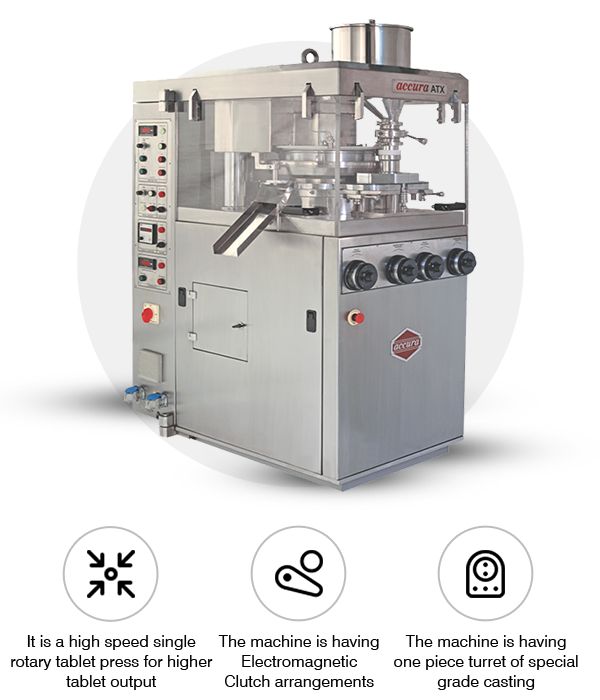
For medium to large-scale production, the industry standard is the rotary tablet compression machine. The "rotary" designation refers to the circular turret that houses multiple sets of punches and dies. As this turret rotates, each station passes through a series of stages: filling, weight adjustment, pre-compression, main compression and ejection. This continuous cycle allows for a much higher throughput compared to older, single-station designs.
A significant feature of a modern rotary tablet compression machine is the inclusion of a pre-compression stage. In this phase, a smaller amount of pressure is applied to the powder before the main compression force is exerted. This helps to de-aerate the powder, removing trapped air that could otherwise lead to common tableting defects like capping or lamination. For manufacturers dealing with complex formulations, the ability to fine-tune both pre-compression and main compression is an indispensable feature of professional tablet compression machinery.

Single Rotary Tablet Compression Machine for Targeted Applications
While high-capacity systems are popular, the single rotary tablet compression machine remains a vital tool for many facilities. These machines feature a single discharge chute and are typically used for batches that require high precision but not necessarily the extreme volumes of a double-sided press. They are often more compact, making them easier to clean and maintain, which is a major advantage in facilities that handle multiple different products and require frequent changeovers.
The single rotary tablet compression machine is an excellent choice for pilot plant scale-ups or for producing niche medications. Because it has fewer stations than its larger counterparts, it is also easier to troubleshoot and set up. When selecting this type of tablet press compression machine, buyers should focus on the quality of the turret material - usually electroless nickel plating or stainless steel - to ensure longevity and resistance to the abrasive nature of certain pharmaceutical powders.
Double Rotary Tablet Compression Machine for Maximum Industrial Throughput
When the goal is maximum output, the double rotary tablet compression machine is the preferred solution. Unlike the single-sided version, a double rotary press has two sets of feeders and two discharge chutes, effectively producing two tablets per station for every single revolution of the turret. This design allows for massive production numbers, making it a staple in industrial tablet compression machine environments.
The complexity of a double rotary tablet compression machine requires advanced control systems. Because the machine is essentially doing twice the work, it is vital to have independent weight control for both sides of the press. High-end models will feature automated weight regulation, where the machine’s computer adjusts the fill depth in real-time based on the force readings from the compression rollers. This level of automation in a pharmaceutical tablet compression machine reduces the need for constant manual intervention and significantly lowers the rate of rejected product.
Multi-Layer Capabilities and the Double Layer Tablet Compression Machine
As pharmaceutical formulations become more complex, there is an increasing need for tablets that contain multiple active ingredients that must be kept separate. This is where the double layer tablet compression machine becomes necessary. These specialized units are designed to fill a die with one layer of powder, tamp it down, fill a second layer of a different powder on top and then compress them into a single, cohesive tablet.
A double layer tablet compression machine requires extremely precise feeding and suction systems to prevent cross-contamination between the two layers. This is also referred to as a bilayer tablet compression machine. The ability to produce bilayer tablets allows for modified-release profiles, where one layer dissolves quickly for an immediate effect and the second layer dissolves slowly over time. When purchasing a bilayer tablet compression machine, it is crucial to ensure that the unit has the capability to monitor the thickness and weight of each individual layer independently.
Selecting the Right Tablet Press Compression Machine for Your Facility
Choosing between the various types of tablet compression machines requires a deep analysis of your current and future production needs. If you are a laboratory or a research institution, a small-scale, versatile unit might be best. However, for commercial manufacturing, the reliability and speed of a rotary tablet compression machine are hard to match.
A cheaper tablet compression machine might seem attractive, but if it lacks the automated features and durable construction of a high-end industrial tablet compression machine, you may end up spending more on maintenance, labor and rejected batches in the long run. Look for features such as oil-free lubrication zones, advanced dust extraction systems and robust technical support from the manufacturer.

Conclusion
The modern tablet compression machinery market offers a wide array of solutions tailored to specific manufacturing challenges. From the high-speed output of a double rotary tablet compression machine to the specialized layered delivery of a bilayer tablet compression machine, the right features can transform your production line. By prioritizing automation, regulatory compliance and mechanical precision, you ensure that your pharmaceutical tablet compression machine remains a valuable asset for years to come, consistently delivering the high-quality medicine that patients rely on.