





High-Speed Tablet Manufacturing with 16/20 Station Rotary Press Machines
The objective of this guide is to provide a comprehensive technical and practical understanding of the 16/20 station rotary tablet punching machine with D tooling, including its working principle, specifications, applications, and selection criteria when choosing the right tablet punching machine manufacturer, supplier, and exporter.
The global pharmaceutical and nutraceutical industries are producing tablets at a scale that was unimaginable two decades ago. Consumer demand for vitamins, supplements, generic medicines, herbal formulations, and effervescent health products is growing faster than many manufacturers can keep pace with. At the production floor level, this growth puts enormous pressure on tablet press equipment to deliver higher output, tighter quality tolerances, and greater flexibility — all within a cost structure that remains competitive.
Overview of 16/20 Station Rotary Tablet Punching Machine
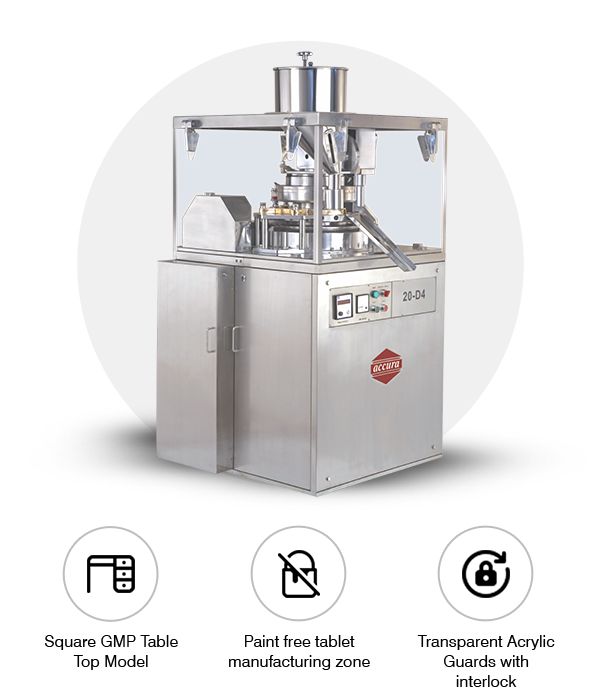
The 16/20 station rotary tablet punching machine with D tooling sits at the heart of this challenge. It is one of the most widely specified machines in mid-to-large scale pharmaceutical and nutraceutical tablet manufacturing, valued for its combination of throughput, precision, and compatibility with a broad range of formulations. Understanding exactly what this machine does, how it works, and what to look for when purchasing one is essential knowledge for production engineers, procurement managers, and plant managers.
This guide provides a comprehensive technical overview of the 16/20 station rotary tablet punching machine with D tooling — from its working principle and key specifications to industrial applications, maintenance practices, and how to select the right manufacturer. Fluidpack, with over 25 years of pharmaceutical machinery manufacturing experience in Ahmedabad, has compiled this guide based on direct application knowledge from customers across 40+ countries.
Understanding the 16/20 Station Configuration
The designation ‘16/20 station’ refers to the number of punch-and-die sets mounted on the machine’s rotating turret. A 16-station machine carries 16 sets of upper punches, lower punches, and dies; a 20-station machine carries 20. As the turret rotates continuously, each station completes a full compression cycle — fill, compress, eject — with every revolution.
This multi-station design is what gives rotary tablet presses their production advantage over single-station eccentric presses. A single-station press produces one tablet per cycle; a 20-station rotary press produces 20 tablets per revolution. At a turret speed of 30–60 RPM, a 20-station machine delivers 36,000–72,000 tablets per hour at moderate settings, with higher-speed configurations reaching 100,000–120,000 tablets per hour.
The choice between 16 and 20 stations affects more than just output. Machines with more stations have a larger turret diameter, which means longer dwell time at peak compression — the period during which the punches hold maximum force on the tablet. Longer dwell time improves tablet hardness and reduces lamination risk in formulations that are difficult to compact, such as high-fibre nutraceutical blends or herbal powders with poor flow properties.
When to Choose 16 Stations vs 20 Stations
A 16-station configuration is typically preferred when the production requirement is moderate (50,000–80,000 tablets per hour), tablet sizes are larger (as is common with D tooling), and changeover frequency is high. Fewer stations mean fewer punches and dies to remove, clean, and reinstall during product changeovers — a meaningful time saving for contract manufacturers running multiple products per shift.
A 20-station configuration suits higher-volume operations producing a smaller range of products. The additional stations boost output by approximately 25% at equivalent turret speed, and the larger turret provides more compression dwell time — advantageous for tablet formulations that require extended contact time to achieve target hardness without excessive force.
D Tooling: What It Is and Why It Matters
Tooling — the punches and dies that shape and compress tablets — comes in several standardised formats. The two most common in pharmaceutical and nutraceutical manufacturing are B tooling and D tooling, each defined by the punch barrel diameter and the maximum tablet size they can produce.
D tooling has a punch barrel diameter of 1 inch (25.4 mm), compared to B tooling’s 0.945 inch (24 mm). More importantly, D tooling supports a maximum tablet diameter of 25 mm and a maximum compression force of approximately 80–100 kN, versus B tooling’s 16 mm and 35–40 kN limits. These figures translate directly into the types of products each tooling format can produce.
Practical Advantages of D Tooling
The larger punch face in D tooling enables manufacturers to produce tablets that would simply be impossible on a B tooling machine. Multi-layer nutritional tablets, high-dose mineral supplements (calcium carbonate, magnesium oxide), large-format effervescent tablets, and bilayer pharmaceutical tablets all require the larger die cavity and higher compression force that D tooling provides.
D tooling also offers mechanical advantages in long production runs. The larger barrel diameter distributes compression stress over a greater contact area, reducing punch deflection under high force and extending tooling service life. For operations running 20+ hours per day on abrasive formulations containing silica, talc, or calcium compounds, this durability difference has a direct impact on tooling replacement costs.
Manufacturers using D tooling should specify punch material carefully. Standard tool steel (EN31) is sufficient for most pharmaceutical formulations. For abrasive nutraceutical blends or highly corrosive compounds, hardened stainless steel (AISI 440C) or tungsten carbide-tipped punches significantly extend service intervals. Fluidpack supplies machines with compatibility for TSM-standard D tooling from all major tooling manufacturers, ensuring customers are not locked into proprietary tooling sources.
How the 16/20 Station Rotary Tablet Punching Machine Works
Understanding the compression cycle helps operators optimise machine settings and troubleshoot quality issues. The process follows four sequential stages at every station as the turret completes one rotation.
Stage 1: Powder Feeding and Die Filling
Granulated powder or direct-compression blend enters the machine from a hopper positioned above the turret. A motorised force feeder — a rotating paddle or scroll mechanism — actively pushes material into the die cavities as each station passes beneath the feed frame. Without a force feeder, poorly flowing materials (common in herbal and high-fibre nutraceutical blends) would under-fill, producing tablets below target weight.
Die fill depth is controlled by the lower punch position at this stage. A deeper lower punch position allows more material to enter the die, increasing tablet weight. This is the primary weight adjustment mechanism and is typically controlled via the machine’s PLC interface.
Stage 2: Pre-Compression
Before main compression, each station passes through a pre-compression roller that applies a lower force — typically 5–15% of main compression force. This step consolidates the powder bed and expels trapped air from the granule mass. Skipping pre-compression on airy formulations causes the entrapped air to escape explosively during main compression, producing laminated tablets that split horizontally.
For nutraceutical formulations with high botanical content or spray-dried herbal extracts, pre-compression is essential and the pre-compression force must be individually adjustable. Fluidpack machines feature independent pre-compression roller height adjustment with digital readout, allowing operators to fine-tune this parameter without tools.
Stage 3: Main Compression
The main compression roller applies the full specified compression force, forming the tablet to its final hardness, thickness, and density. On D tooling machines, main compression forces typically range from 20 kN to 80 kN depending on the formulation and tablet size. Force measurement via strain gauges on each station enables real-time monitoring — deviations from the set point trigger automatic weight adjustments or tablet rejection.
 Call Us Now!
 Stage 4: Ejection and Tablet Collection
After compression, the lower punch rises to eject the tablet from the die cavity. A fixed ejection cam controls this motion, and a scraper blade deflects the tablet into the discharge chute. Tablets then pass through an optional deduster before being discharged into the collection container or directly onto a coater feed conveyor.
Technical Specifications: What the Numbers Mean
When evaluating a 16/20 station rotary tablet punching machine, the specification sheet contains several parameters that require careful interpretation. Here is what the key figures actually mean in production terms.
- Output capacity (60,000–120,000 tablets/hour): This range reflects variability in turret speed and tablet size. Larger D tooling tablets run at the lower end of this range; small-to-medium tablets can approach the upper end. Always verify capacity at your specific tablet diameter and hardness target, not at the machine’s theoretical maximum.
- Maximum compression force (80–100 kN): Sufficient for most nutraceutical and pharmaceutical formulations on D tooling. Effervescent and chewable tablets typically require 20–40 kN; high-dose mineral tablets may require 60–80 kN. The machine should maintain this force stably, not just achieve it momentarily.
- Tablet diameter range (up to 25 mm with D tooling): The actual range depends on the punch tip diameter specified when ordering. Most D tooling machines accommodate tips from 6 mm to 25 mm with appropriate die changes.
- Turret speed (10–60 RPM typical): Lower speeds improve dwell time, aiding compaction of difficult formulations. Higher speeds maximise output for well-flowing materials. Variable speed via inverter drive is standard on modern machines.
- Weight variation (±0.5–1.0%): The achievable weight variation under normal operating conditions. Automatic weight control (AWC) systems that continuously monitor and adjust die fill depth are required to maintain this tolerance over full production batches.
Our Other Machine
Semi Automatic Tablet Press(Manual Machine)Industrial Applications Across Sectors
The 16/20 station rotary tablet punching machine with D tooling serves a wide range of industries, each with distinct formulation challenges and quality requirements.
Pharmaceutical Manufacturing
Pharmaceutical applications include antibiotics, antacids, analgesics, and cardiovascular tablets where dosage accuracy is legally mandated and batch-to-batch consistency is audited against pharmacopoeial standards. D tooling machines are particularly common in generic pharmaceutical manufacturing, where high-dose active pharmaceutical ingredients (APIs) require large tablet formats to accommodate the required dose in a single unit.
Nutraceuticals and Dietary Supplements
The nutraceutical sector drives significant demand for D tooling machines. Products like calcium and magnesium supplements, multivitamin tablets, protein and amino acid tablets, and joint health formulations all require large, high-force tablets that exceed B tooling’s capabilities. The nutraceutical market’s tolerance for product format variation — oval, oblong, embossed, bi-layer — also benefits from D tooling’s versatility.
Herbal and Ayurvedic Formulations
Herbal manufacturers face unique compaction challenges. Botanical extracts, dried plant powders, and Ayurvedic formulations often have poor flow, low bulk density, and high fibre content — properties that demand the higher compression force and extended dwell time that D tooling on a 16/20 station machine provides. Many herbal tablets also require a larger format to include the full dose of extract, making D tooling’s 25 mm maximum diameter important.
Effervescent Tablets
Effervescent tablets for vitamins C and B, electrolyte drinks, and antacids are large-diameter, moisture-sensitive products. They require low compression forces (to maintain porosity for rapid dissolution) but large die cavities — exactly the combination D tooling provides. Effervescent production requires humidity-controlled environments and rapid cleaning protocols; Fluidpack machines for effervescent applications feature full-enclosure designs and tool-free disassembly for rapid changeover and washdown.
Read Our Article
B4-Double Sided Rotary Tablet Press – Features and ApplicationsIndustrial and Chemical Tablets
Beyond healthcare, D tooling machines are used for detergent tablets, water treatment tablets, fertiliser compacts, and catalyst pellets. These applications often require exceptionally high compression forces and tolerate less precise weight control than pharmaceutical applications. Machines supplied for industrial use typically feature reinforced turret structures and are specified with harder tooling materials to handle abrasive compounds.
Buying Guide: Selecting the Right Machine and Manufacturer
Purchasing a 16/20 station rotary tablet punching machine is a long-term capital investment. The machine you buy today will likely run for 10–15 years with proper maintenance. The following criteria will help you make the right choice.
Define Your Production Requirements First
Before evaluating machines, establish your production parameters: required output in tablets per hour, tablet diameter and shape, target hardness range, and annual number of product changeovers. These figures determine whether a 16-station or 20-station configuration is appropriate, what turret speed range you need, and whether standard or high-speed compression rollers are required.
Evaluate Compliance Documentation
For pharmaceutical and nutraceutical applications, the machine must come with full GMP compliance documentation. Request the following from any prospective supplier before purchasing:
- Factory Acceptance Test (FAT) protocol and report
- IQ/OQ/PQ documentation package for equipment qualification
- Material certificates for all product contact surfaces (316L stainless steel)
- CE marking certificate (for EU market use)
- Calibration certificates for compression force sensors, weight sampling systems, and turret speed measurement
- 21 CFR Part 11 compliance documentation for electronic batch records (for US FDA-registered facilities)
Assess After-Sales Support
A tablet press running at 100,000 tablets per hour losing even two hours of production to a preventable breakdown costs a manufacturer significantly. Before committing to a supplier, verify their spare parts inventory, on-site service response time for your region, and availability of operator training. Suppliers without local or regional service capability create serious operational risk.
Fluidpack maintains a comprehensive spare parts inventory in Ahmedabad for same-day dispatch within India and 72-hour international shipping. Our service engineers are available for on-site commissioning, operator training, and annual qualification across Asia, the Middle East, Africa, and Europe.
Our Other Machine
Fully Computerized Tablet Press(ACT Series)Maintenance Programme for Long-Term Performance
A well-maintained 16/20 station rotary tablet punching machine will deliver consistent output for 10–15 years. Neglected machines fail unpredictably, produce out-of-spec tablets, and create compliance risks during GMP audits. The following maintenance schedule reflects Fluidpack’s recommendations based on field experience across hundreds of installed machines.
After Every Batch
- Disassemble and clean all product contact parts (feed frame, hopper, die table, punches, dies)
- Inspect upper and lower punches for tip chipping, barrel scoring, or key damage
- Check last 20 tablets from batch against weight and hardness specification
- Record compression force log and compare against batch baseline
Weekly
- Lubricate cam tracks, punch guides, and compression roller bearings per lubrication chart
- Verify turret alignment using dial gauge; correct if runout exceeds 0.02 mm
- Inspect force feeder paddles for wear; replace if blade clearance exceeds 1 mm
- Test overload protection system and emergency stop function
Monthly
- Calibrate automatic weight control (AWC) system against certified reference weights
- Inspect and re-torque all electrical connection terminals
- Replace punch seals and wiper rings on all stations
- Verify PLC calibration for compression force, turret speed, and tablet thickness sensors
Annually
- Full mechanical overhaul: replace worn cams, rollers, and bearings
- Dimensional inspection of all punches and dies; replace sets below minimum tip length
- Recalibrate all sensors against traceable standards
- Complete IQ/OQ re-qualification if required for GMP documentation