




AI Summary
- Saudi Arabia is the fastest-growing pharmaceutical manufacturing market in the Middle East, driven by Vision 2030 investment of USD 65 billion in healthcare and a government mandate to localise drug production and reduce pharmaceutical imports.
- The Saudi Food and Drug Authority requires pharmaceutical manufacturers to operate GMP compliant equipment with validated processes, electronic batch records, and documented qualification protocols, making automatic tablet press machines with 21 CFR Part 11 alignment essential for market participation.
- Pharma manufacturers in Saudi Arabia are actively investing in high speed rotary tablet press machines and automatic tablet compression equipment to meet both domestic demand and export targets across the GCC and broader Middle East region.
- Fluidpack's ACCURA F7200 High Speed Double Rotary Tablet Compression Machine is designed for exactly this level of production, delivering up to 7,77,600 tablets per hour with full computerised control, locked panel, auto rejection, and compliance-ready batch reporting.
Introduction: Saudi Arabia's Pharmaceutical Manufacturing Transformation
Saudi Arabia is undergoing one of the most ambitious healthcare transformations in its history. Under Vision 2030, the Kingdom has committed to fundamentally restructuring its pharmaceutical sector, shifting from heavy import dependence to domestic manufacturing capability, and positioning itself as a regional hub for pharmaceutical production and export.
For manufacturers of pharmaceutical equipment, and for Saudi-based pharma companies evaluating their production investments, this transformation creates a clear and pressing requirement: the right tablet press machine, compliant with SFDA requirements, capable of meeting international export standards, and built for the output volumes that Vision 2030's local production targets demand.
This article is written for pharmaceutical manufacturers in Saudi Arabia and the broader GCC region who are evaluating tablet compression machine options, whether for new facility setup, capacity expansion, or compliance-driven equipment upgrades.

The Scale of Saudi Arabia's Pharmaceutical Manufacturing Push
Saudi Arabia's pharmaceutical market is currently valued at approximately USD 13.2 billion and is growing at over 16 percent year on year, the fastest growth rate of any country in the Middle East and Africa region. The government's Vision 2030 programme has allocated USD 65 billion to healthcare infrastructure development, a significant portion of which is directed at building domestic pharmaceutical manufacturing capacity.
The strategic goal is clear: reduce Saudi Arabia's dependence on pharmaceutical imports, which currently account for a substantial majority of drug supply, and replace them with locally manufactured generics and specialty pharmaceuticals. This requires not just new manufacturing facilities but the right equipment inside those facilities, equipment that meets SFDA regulatory standards, produces consistent quality, and generates the documentation trail required for both domestic marketing and international export.
For pharma companies operating in Saudi Arabia, the tablet compression machine sitting at the heart of the solid dose production line is one of the most critical investment decisions in this transformation.
SFDA Compliance Requirements for Tablet Press Machines
The Saudi Food and Drug Authority regulates pharmaceutical manufacturing in the Kingdom and operates in alignment with ICH guidelines and international GMP standards. SFDA-regulated pharmaceutical facilities are expected to meet the same equipment qualification and documentation standards as FDA and EU-GMP regulated facilities, including requirements for installation qualification, operational qualification, and performance qualification of all critical manufacturing equipment.
For a tablet compression machine to meet SFDA requirements in a GMP-compliant Saudi pharmaceutical facility, it must support documented equipment qualification protocols, maintain electronic batch records for every production run, operate with validated and locked process parameters, and provide an audit trail for any parameter changes during production.
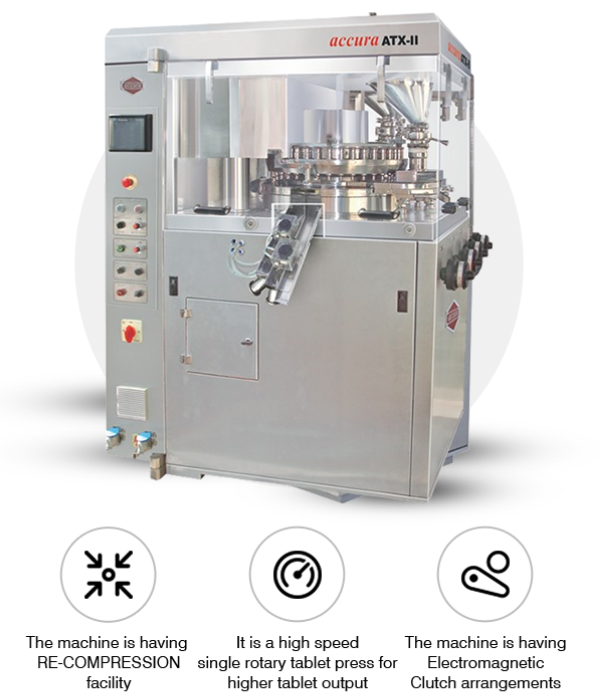
A fully automatic tablet press machine with PLC control, locked panel functionality, auto weight control through compaction force monitoring, and automatic batch report generation meets all of these requirements by design. A semi-automatic tablet press that relies on manual operator logging and mechanical controls does not provide the documentation infrastructure that SFDA compliance demands for export-grade production.
Why Automatic Tablet Compression Machines Are Essential for Saudi Export Ambitions
Many Saudi pharmaceutical manufacturers are not just producing for the domestic market. The Vision 2030 framework explicitly targets Saudi pharma companies as exporters to the GCC, wider Arab states, and African markets. This export ambition significantly raises the equipment standard required.
When a Saudi pharma manufacturer exports to a regulated market, the importing country's regulatory authority may conduct a facility inspection or review batch documentation before granting market access. This means the batch reports generated by the tablet compression machine are not just internal quality records. They are regulatory submissions, evidence of manufacturing control, and protection against import rejection.
A fully automatic tablet press that generates a complete end-of-batch production report covering all process parameters, total tablets produced, tablets rejected, rejection reasons, and batch yield provides exactly the documentation package that export compliance requires. Manufacturers relying on manual batch records from semi-automatic machines face a significant disadvantage in regulated export markets.
High Speed Rotary Tablet Press for Saudi Production Volumes
Saudi pharmaceutical manufacturers targeting meaningful domestic market share and export capacity need machines capable of high volume output. The arithmetic of pharmaceutical production at national scale is straightforward: meeting the domestic demand of a population of over 35 million people, plus export volumes, requires production capacity measured in hundreds of millions of tablets per year.
A high speed double rotary tablet press machine delivering 5 lakh to 7 lakh tablets per hour is the appropriate production tool for this scale. The double rotary design, where the turret passes through two compression zones per revolution, effectively doubles output compared to a single rotary tablet press of the same station count, without requiring proportionally larger factory floor space.
For manufacturers producing multiple products, an interchangeable turret design that supports B tooling, D tooling, BB tooling, and Bbs tooling configurations provides the flexibility to run different tablet formats on the same machine, maximising asset utilisation across the product portfolio.
Our Other Machine
Tablet In Tablet Single Rotary Tablet PressKey Features to Look for in a Tablet Press Machine for Saudi Arabia
For pharmaceutical manufacturers in Saudi Arabia evaluating tablet compression machines, the following features should be treated as non-negotiable for any facility targeting SFDA compliance and export capability.
The machine must be fully computerised with a PLC touch screen panel where all process parameters including compression force, turret speed, weight target, and rejection threshold are set digitally before each batch. The control panel must lock once the batch begins, preventing operator changes without documented authorisation. This is the foundation of process control and data integrity that SFDA and all international GMP frameworks require.
Auto weight control through compaction force monitoring ensures every tablet is checked in real time, not just through periodic manual sampling. For manufacturers producing generics for a price-sensitive market, this precision minimises material wastage and maximises batch yield. For manufacturers producing specialty or high value pharmaceuticals for the Saudi market, it ensures dosing consistency across every tablet in every batch.
Automatic tablet rejection with digital logging, complete end-of-batch production reports, and a full audit trail covering all machine events round out the compliance feature set. Equipment that is designed and manufactured to cGMP standards, with SS 316L contact parts and a dust-free compression zone, is the final requirement for SFDA-compliant pharmaceutical manufacturing.
Pilot Scale and R&D Tablet Press for Saudi Pharmaceutical Development
Not every Saudi pharmaceutical manufacturer is operating at commercial production scale. The Vision 2030 programme is also creating a new wave of pharmaceutical startups, contract development and manufacturing organisations, and formulation development centres across the Kingdom.
For these organisations, a pilot scale tablet press machine or an R&D tablet press is the appropriate starting point. Pilot scale machines produce smaller batches suitable for clinical trial supply and formulation development, using the same tooling types as production machines to ensure that development data translates accurately to commercial scale.
A single rotary tablet press machine in a semi-automatic or fully automatic configuration is the typical pilot scale tool, with outputs in the range of 10,000 to 1,00,000 tablets per batch. Fluidpack manufactures machines across this entire range, from laboratory scale single punch tablet press machines through pilot scale single rotary presses to the high speed ACCURA F7200 for commercial production.

Conclusion: Choosing the Right Tablet Compression Machine for Your Saudi Facility
Saudi Arabia's pharmaceutical manufacturing transformation is creating significant demand for high quality, compliant, and capable tablet press machines. Whether you are setting up a new GMP facility, expanding existing capacity, or upgrading to meet SFDA compliance requirements for export, the tablet compression machine you choose will define your production capability, your regulatory standing, and your competitiveness in both the domestic and regional market.
A fully automatic tablet press machine with locked controls, auto weight control, auto rejection, batch reporting, and cGMP design is the baseline requirement for any Saudi pharmaceutical manufacturer with serious production and export ambitions.