




AI Summary
- A roll compactor machine performs dry granulation, converting fine pharmaceutical powder into granules with improved flow and compressibility properties that are essential for producing high-quality tablets on a rotary tablet press machine.
- Dry granulation using roller compaction is the preferred granulation method for moisture-sensitive APIs, heat-sensitive formulations, and any product where wet granulation's water and drying steps would compromise the active ingredient.
- The quality of granules produced by a roll compactor machine directly determines the quality of tablets produced downstream, making roller compaction one of the most critical process steps in the entire solid dose manufacturing line.
- Fluidpack manufactures roll compactor machines designed for pharmaceutical GMP production with precise roll gap control, variable roll pressure, and integrated milling systems that deliver consistent granule quality batch after batch.
Introduction: Why Granulation Is the Foundation of Tablet Quality
Before powder becomes a tablet, it almost always goes through a granulation step. Most pharmaceutical APIs and excipient blends in their raw powder form are not suitable for direct compression on a rotary tablet press machine. Raw powders typically have poor flow properties, inconsistent bulk density, and inadequate compressibility to produce tablets of uniform weight and hardness.
Granulation transforms these raw powders into granules with the flow properties, bulk density, and compressibility that a tablet compression machine requires to produce consistent, high-quality tablets. Poor granulation produces poor tablets. No amount of downstream tablet press optimisation can fully compensate for granule quality problems introduced in the granulation step.
The roll compactor machine is the key equipment in dry granulation, one of the two major granulation approaches used in pharmaceutical tablet manufacturing. Understanding how it works, when to use it, and how to select the right roll compactor for your production line is essential knowledge for any pharmaceutical manufacturer producing solid dose products.

What Is a Roll Compactor Machine and How Does It Work?
A roll compactor machine, also called a roller compactor or chilsonator, performs dry granulation by feeding pharmaceutical powder between two counter-rotating rolls under high pressure. The rolls compact the powder into a dense, continuous ribbon of material. This ribbon is then broken down by an integrated milling system into granules of the required particle size range.
The dry granulation process using a roll compactor proceeds in three stages. In the first stage, the powder blend is fed from a hopper into the compaction zone between the two rolls. The feed screw controls the rate at which powder is delivered to the rolls, and its speed must be precisely matched to the roll speed to ensure consistent feeding and prevent powder starvation or overfeeding.
In the second stage, the powder passes through the nip, which is the zone of maximum pressure between the two rolls. The roll gap, which is the minimum distance between the roll surfaces at the nip, and the roll pressure, which is the hydraulic or mechanical force applied to push the rolls together, are the two primary parameters that determine the density and mechanical strength of the compacted ribbon. A narrower roll gap and higher roll pressure produce a denser ribbon with larger, harder granules after milling. A wider gap and lower pressure produce a lighter ribbon with smaller, softer granules.
In the third stage, the compacted ribbon exits the rolls and is fed into an integrated granulator, typically an oscillating granulator or a hammer mill with an appropriate screen, which breaks the ribbon down into granules. The screen aperture size controls the maximum granule size. Fines generated during milling can be recycled back to the roll compactor feed for reprocessing.
Dry Granulation vs Wet Granulation: When to Choose Roller Compaction
Wet granulation uses a liquid binder solution to agglomerate powder particles, followed by drying to remove the liquid. It produces granules with excellent flow properties and is the traditional preferred method for many pharmaceutical formulations. However, wet granulation is not suitable for all APIs and products.
Dry granulation using a roll compactor machine is the preferred choice in several important situations. When the API is moisture-sensitive, water contact during wet granulation would degrade the active ingredient. When the API is heat-sensitive, the drying step in wet granulation, which typically uses elevated temperatures, would cause thermal degradation. When the manufacturing facility needs to avoid aqueous processes for stability or containment reasons, roll compaction eliminates the water entirely. And when production time and process cost are priorities, dry granulation eliminates the drying step, which is often the longest and most energy-intensive step in wet granulation.
Direct compression, which bypasses granulation entirely, is a third approach. However, many APIs and excipient combinations do not have the flow properties and compressibility needed for successful direct compression, making roll compaction the necessary intermediate step between raw powder and finished tablet.
Critical Parameters of Roll Compactor Operation
Roll Pressure
Roll pressure is the force applied to the rolls to compact the powder into a ribbon. It is the primary determinant of ribbon density and therefore granule hardness after milling. Roll pressure must be optimised for each formulation: too low and the ribbon is too loose and crumbles into fines rather than granules; too high and the ribbon is so dense that it is difficult to mill and the resulting granules are too hard for good tablet compression. Modern pharmaceutical roll compactor machines allow roll pressure to be set and monitored precisely during operation, with the ability to detect and record deviations.
Roll Gap
The roll gap is the minimum distance between the two roll surfaces at the point of maximum pressure. A narrower roll gap produces a thinner, denser ribbon. A wider roll gap produces a thicker, less dense ribbon. The roll gap is typically controlled by a feedback system that maintains the gap at the set value despite variations in powder feed rate and compressibility. Consistent roll gap control is essential for consistent ribbon quality and therefore consistent granule quality.
Roll Speed and Feed Screw Speed
The speed ratio between the feed screw and the rolls determines how much powder is delivered to the nip per revolution of the rolls. If the feed rate is too low relative to roll speed, the rolls are starved of powder and the ribbon quality suffers. If the feed rate is too high, the powder builds up ahead of the rolls and is not uniformly compacted. The optimal ratio depends on the powder's density and flow characteristics and must be established during process development.
Roll Surface Design
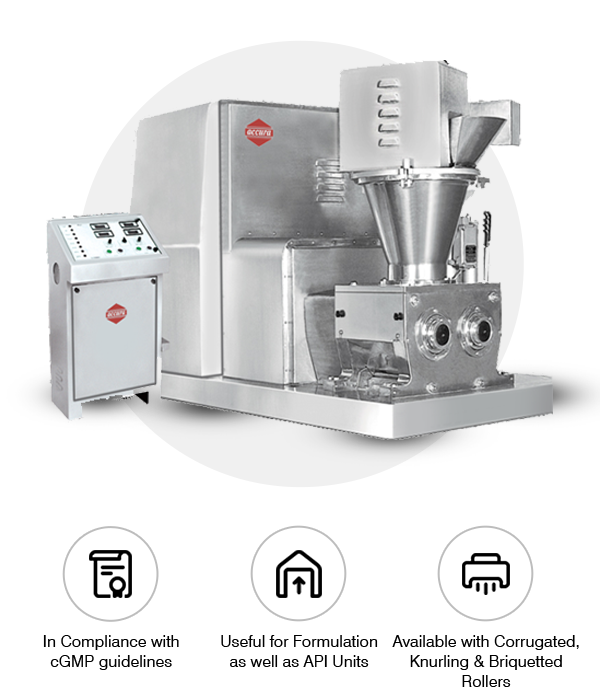
Roll compactor rolls are available in different surface designs, most commonly smooth rolls, knurled rolls, and pocket rolls. Smooth rolls produce a flat ribbon suitable for most pharmaceutical formulations. Knurled rolls provide better traction on cohesive powders that might otherwise slip on smooth roll surfaces. Pocket rolls produce a pre-formed ribbon with a corrugated surface that breaks down more easily in the milling step.
Our Other Machine
F210 Bi Layer Mini Tablet Press Machine (R & D)How Roll Compactor Quality Affects Tablet Press Performance
The connection between roll compactor performance and tablet press performance is direct and significant. Granules produced by the roll compactor are the material that feeds into the tablet compression machine. If the granule quality is inconsistent, the tablet quality will be inconsistent regardless of how well the tablet press is set up and operated.
Granule flow properties determine how consistently the die cavity is filled on the tablet press. Poor-flowing granules result in inconsistent die fill and therefore tablet weight variation, which is one of the most common and consequential tablet press problems. Granule particle size distribution affects fill uniformity and also influences tablet hardness at a given compression force.
Granule compressibility determines the compression force required to produce a tablet of the target hardness. If the roll compactor produces granules that are too hard due to over-compaction, the granules may not deform sufficiently during tablet compression, resulting in tablets with inadequate hardness or lamination problems. If the granules are too soft due to under-compaction, they may compact differently from batch to batch, causing variability in tablet hardness.
Pharmaceutical manufacturers who invest in a high-specification roll compactor machine with precise roll pressure control, consistent roll gap management, and integrated milling capability will find that the quality and consistency of their tablet press output improves correspondingly.

GMP Requirements for Pharmaceutical Roll Compactor Machines
A pharmaceutical roll compactor machine used in GMP-regulated manufacturing must meet several design and documentation requirements. The machine must be constructed from materials that are compatible with pharmaceutical powders, which means SS 316L for product contact parts, with surface finishes that are cleanable and do not harbour product residues.
The machine must support equipment qualification through IQ, OQ, and PQ protocols. Critical parameters including roll pressure, roll gap, and roll speed must be measurable and controllable with traceable calibration. Batch production records must document the critical parameters used in each granulation batch, with deviations captured and logged.
For containment applications, where the API has a potency level that requires protection of operators from powder exposure, high-containment roll compactor designs with integrated containment solutions including enclosed transfer systems and contained sampling are required.
Fluidpack Roll Compactor Machine for Pharmaceutical Manufacturing
Fluidpack manufactures roll compactor machines designed for pharmaceutical GMP dry granulation under the ACCURA brand. Key features include precise hydraulic roll pressure control with real-time monitoring, servo-controlled roll gap management for consistent ribbon density, variable-speed feed screw with ratio control relative to roll speed, integrated oscillating granulator for controlled ribbon milling, SS 316L product contact construction with pharmaceutical-grade surface finish, and full documentation support for IQ, OQ, and PQ equipment qualification.
Fluidpack roll compactor machines are available in laboratory scale for formulation development and pilot scale for clinical trial supply, through to production scale for commercial manufacturing, allowing manufacturers to develop and validate their dry granulation process at laboratory scale and then transfer directly to the same equipment technology at production scale.
Conclusion: The Roll Compactor Machine Is the Foundation of Your Tablet Quality
In solid dose pharmaceutical manufacturing, the quality of the finished tablet begins with the quality of the granules. The roll compactor machine is the equipment that transforms raw pharmaceutical powder into the granules that your tablet compression machine needs to produce consistent, high-quality tablets. Investing in a high-specification pharmaceutical roll compactor with precise process control and GMP-compliant design is one of the most impactful decisions a tablet manufacturer can make for their overall production quality.
Contact Fluidpack at info@accuratabletpress.com or visit www.fluidpack.net to discuss your dry granulation requirements and find the right roll compactor machine for your production scale.