





AI Summary
- In pharmaceutical tablet manufacturing, precision means every tablet contains exactly what the label says, not approximately, not close enough, but exactly. Deviation from target weight is a regulatory violation, not just a quality concern.
- Fully automatic tablet press machines use compaction force monitoring to check and control tablet weight in real time for every tablet (not just periodic manual samples) making true precision compression achievable at scale.
- Tablets that deviate from the target weight are automatically rejected and logged; the final batch report shows exactly how many tablets were out of spec, the deviation range, and the batch yield.
- Fluidpack's F7200 applies this precision at up to 7,77,600 tablets per hour, with a locked PLC panel that prevents operator changes from compromising the weight target mid-batch.
Introduction: What Does Precision Tablet Compression Actually Mean?
In tablet manufacturing, precision is not about being close. It is about being exact. If a tablet is labelled 500mg, it must contain 500mg of active ingredient (within the pharmacopoeia-accepted tolerance, which is tightly defined. A tablet at 490mg underdoses the patient. A tablet at 510mg overdoses them. In a chronic disease tablet) for blood pressure, epilepsy, cancer, this deviation has real clinical consequences.
The question is not whether you care about precision. Every manufacturer does. The question is whether your tablet press machine can actually deliver it, and prove it with documentation.

The Precision Problem with Semi-Automatic Tablet Press Machines
Semi-automatic tablet press machines rely on manual weight checking. An operator periodically pulls tablets from the output, weighs them on a balance, and checks whether they are within range. If not, the operator adjusts the die fill depth or compression force manually.
The problem with this approach:
- Between manual checks, hundreds or thousands of tablets are produced. Out-of-spec tablets produced in this window pass through undetected.
- Different operators adjust settings differently, introducing variability between shifts.
- There is no continuous digital record of what happened between checks.
- For high-speed production, manual sampling cannot keep up with the output rate.
For commodity drugs with wide acceptable ranges, this may be manageable. For high-value, narrow-tolerance formulations, it is not a reliable system.
How Compaction Force Monitoring Delivers Real Precision
Fully automatic tablet press machines solve the precision problem through compaction force monitoring, also called force feeder control or in-process weight control.
Here is the principle behind it:
- For a given formulation (powder blend, moisture content, granule size), the compression force required to produce a tablet correlates directly with the tablet's weight.
- The machine measures this force for every single tablet as it is compressed.
- If the force is within the set range, the tablet passes. If it is above or below range, the tablet is automatically rejected.
- This check happens at full production speed (7,77,600 tablets per hour in the case of Fluidpack's F7200) with no manual intervention.
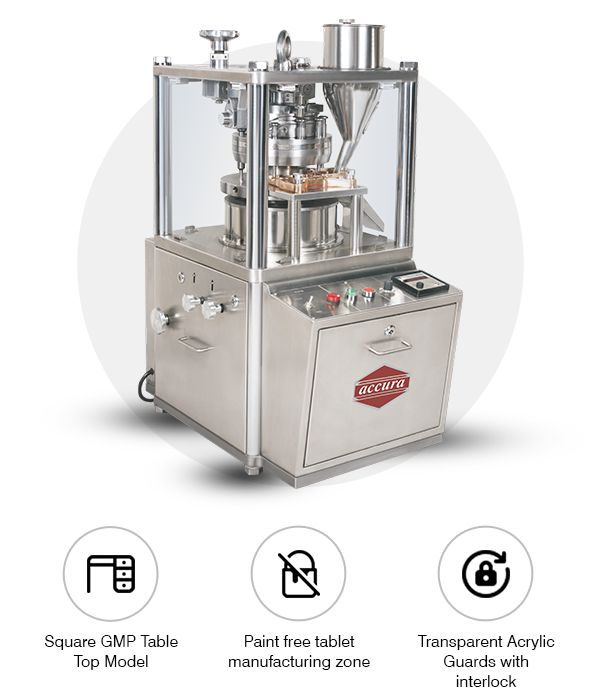
The result is that when you set a target weight of 500mg, the machine actively works to maintain that throughout the batch, and automatically removes any tablet that deviates beyond the acceptable tolerance.
What Happens When a Tablet Is Out of Spec?
In a fully automatic tablet press, an out-of-spec tablet triggers an automatic, instantaneous response:
- The tablet is diverted from the main output by the auto rejection mechanism.
- The rejection is logged: timestamp, position in the batch, force reading recorded, force deviation from set value.
- Production continues without interruption, the machine does not stop for individual rejections unless the rejection rate exceeds a defined threshold.
- If the rejection rate exceeds the threshold (indicating a process problem rather than a random deviation), the machine alerts the operator.
This is what precision tablet compression actually looks like in practice: not zero deviations (that is physically impossible), but instant detection, instant rejection, and complete documentation of every deviation.
Our Other Machine
F210 Bi Layer Mini Tablet Press Machine (R & D)The Weight Deviation Report: Seeing Exactly What Happened
At the end of every batch, Fluidpack's fully automatic tablet press machines generate a report that includes weight deviation data. This report answers the questions that QA managers, regulatory affairs teams, and FDA inspectors all need answered:
- How many tablets were produced in this batch?
- How many tablets were rejected, and what percentage does that represent?
- What was the reason for rejection, over-weight, under-weight?
- Were any parameters adjusted during the batch? If so, what, when, and by whom?
- What is the batch yield as a percentage of total material processed?
This report is generated automatically, no manual compilation, no opportunity for data manipulation. It is a direct output of the machine's monitoring system, and it forms part of the official batch record.
The Locked Panel: Protecting the 500mg Target Throughout the Batch
Precision tablet compression depends not just on technology but on process discipline. An operator who notices a higher-than-expected rejection rate might be tempted to widen the acceptable force range to bring more tablets within spec. On a semi-automatic machine, they can do this freely. On a fully automatic machine with a locked panel, they cannot.
Once the batch begins on a Fluidpack fully automatic machine, the control panel is locked. If a change is genuinely needed (for example, because the powder blend characteristics have shifted) it requires supervisor authorisation. The change is logged with the reason, and the audit trail reflects it accurately.
This is what protects the integrity of your 500mg claim from the first tablet to the last.
Read Our Article
How to Keep Your Tablet Press Machine CleanPrecision Tablet Press Machine for Which Industries?
While all tablet manufacturers benefit from precision, some industries depend on it more than others:
- Oncology: Cancer drugs typically have narrow therapeutic windows. Underdosing reduces efficacy; overdosing increases toxicity.
- Neurology: Neurological drugs like anticonvulsants require precise dosing for effective seizure control.
- Cardiology: Cardiovascular drugs such as anticoagulants have critical dose-response relationships.
- Pharma API manufacturers: When the API costs are high, every rejected tablet is expensive, precision control directly reduces wastage cost.
- Paediatric formulations: Dose precision is especially critical for children's medicines.

Fluidpack F7200: Precision Tablet Compression at Scale
The Fluidpack F7200 High Speed Double Rotary Tablet Compression Machine delivers precision tablet compression at industrial scale:
- Compaction force-based auto weight control, every tablet, every cycle
- Auto rejection with complete logging, no tablet passes unchecked
- Locked PLC panel, target weight is protected throughout the batch
- Automatic weight deviation report at batch end
- 21 CFR Part 11 compliant documentation
- Up to 7,77,600 tablets per hour with 10-ton pre and main compression
Our Other Machine
F360 R High Speed Double Rotary Tablet Press MachineConclusion: Precision Tablet Press Machine. The Only Standard That Counts in Pharmaceutical Manufacturing
Setting a target weight of 500mg is easy. Maintaining it across an entire batch of hundreds of thousands of tablets, with automatic rejection of deviations and a regulatory-grade report to prove it, that is what a precision tablet press machine actually does.
Fluidpack's F7200 is built for exactly this standard of manufacturing. Contact Fluidpack at info@accuratabletpress.com or visit www.fluidpack.net.