





Tablet Compression: Operational Safety
The primary objective of this article is to provide an in-depth exploration of the advanced safety mechanisms integrated into modern tablet compression technology. By examining the 4-side interlock systems, pressure overload protections and real-time notification arrays, this content aims to educate manufacturers and operators on how these features prevent mechanical failure and ensure workplace safety. Furthermore, the article serves as a guide for selecting equipment that meets international safety standards while maintaining high-efficiency production yields.
Ensuring Operational Excellence: A Deep Dive into Safety Interlocks and Overload Systems
The pharmaceutical and nutraceutical industries rely heavily on the precision and reliability of compression technology. As production demands increase, the role of a Tablet Press has evolved from a simple mechanical device into a highly sophisticated piece of machinery. While output speed and weight consistency are often the primary metrics for success, operational safety remains the most critical pillar of modern manufacturing. Ensuring that operators are protected from mechanical hazards while simultaneously shielding the equipment from structural damage is a dual challenge that requires advanced engineering. By integrating robust safety protocols, manufacturers can maintain high-quality output without compromising the well-being of their workforce or the longevity of their assets.
The core of safe compression lies in the ability of the machine to monitor its own environment and internal stresses. Advanced systems now feature comprehensive interlock frameworks and pressure-sensing technologies that act as a first line of defense. This article explores the intricate safety mechanisms designed to prevent accidents and equipment failure, focusing on how these innovations have become standard requirements for any leading Tablet Press Machine Manufacturer.
Rotary Tablet Press Machine Safety via the 4-Side Interlock System
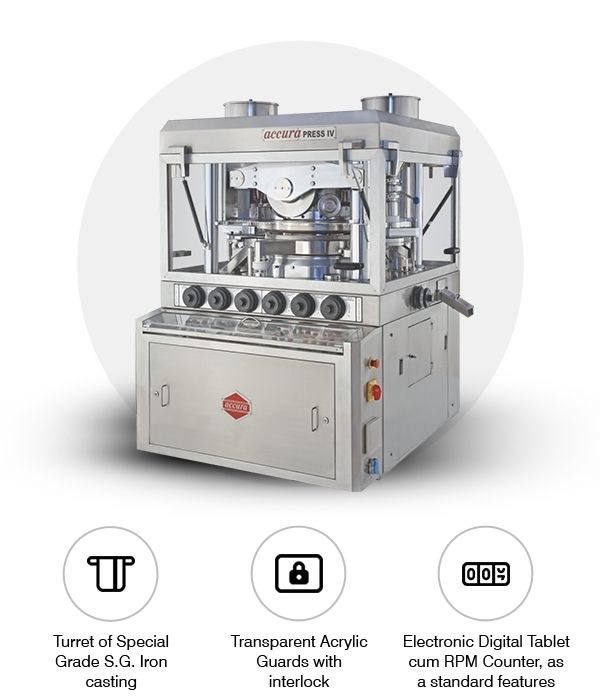
In any high-capacity production environment, the physical guarding of the machine is the most basic yet essential safety feature. A modern Rotary Tablet Press Machine is typically enclosed in a stainless steel cabinet with transparent acrylic or polycarbonate guards. These guards allow for visual monitoring while preventing physical access to the moving parts during operation. However, a physical barrier is only effective if it is tied to the machine’s control logic.
The 4-side interlock system is a comprehensive safety net that ensures the machine cannot run if any of the main access panels are open. These sensors are strategically placed on the front, rear and both side doors. If an operator attempts to open a guard while the turret is spinning, the interlock system immediately triggers a stop sequence. This prevents accidental contact with the punch heads, feeders or the turret itself. For a Tablet Press Machine Supplier, providing this level of integrated safety is non-negotiable, as it minimizes the risk of human error during high-speed operations.
Beyond simple door switches, these interlocks are often designed with "fail-safe" logic. This means that if the sensor itself fails or the wiring is compromised, the machine defaults to a safe state - usually a complete shutdown. This level of redundancy is vital when dealing with heavy mechanical components moving at high velocities.
Read Our Article
Tablet Compression Machine Working PrincipleTablet Press Machines and the Critical Role of Pressure Overload Systems
While interlocks protect the operator, the overload system protects the machine. During the compression cycle, the upper and lower punches exert immense force on the granules to form a solid tablet. If a foreign object enters the die or if there is an accidental double-feeding of granules, the pressure can exceed the structural limits of the machine. Without a relief mechanism, this could lead to shattered punches, a damaged turret or even a cracked main frame.
Modern Tablet Press Machines utilize sophisticated hydraulic or spring-loaded pressure release systems. When the compression force exceeds a pre-set limit, the system allows the pressure roller to move slightly, absorbing the excess energy and preventing a catastrophic mechanical failure. This not only saves the expensive tooling but also prevents downtime that could last weeks while waiting for replacement parts. The transition from manual mechanical levers to automated hydraulic overload systems has significantly increased the reliability of production lines across the globe.
High Speed Tablet Press Safety with Servo Motor Movement Notifications
Speed is a double-edged sword in pharmaceutical manufacturing. A High Speed Tablet Press can produce hundreds of thousands of tablets per hour, but at those velocities, even a minor adjustment error can escalate quickly. One of the most significant advancements in operational safety is the integration of servo-driven adjustments coupled with real-time notifications.
In the past, adjustments to tablet thickness or weight were done manually. Today, servo motors handle these tasks with micron-level precision. However, safety protocols now dictate that any movement of these motors must be clearly communicated to the operator. If the machine's control system initiates a movement in the dosing or compression station, a visual or audible notification is triggered on the Human-Machine Interface (HMI). This ensures that an operator performing a visual inspection near the machine is aware that internal components are shifting. This transparency between the machine's automated "brain" and the human supervisor is essential for a safe working environment.
Our Other Machine
F360 R High Speed Double Rotary Tablet Press MachineDouble Rotary Tablet Press Reliability and Hand Wheel Guard Notifications
In a Double Rotary Tablet Press, where production happens at two points on the turret simultaneously, the complexity of the machine increases. One often overlooked safety feature is the hand wheel guard. The hand wheel is used by technicians to manually rotate the turret during setup, cleaning or maintenance.
For safety reasons, the hand wheel should never be engaged while the motor is running. Modern safety systems include a dedicated guard for the hand wheel equipped with a sensor. If the guard is moved to allow access to the wheel, the machine’s main drive is electronically locked out. Conversely, if the hand wheel is left engaged after maintenance, the system will prevent the motor from starting. This "hand wheel guard notification" is a simple but effective way to prevent the machine from accidentally spinning while a tool is attached to the drive shaft, protecting both the technician and the mechanical integrity of the drive system.
High Speed Double Rotary Tablet Presses and Emergency Stop Integration
The emergency stop is the most recognizable safety feature on any industrial equipment, but its implementation on High Speed Double Rotary Tablet Presses is particularly advanced. Because these machines have a high inertia due to the weight of the turret and the speed of rotation, a simple "power cut" isn't enough to stop the machine safely.
Modern E-Stop systems are integrated with electronic braking modules. When the red mushroom button is pressed, the system doesn't just cut the power; it applies a controlled counter-force to bring the turret to a rapid yet smooth halt. Furthermore, E-Stops are placed at multiple strategic locations - usually at each corner of the machine - to ensure that an operator can reach a button regardless of where they are standing. This immediate accessibility is a hallmark of safety-conscious design, ensuring that in the event of an unexpected mechanical sound or a material spill, the process can be terminated instantly.
High Speed Rotary Tablet Press Maintenance and Automated Safety Checks
Safety is not just about what happens during a run; it is also about how the machine behaves before it starts. A High Speed Rotary Tablet Press often includes a pre-start diagnostic routine. Before the main drive is allowed to engage, the PLC checks the status of all interlocks, pressure sensors and lubrication levels.
If the lubrication system is not pressurized or if a safety gate is not fully latched, the HMI will display a specific error message rather than simply refusing to start. This diagnostic approach helps maintenance teams identify issues without having to manually probe every sensor. By ensuring that the machine is in a good state before every shift, manufacturers can reduce the likelihood of mid-production failures that could pose safety risks to the staff on the floor.
Read Our Article
Types of Tablet Compression Machines and Their ApplicationsOpportunities for Improvement and Structural Suggestions
To further enhance the safety profile of your manufacturing facility, consider the following structural and operational improvements:
- Integrated Dust Extraction Monitoring: While the 4-side interlock protects against physical injury, dust inhalation is a long-term health risk. Ensuring that the tablet press is linked to the dust extraction system - where the machine will not run unless the vacuum is active - adds an extra layer of environmental safety.
- Zone-Based Guarding: For larger production suites, implementing zone-based sensors can ensure that the machine slows down or stops if an operator enters a specific proximity, even before they touch a physical guard.
- User Access Levels: Implementing biometric or RFID-based logins on the HMI ensures that only trained personnel can adjust critical safety parameters or override certain warnings. This prevents unauthorized personnel from inadvertently disabling a safety feature.

Summary of Safety Guidance
The evolution of tablet compression technology has made the process faster, but more importantly, it has made it safer. The transition from purely mechanical stops to integrated electronic safety systems allows for a more responsive and "intelligent" production environment.
- Prioritize Interlocks: Never bypass door sensors for the sake of convenience. The 4-side interlock system is there to prevent life-altering injuries.
- Regular Overload Testing: Periodically calibrate the pressure overload system to ensure it reacts correctly to excess force.
- Operator Training: Ensure all staff understand what the notifications for servo motor movement and hand wheel guards mean. Knowledge is just as important as the physical hardware.
By focusing on these sophisticated safety breakdowns, manufacturers can ensure that their facility remains a place of high productivity and zero accidents. Whether you are operating a standard unit or a complex high-output system, the principles of operational safety remain the same: protect the person, protect the machine and protect the product.
Our Other Machine
F3000 Single Rotary Tablet PressConclusion
The integration of advanced safety features like the 4-side interlock and pressure overload systems has transformed tablet manufacturing into a highly secure and efficient process. These innovations do more than just meet regulatory requirements; they foster a culture of safety that protects the most valuable assets of any company: its people and its technology. As we have explored, the transition to high-speed automation requires a parallel advancement in monitoring systems, from servo motor movement notifications to fail-safe emergency stops. By investing in equipment that prioritizes these operational safeguards, manufacturers can ensure continuous uptime, minimize costly mechanical damage and maintain a competitive edge in the global market. Safety is not merely a feature of modern tablet compression-it is the foundation upon which reliable, high-quality production is built.