




AI Summary
- The global nutraceutical tablet market is one of the fastest-growing segments in solid dose manufacturing, driven by rising consumer demand for vitamins, minerals, herbal supplements, and functional nutrition products in tablet form.
- Nutraceutical tablet manufacturing shares many of the same equipment principles as pharmaceutical tablet manufacturing but differs in regulatory framework, formulation characteristics, tablet size requirements, and the balance between output speed and product flexibility.
- Choosing the right tablet press machine for nutraceutical production requires understanding how the larger tablet sizes, higher fill weights, and diverse ingredient profiles of supplement formulations affect compression machine selection, tooling choice, and feeder design.
- Fluidpack manufactures tablet press machines for both pharmaceutical and nutraceutical production, with the ACCURA range offering configurations suited to the specific compression requirements of vitamin, mineral, herbal, and functional nutrition tablet production.
Introduction: The Nutraceutical Tablet Market and Why Equipment Choice Matters
The global nutraceutical market has experienced sustained double-digit growth over the past decade, and tablet form remains the dominant delivery format for vitamins, minerals, herbal supplements, and functional nutrition products. From multivitamin tablets to calcium supplements, from herbal botanical tablets to sports nutrition products, the tablet press machine is the central piece of production equipment for nutraceutical manufacturers of every scale.
As the nutraceutical industry has grown, so has the sophistication of its manufacturing requirements. Consumer expectations for product quality, ingredient transparency, and manufacturing standards have risen significantly. Retailer and distribution partner requirements have become more demanding. And in many markets, nutraceutical manufacturers are voluntarily adopting pharmaceutical-grade GMP standards to differentiate their products and access premium retail channels.
The result is that nutraceutical tablet manufacturers today need tablet press machines that are considerably more capable than the basic machines that served the supplement industry a decade ago. This article explains how nutraceutical tablet compression differs from pharmaceutical tablet compression, what specific machine features matter for supplement production, and how to choose the right tablet press for your nutraceutical manufacturing operation.

How Nutraceutical Tablet Manufacturing Differs from Pharmaceutical
Regulatory Framework
Pharmaceutical tablet manufacturing operates under strict GMP regulations enforced by bodies such as the FDA, EU-GMP authority, WHO, and national equivalents. These regulations specify equipment qualification requirements, batch documentation standards, and process validation frameworks in considerable detail.
Nutraceutical tablet manufacturing operates under a different, generally less prescriptive regulatory framework. In the United States, dietary supplements are regulated under DSHEA and must be manufactured in compliance with 21 CFR Part 111, which specifies GMP requirements for dietary supplement manufacturing that are similar in principle to pharmaceutical GMP but less detailed in their equipment qualification and documentation requirements. In the European Union, food supplement regulations apply. In India, FSSAI regulations govern nutraceutical products.
Many nutraceutical manufacturers, particularly those supplying premium retail channels or exporting to multiple markets, voluntarily adopt pharmaceutical GMP standards for their manufacturing operations, even when not legally required to do so. This provides a quality and marketing differentiation advantage and simplifies the documentation requirements for multi-market export.
Formulation Characteristics
Nutraceutical tablet formulations are typically larger, heavier, and more challenging to compress than standard pharmaceutical tablets. A typical multivitamin tablet may weigh 1,000 mg to 1,500 mg, compared with a standard pharmaceutical tablet at 200 mg to 600 mg. Calcium supplement tablets can weigh 1,000 mg to 2,000 mg. These heavier tablets require a tablet press with the die fill depth and compression force capacity to handle the larger fill volumes.
The ingredients in nutraceutical tablets are also often more challenging to compress than pharmaceutical excipient blends. Vitamins and minerals are frequently abrasive. Herbal botanical powders are often fibrous and cohesive. Calcium carbonate and calcium citrate, major ingredients in bone health supplements, can be very hard and require high compression forces to produce acceptable tablet hardness. Nutraceutical formulations frequently need specific lubricant selection and granulation strategies to achieve acceptable tablet hardness and disintegration without compromising ingredient stability.
Tablet Size and Tooling Requirements
The larger tablet sizes common in nutraceutical production often require D tooling rather than the B tooling that is standard for most pharmaceutical tablets. D tooling punches have a larger barrel diameter and die cavity, accommodating the higher fill weights of supplement tablets. A nutraceutical tablet press machine configured with D tooling in a 51 station double rotary configuration is a common setup for high-volume vitamin and mineral tablet production.
Specialised tablet shapes are also common in nutraceuticals. Oval tablets, caplet shapes, and modified round tablets with specific visual identities are used by nutraceutical brands for product differentiation. Custom-shaped punches and dies for these formats are available from tooling suppliers and must be compatible with the chosen tablet press machine platform.
Output and Flexibility Requirements
Nutraceutical manufacturers typically produce a broader range of products than a pharmaceutical company of equivalent size. A supplement brand may have dozens of SKUs across vitamins, minerals, herbals, and combination products. This product range diversity means that changeover speed and operational flexibility are important tablet press selection criteria for nutraceutical producers, often more so than for pharmaceutical manufacturers with smaller, more stable product portfolios.
Our Other Machine
Single Rotary High Speed Tablet Press(ATX)Key Features to Look for in a Nutraceutical Tablet Press Machine
Compression Force Capacity
Nutraceutical tablets, particularly calcium supplements and herbal botanical tablets, often require higher compression forces than standard pharmaceutical tablets to achieve acceptable hardness. A tablet press machine for nutraceutical production should have main compression capacity of at least 10 tons, and for the hardest supplement formulations, higher compression capacity is preferable. Confirm the compression force specification for the specific machine model before purchase and verify that it is adequate for your most challenging formulations.
Die Fill Depth
The die fill depth, which is the maximum distance between the punch tips when the die is at maximum fill, determines the maximum tablet weight the machine can produce at a given die diameter. For nutraceutical tablets with high fill weights, adequate die fill depth is a critical specification. D tooling provides greater fill depth than B tooling for the same die diameter, and this is one of the primary reasons D tooling is preferred for many nutraceutical tablet applications.
Force Feeder Design
The force feeder is the component that fills powder or granules into the die cavity. For nutraceutical formulations with poor flow properties, which are common in herbal botanical and high-mineral-content products, the force feeder design is critical for achieving consistent die fill and therefore consistent tablet weight. A well-designed force feeder with adjustable paddle speed and configuration can handle a wide range of nutraceutical powder flow characteristics.
Changeover Ease
Given the product range diversity of most nutraceutical manufacturers, the time and effort required to change over the tablet press between products is an important operational efficiency consideration. A machine designed for rapid, tool-free changeover of the feeder, turret, and tooling reduces the non-productive time associated with product changes and allows more flexible production scheduling across a broad product portfolio.
GMP Standards for Nutraceutical Tablet Manufacturing
Nutraceutical manufacturers who voluntarily adopt pharmaceutical GMP standards, or who are required to do so by their export markets, need tablet press machines with the same compliance features as pharmaceutical tablet presses: PLC control with locked parameters, auto weight control, auto rejection with logging, and automatic batch report generation.
For nutraceutical manufacturers operating under dietary supplement GMP requirements, which are less prescriptive than pharmaceutical GMP, the minimum documentation requirements are simpler. However, the trend in the nutraceutical industry is consistently toward higher quality standards and more rigorous documentation, driven by consumer awareness, retailer requirements, and the competitive advantage of certified quality manufacturing.
A nutraceutical tablet press machine with pharmaceutical-grade compliance features provides future-proof manufacturing capability that can support the manufacturer's quality journey as standards rise, without requiring equipment replacement as requirements evolve.
Our Other Machine
F210 Bi Layer Mini Tablet Press Machine (R & D)Fluidpack Tablet Press Machines for Nutraceutical Manufacturing
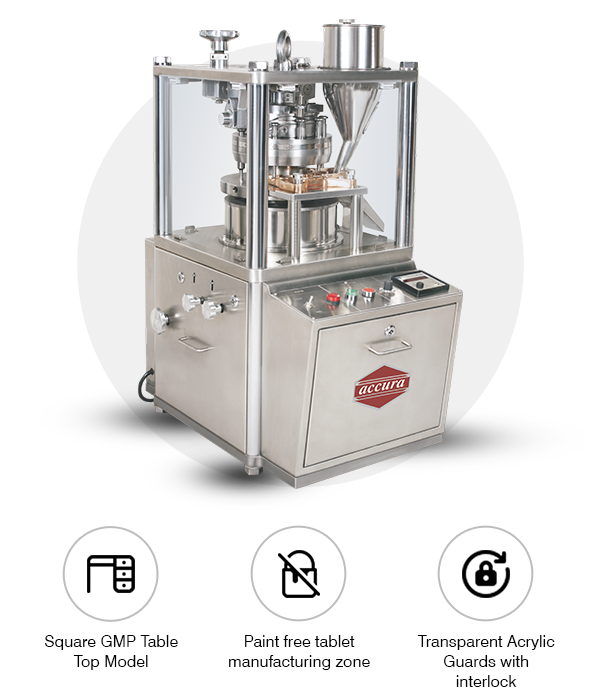
Fluidpack manufactures tablet press machines suitable for nutraceutical tablet production under the ACCURA brand. The ACCURA range includes semi-automatic machines for smaller nutraceutical manufacturers and fully automatic machines with PLC control for production at scale. D tooling configurations with 51 stations for the F7200 double rotary press are available for manufacturers producing larger supplement tablets.
For nutraceutical manufacturers producing vitamin and mineral tablets in high volume, the ACCURA F7200 High Speed Double Rotary Tablet Compression Machine provides up to 7,77,600 tablets per hour in B tooling or appropriate D tooling configurations. The machine's fully automatic PLC control, compaction force-based auto weight monitoring, and automatic batch reporting make it suitable for nutraceutical manufacturers who want pharmaceutical-grade quality documentation for premium market positioning.
Upstream equipment including roll compactor machines for dry granulation of nutraceutical ingredient blends, oscillating granulators, and vibro sifters is also available from Fluidpack for nutraceutical manufacturers building complete tablet production lines.

Conclusion: Choosing the Right Tablet Press Machine for Your Nutraceutical Production
The nutraceutical tablet press machine is not simply a pharmaceutical tablet press with the compliance requirements removed. It is a machine that must handle the specific formulation challenges of supplement production, the larger tablet sizes common in vitamins and minerals, and the product range diversity that characterises successful nutraceutical brands. Getting this selection right from the start saves significant time, money, and production quality issues compared with retrofitting or replacing equipment that was not suited to the nutraceutical application.
For nutraceutical manufacturers at any scale, from startup supplement brands to established large-scale producers, Fluidpack can advise on the right tablet press machine for your specific product portfolio. Contact Fluidpack at info@accuratabletpress.com or visit www.fluidpack.net.