




AI Summary
- Semi-automatic tablet press machines offer mechanical controls and FDA-standard rejection, ideal for domestic production, medium batches, and operations where regulatory documentation requirements are lighter.
- Fully automatic tablet press machines bring touch screen PLC control, auto weight monitoring, locked settings, auto rejection with logging, and complete batch report generation, essential for export and regulated markets.
- The right choice depends on your production scale, target market, regulatory requirements, and whether you are manufacturing standard or high-value API drugs.
- Fluidpack manufactures both, from entry-level semi-automatic machines to the high-speed F7200 double rotary press, and has helped over 2,250 pharma manufacturers make the right decision since 1983.
Introduction: A Decision That Affects Your Output, Your Compliance, and Your Market Access
Choosing between a semi-automatic and a fully automatic tablet press machine is one of the most consequential equipment decisions a pharmaceutical manufacturer can make. Get it right and you have a machine that matches your production scale, your regulatory requirements, and your business ambitions. Get it wrong and you are either over-investing in capability you do not use, or under-investing in compliance that your markets require.
This article gives you a clear, practical comparison (without the marketing language) so you can make the right decision for your plant.
Semi-Automatic Tablet Press Machine: What It Is and When It Works
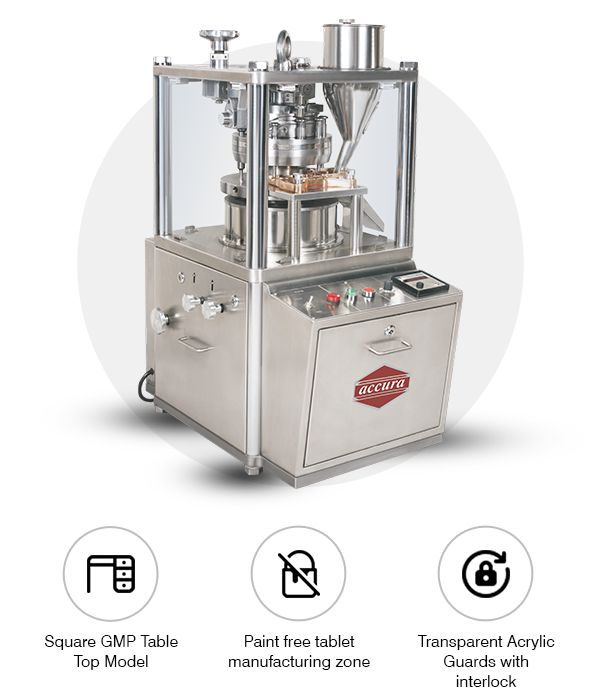
A semi-automatic tablet press (also called a manual tablet press) uses mechanical controls for most functions. The operator sets the compression force, turret speed, and tablet weight by manual adjustment, using dials and mechanical gauges rather than a digital interface.
Key features of a semi-automatic tablet press:
- Mechanical controls for speed, compression, and filling depth
- FDA standard rejection system at the machine front, tablets are rejected based on pre-set mechanical limits
- No digital batch record, production data must be logged manually by operators
- Settings can be adjusted at any time during production
- Lower capital cost than fully automatic machines
- Simpler to operate and maintain
Read Our Article
Tablet Press Machine: Its Applications and AdvantageWhen a semi-automatic tablet press is the right choice:
- Small to medium batch production for domestic markets
- R&D and pilot scale production where flexibility matters more than speed
- Markets where regulatory requirements do not mandate electronic batch records
- Manufacturers new to tablet production who need a lower entry cost
- Contract manufacturers handling varied, short-run products
Fully Automatic Tablet Press Machine: What It Is and When It Is Required
A fully automatic tablet press (also called a computerised tablet press) replaces mechanical controls with a PLC (Programmable Logic Controller) and a touch screen interface. Every parameter is set digitally before the batch, and the machine controls and monitors the process throughout.
Key features of a fully automatic tablet press:
- Touch screen PLC control, all parameters set and monitored digitally
- Locked panel after batch start, settings cannot be changed without authorisation
- Auto weight control through compaction force monitoring, every tablet measured in real time
- Auto tablet rejection with logging, every rejection recorded with reason and timestamp
- Automatic end-of-batch production and wastage report
- 21 CFR Part 11 compliant, audit trail, electronic records, role-based access
- High output capacity, machines like Fluidpack's F7200 produce up to 7,77,600 tablets per hour
Our Other Machine
Single Rotary Mini Tablet Press MachineWhen a fully automatic tablet press is required:
- Export to FDA-regulated markets (USA, Canada)
- Export to EU-GMP regulated markets (Europe)
- Manufacturing of oncology, neurology, and other high-value API drugs
- Large-scale, continuous production requiring consistent output
- Any operation where batch documentation and audit trails are mandatory
- Facilities seeking WHO-GMP or other international certifications
The Controls Difference: Mechanical vs Touch Screen PLC
This is where the practical day-to-day difference between the two machine types is most visible.
On a semi-automatic tablet press, setting the machine means physically turning dials, adjusting mechanical stops, and checking gauges. An experienced operator can do this quickly, but it is inherently variable, two operators may set the same machine slightly differently, producing subtle differences in output.
On a fully automatic machine, settings are entered numerically on the touch screen. The machine implements them precisely. Recipes can be saved and recalled, meaning the machine is set identically every time a particular product is run. This repeatability is the foundation of consistent tablet quality and the reason fully automatic machines are preferred for regulated production.
The Rejection Difference: FDA Standard vs Compaction Force-Based
Both machine types include tablet rejection, but the mechanism and documentation capability are very different.
In a semi-automatic machine, rejection happens at the machine front based on mechanical limits. It catches tablets that are grossly out of spec, but does not log rejections digitally and cannot detect subtle weight variations.
In a fully automatic machine, rejection is triggered by compaction force monitoring. Every tablet that does not meet the force threshold corresponding to the target weight is automatically rejected. Each rejection is logged with the force reading, deviation, and timestamp, providing a complete rejection record that is part of the batch documentation.
Read Our Article
Advanced Tablet Press Machines and Their UsesThe Reporting Difference: No Report vs Full Batch Report
For domestic production with lighter compliance requirements, manual logging may be acceptable. For export to regulated markets, it is not.
A fully automatic tablet press generates a complete batch report automatically at the end of every run. This report covers:
- All process parameters as set and as recorded during the batch
- Total tablets produced and total rejections
- Rejection reasons and percentage
- Batch yield
- Start time, end time, total run time
This document is part of your batch record and is a requirement under FDA 21 CFR Part 211 and EU-GMP. A semi-automatic machine cannot provide this.

Fluidpack: Manufacturer of Both Semi-Automatic and Fully Automatic Tablet Press Machines
Fluidpack, based in Ahmedabad and manufacturing pharmaceutical equipment since 1983, offers both types of machine under the ACCURA brand:
- Semi-automatic tablet press machines: For small to medium batches, R&D, and domestic production.
- Fully automatic tablet press machines. F Series and ACT Series: For high-speed, export-grade, compliance-ready production.
- F7200 High Speed Double Rotary: The flagship fully automatic machine, producing up to 7,77,600 tablets per hour with full 21 CFR Part 11 compliance.
Fluidpack has helped over 2,250 pharma manufacturers select the right machine for their production needs, across 70+ countries.
Our Other Machine
B4 - Double Sided Rotary Tablet Press MachineConclusion: Match Your Tablet Press Machine to Your Market, Not Just Your Budget
The question is not which machine is better in absolute terms. The question is which machine is right for your specific situation. If you are producing for the domestic market, a semi-automatic tablet press may be exactly what you need. If you are exporting, manufacturing high-value APIs, or scaling up your production to meet international standards, a fully automatic tablet press machine is not just preferable, it is necessary.
To speak with Fluidpack's team about the right machine for your production requirements, contact info@accuratabletpress.com or visit www.fluidpack.net.