





AI Summary
- Effervescent tablets fizz when an acid and a carbonate or bicarbonate component react once water is present, and moisture reaching the powder during manufacturing can trigger that early.
- Compression follows standard rotary mechanics, but formulation sensitivity changes feeding, tooling, lubrication and packaging transfer.
- Machine and tooling choices should follow the specific formulation and tablet dimensions rather than general assumptions.
- Moisture has to be controlled continuously from storage through packaging, since a gap at one stage can undermine the rest.
- Compression defects usually have more than one cause and need investigation across formulation, tooling and environment together.
- Fluid Pack's ACCURA tablet press range can be evaluated for effervescent applications once formulation and tablet specifications are available.
What Makes an Effervescent Tablet Press Machine Different?
An effervescent tablet press machine compresses powder or granules into tablets using the same rotary mechanics as any pharmaceutical tablet press machine: a hopper, feeder, die cavities and punches forming each tablet to a set weight, thickness and hardness. What sets effervescent tablet compression apart is the formulation, not the mechanical action. Effervescent tablets pair an acid with a carbonate or bicarbonate component that reacts in the presence of water, releasing carbon dioxide, so the same water that dissolves a tablet in a glass can start the reaction early on the shop floor.
Successful effervescent tablet manufacturing depends on matching the behaviour of the effervescent tablet formulation with the right feeding, tooling, compression and environmental controls. Effervescent products often call for a larger tablet than swallowed doses, since the dose has to dissolve completely in a set volume of water, affecting fill depth, compression force and output. In practice, a rotary tablet press machine used for effervescent tablet production must combine consistent die filling with controlled low-humidity handling and rapid downstream transfer.
Factors that most often need attention include powder flow, adhesion to punches and dies, lubrication balanced against dispersion needs, entrapped air, tooling geometry and ejection behaviour, and transfer time to packaging.

How Effervescent Tablet Compression Works
Effervescent formulations combine an organic acid with a carbonate or bicarbonate source, the materials and ratio varying by product. In a properly controlled dry formulation, these components remain stable until the tablet is added to water, where they dissolve and react, releasing carbon dioxide gas that produces the familiar fizz and helps the tablet disperse quickly. Even limited moisture exposure can affect sensitive formulations during holding, compression or transfer, from humid air, condensation or an inadequately dried raw material, ranging from a minor loss of capacity to visible swelling or slower dispersion.
Mechanically, the press follows the same rotary sequence used across pharmaceutical tablet manufacturing. Powder moves from the hopper through a feeder into the die cavities as the turret turns, with fill depth governing tablet weight. Many machines include a precompression stage that removes trapped air before main compression brings the tablet to target thickness and hardness. The lower punches then eject the tablets, which move through take-off, dedusting and inspection before a fast transfer into protective packaging. The press does not control the reaction; its job is to form the tablet while limiting moisture exposure.
Why Moisture Control Is Critical in Effervescent Tablet Manufacturing
Moisture control in effervescent tablet manufacturing has to run continuously across storage, dispensing, granulation, compression, dedusting, holding and packaging, since the acid and carbonate reaction responds to water at almost any stage. Common entry points include inadequately dried raw materials, humid room air, open containers and delayed packaging. Left uncontrolled, exposure can trigger premature carbon dioxide release, softening, surface defects, sticking, altered powder flow, pressure buildup inside sealed packs, or a shorter stability window. Not every defect traces back to moisture alone; formulation, tooling and compression settings can produce similar symptoms, so investigation should weigh all of them together.
Related terms are worth keeping distinct: relative humidity is the moisture content of air relative to what it can hold at a given temperature, dew point is the temperature at which airborne moisture starts to condense, and material moisture content is water held within the raw material. Manufacturing effervescent tablets under controlled conditions still requires specific limits from formulation data and process trials, not a figure carried over from another product.
Effervescent Tablet Formulation and Granulation Requirements
Manufacturing routes vary across the category. Direct compression can suit a blend that already flows and compresses well, while dry granulation, including roller compaction, is common because it avoids introducing water where the acid and carbonate system is most exposed. Water-based wet granulation is not an automatic choice, since the water used to bind the powder can start the reaction it is meant to control unless drying is tightly managed. A roll compactor is not needed for every formulation; the right route follows from the acid and carbonate system and the powder's behaviour during development.
Feeding, Tooling and Compression Parameters
Consistent powder flow into the die cavities is essential; when it varies, so do fill depth, tablet weight and hardness. Feeder speed and paddle action need to suit the blend, since excess agitation can affect granule integrity or generate heat.
Tablet diameter, shape, thickness, target weight, fill depth, bulk density, compression force and output together determine the right tooling; weight alone is not a reliable basis for choosing between B, BB, BBS or D standards.
Precompression, where fitted, removes trapped air before main compression brings the tablet to target density and hardness. Entrapped air, granule properties and turret speed interact to influence capping and ejection force, so settings are usually set through formulation-specific trials, not by assuming more force helps.
Lubrication supports powder flow and reduces friction while keeping ejection force in range, and also affects dispersion speed and taste. Too little shows up as sticking; too much can slow disintegration.
Common Effervescent Tablet Compression Problems
Sticking, picking, capping, lamination, weight variation, high ejection force, premature effervescence and slow dispersion can all occur during effervescent compression. These share overlapping causes, so troubleshooting checks formulation, tooling, environment and compression parameters together.
| Compression Problem | Factors to Investigate |
|---|---|
| Sticking or picking | Lubrication, tooling surface, material moisture, compression force |
| Capping or lamination | Entrapped air, precompression setting, granule properties |
| Weight variation | Powder flow, feeder settings, fill depth consistency |
| Premature effervescence | Moisture exposure during storage, holding or packaging |
| Slow dispersion | Lubrication, compression force, tablet hardness |
Changeover for a moisture-sensitive product includes removing powder residue, reaching compression zones fully, and drying thoroughly so no residual moisture remains on contact parts, following the equipment manual and the manufacturer's validated process to help prevent cross-contamination between products.
Packaging and Production Line Coordination
Because effervescent tablets stay moisture-sensitive after compression, packaging has to be planned into the production line, not treated as a separate step. A controlled, fast transfer from compression limits exposure before protection. Common formats include moisture-protective tubes, desiccant closures, moisture-barrier blister systems and individual packaging for single-dose products, with the choice following from the formulation and shelf life target. The press forms the tablet; it does not itself provide moisture protection, so compression and packaging capacity need to be planned together.
Conventional Tablet Compression vs Effervescent Tablet Compression
| Factor | Conventional Compression | Effervescent Compression |
|---|---|---|
| Formulation behaviour | Stable across a wider humidity range | Reacts on contact with water |
| Moisture sensitivity | Varies, often moderate | Typically high, central to integrity |
| Environmental control | Standard facility controls | Closer monitoring of humidity and dew point |
| Tablet dimensions | Wide range, often smaller | Frequently larger, sized to dissolve fully |
| Powder preparation | Wet or dry granulation common | Water-based granulation used with caution |
| Compression defects | Sticking, capping, weight variation | Same issues, plus premature effervescence |
| Packaging urgency | Product-specific, less time critical | Often time critical, tied to compression |
How to Select a Tablet Press for Effervescent Tablets
A press's maximum rated output is usually based on smaller, simpler tablets at top turret speed, not a promise for a specific product. What matters in practice is the validated speed for that formulation, shaped by tablet size, compression force, tooling and environmental controls.
| Selection Factor | Why It Matters |
|---|---|
| Tablet diameter and thickness | Determines tooling and clearance requirements |
| Target tablet weight | Influences die fill depth and powder demand |
| Bulk density | Affects whether the dose fits the fill depth |
| Target output | Helps determine station count and speed |
| Room conditions | Determines environmental control needs |
| Packaging capacity | Prevents tablets waiting in exposed conditions |
Sharing detailed information up front speeds up evaluation: the application, formulation where confidentiality allows, acid and carbonate system, manufacturing route, powder characteristics, target tablet weight and dimensions, required output, tooling preference and the planned packaging system.

ACCURA Tablet Press Solutions for Effervescent Tablet Production
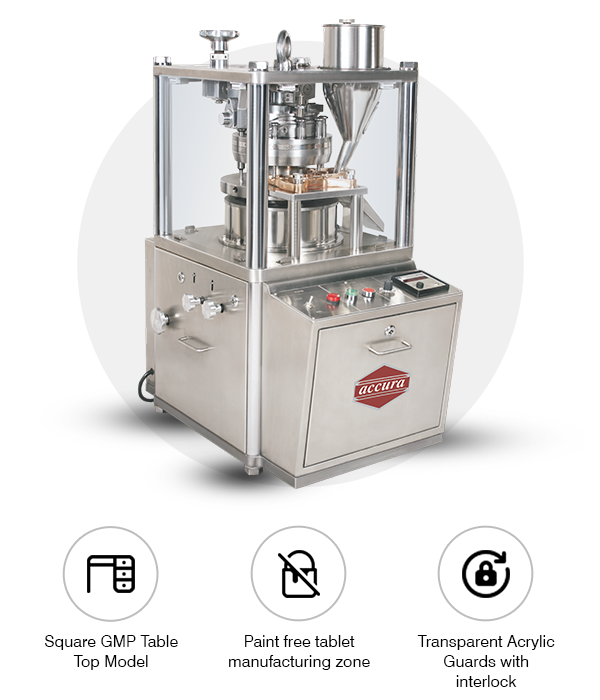
Fluid Pack has manufactured pharmaceutical tablet compression equipment under the ACCURA brand since 1983, with a tablet press machine range spanning semi-automatic models for pilot-scale work through to fully computerized, double-rotary, high-speed systems, in different tooling standards, station counts and automation levels. Suitability for a larger effervescent tablet should be confirmed from the required diameter, thickness, fill depth, compression force and output, not assumed from station count alone.
The right configuration follows from the acid and carbonate system, tablet dimensions, tooling requirements, target output, and environmental controls at the facility. Fluid Pack's range also includes punches and dies, tablet dedusters and dust extractors under allied equipment, and roll compactor machines for dry granulation.
Conclusion: Choosing the Right Effervescent Tablet Press Machine
Selecting an effervescent tablet press machine comes down to more than tablet weight or category assumptions. Formulation behaviour, moisture sensitivity, tablet dimensions, tooling, compression settings, environmental controls and packaging coordination all play a part in the right configuration. No ACCURA model is confirmed as suitable before this information is reviewed and, where needed, tested through trials.
Frequently Asked Questions About Effervescent Tablet Press Machines
Yes, using the same principle, but effervescent formulations need closer attention to moisture control, tooling and packaging transfer speed.
No. The press compresses the formulation; room humidity is managed through separate facility environmental control systems.
Complete tablet dimensions, target weight, shape, bulk density, required compression force and output, since weight or diameter alone is not enough.
Lubrication level, tooling surface condition, material moisture, and compression force are the usual factors investigated together.
Meta Title: Effervescent Tablet Press Machine: How It Works | ACCURA Meta Description: Learn how an effervescent tablet press machine works, why moisture control is critical, and what to review before selecting compression equipment.