




AI Summary
- Direct compression compresses a lubricated powder blend without a separate granulation stage.
- Wet granulation forms granules using a liquid and drying. Dry granulation forms them without added liquid, usually by roller compaction.
- Dose, particle size, flow, compressibility, compactability, segregation tendency and moisture or heat sensitivity guide method selection.
- The tablet press compresses the prepared blend, and its configuration follows how that blend behaves.
- Fluid Pack offers ACCURA tablet presses for compression and roll compactors for upstream dry granulation.
Direct Compression vs Granulation in Tablet Manufacturing
The preparation route is usually settled during formulation development, before a production press is specified. Direct compression, wet granulation and dry granulation are tablet manufacturing methods that prepare the compression blend, but none of them forms the tablet. That work belongs to the pharmaceutical tablet press machine, which fills the dies and compresses the blend during the tablet compression process. A tablet press does not perform wet granulation, and a conventional tablet press does not perform dry granulation.
Tablet formulation and compression planning begins with the properties of the active ingredient, excipients and final dosage form. Once the route is chosen, a suitably configured rotary tablet press machine may run blends prepared through any of the three routes.

Direct Compression Method in Tablet Manufacturing
Direct compression in tablet manufacturing starts with dispensing, with screening where required. The active ingredient is then blended with excipients and lubricated, and the blend is compressed, dedusted and sent for downstream processing. The active ingredient is not compressed alone, because excipients supply the flow and bonding it needs. Avoiding granulation may reduce processing stages, equipment, and exposure to moisture or heat. Scale up may also be simpler when blend properties remain controlled.
These benefits depend heavily on the materials. Common risks include:
- Poor flow and inconsistent die filling
- Weak compacts
- Segregation and dust
- Uniformity concerns at low doses
- Sensitivity to lubricant mixing
- Variation in bulk density
Direct compression may be considered when the blend shows adequate flow and compressibility, acceptable uniformity and a controlled particle size distribution. Compatible component densities, low segregation risk and sufficient stability also support it. Directly compressible excipients often make this possible.
Wet Granulation Process for Tablet Production
In the wet granulation process, materials are dry mixed and a granulating liquid, often containing a binder, is added to form a wet mass. The mass may be wet screened, then dried, milled or sized, blended with lubricant and compressed. Forming granules can improve flow, compressibility, bulk density, particle size distribution, dust levels and ingredient distribution.
The trade-offs are significant:
- Additional stages and longer processing
- Drying and cleaning load
- Exposure to moisture and heat
- Possible migration of soluble ingredients
- Granules that are too hard or too weak
- Scale-up complexity
Wet granulation may be appropriate when a blend flows or compacts poorly, generates dust, or has failed direct compression trials. Its suitability depends on moisture and heat sensitivity, binder and liquid selection, drying conditions, granule strength and product stability.
Dry Granulation Process and Roll Compaction
The dry granulation process forms granules without intentionally adding a granulating liquid, either by slugging or by roller compaction. In roller compaction, the blend is fed between rolls to form ribbons. The ribbons are milled and screened, blended or lubricated where required, and then transferred to the tablet press. The roll compactor machine is therefore upstream pharmaceutical granulation equipment.
Dry granulation may improve flow, increase bulk density and reduce dust. It may suit formulations that cannot tolerate added granulating liquid or a separate drying stage. Its limitations include:
- Extra equipment
- Variation in ribbon density and granule size
- Fines that require recycling
- Sensitivity to roll pressure and feed conditions
- Reduced recompactability in some materials
Roll settings and milling conditions are developed for each product.
Direct Compression vs Wet Granulation vs Dry Granulation
| Comparison Criteria | Direct Compression | Wet Granulation | Dry Granulation |
|---|---|---|---|
| Basic process | Blend and compress | Wet mass, dry, size, compress | Compact, mill, compress |
| Material requirement | Good inherent flow and compactability | Tolerates liquid and drying | Retains bonding after compaction |
| Moisture exposure | No added liquid | Deliberate | No added liquid |
| Heat exposure | Low | Drying stage | Mechanical heat possible |
| Processing stages | Fewest | Most | Intermediate |
| Flow | Depends on raw materials | Often improved | Often improved |
| Compressibility | Depends on excipients | Binder may assist | May reduce after compaction |
| Segregation | Higher with dissimilar particles | Components bound in granules | Fines may segregate |
| Additional equipment | Minimal | Granulator, dryer, mill | Roll compactor, mill |
| Cleaning | Fewest surfaces | Granulator and dryer | Rolls, feeder and mill |
| Possible limitations | Dust, uniformity at low doses | Moisture- or heat-sensitive actives | Fines, ribbon variability |
No route is universally superior. Selection should come from formulation development, process studies, and product quality requirements.
Our Other Machine
Single Rotary High Speed Tablet Press(ATX)How Material Properties Influence Tablet Manufacturing Methods
A low active ingredient dose raises uniformity concerns. At a high dose, the flow and bonding of the active ingredient largely determine how the blend behaves. Particle size, particle shape, and bulk and tapped density affect flow, mixing and segregation. Moisture sensitivity, heat sensitivity, hygroscopicity and chemical compatibility may restrict wet granulation. Electrostatic behaviour and lubricant sensitivity affect blending and tablet strength.
Compressibility describes how much a powder's volume reduces under pressure. Compactability describes its ability to form a mechanically strong compact. A powder can compress readily and still form weak tablets.
Differences in particle size, density and shape can cause segregation during blending, discharge, hopper loading, feeding and compression. Granulation may reduce some of this risk by binding components together, but it does not guarantee uniformity. Flow governs die filling, which in turn drives weight variation and achievable speed. Granulation can also create excessive fines, weak granules or dense granules that recompact poorly. For these reasons, final blend testing and compression trials remain necessary.
Tablet Press for Direct Compression and Granulated Formulations
No tablet press machine is best simply because a process is called direct compression or granulation. Selection depends on the final compression blend, tablet dimensions, tooling, compression force, dwell time, feeder requirements, output target, automation and process control.
A tablet press for direct compression is judged on how consistently it fills dies with that blend. Feeder design, fill depth control, precompression, main compression capacity, weight control and dust control all contribute. Not every such blend needs a force feeder, and a material that can be directly compressed is not automatically suitable for high speed operation.
A tablet press for granulated formulations is assessed against granule strength, fines, bulk density, required fill depth and ejection behaviour. Wet and dry granulated materials may recompress differently, and granulation does not remove the need for feeder trials.
| Tablet Press Selection Factor | Directly Compressed Blend | Granulated Blend |
|---|---|---|
| Die filling | Sensitive to powder flow variation | Affected by fines and granule size |
| Feeder evaluation | Flow and segregation during feeding | Paddle effect on granule attrition |
| Fill depth | Lower bulk density may need more depth | Denser granules may need less |
| Force and dwell time | Depend on excipient compactability | Depend on granule recompactability |
Rotary Tablet Press Configuration Factors
Precompression applies an initial load that may release entrapped air and establishes the compact. Main compression then achieves the final density and strength. Material properties, turret speed, dwell time and force together influence capping, lamination, hardness, friability, ejection and tooling load. Greater force does not always improve quality.
Gravity feeding relies on material flowing from the hopper into the dies. Force feeding uses rotating paddles to assist filling. The choice depends on flow, bulk density, turret speed, granule friability and lubricant sensitivity. Excessive paddle action may break fragile granules or encourage segregation.
Tooling follows tablet diameter, shape, thickness, weight, fill depth, bulk density, force, embossing and ejection behaviour. It should not be chosen from the manufacturing route or tablet weight alone. Maximum rated output applies to a specific tooling configuration. Practical and saleable output also depend on flow, dwell time, rejection rate, dust, and the capacity of upstream and downstream equipment.
Tablet Manufacturing Equipment, Cleaning and Changeover
A direct compression line may use a sifter, blender, tablet press, tablet deduster, and dust extractor. Wet granulation typically adds a granulator, dryer and sizing mill. Dry granulation adds a roll compactor and mill. Not every line needs each machine.
Every added stage brings more surfaces to clean, more transfer points and longer changeovers, which affects scheduling and cleaning validation. Direct compression still requires controlled cleaning of presses, feeders and tooling to manage cross-contamination.
Fluid Pack Equipment for Direct Compression and Granulated Tablet Production
Fluid Pack has manufactured pharmaceutical machinery under the ACCURA brand since 1983. Its equipment covers both upstream dry granulation and final tablet compression.
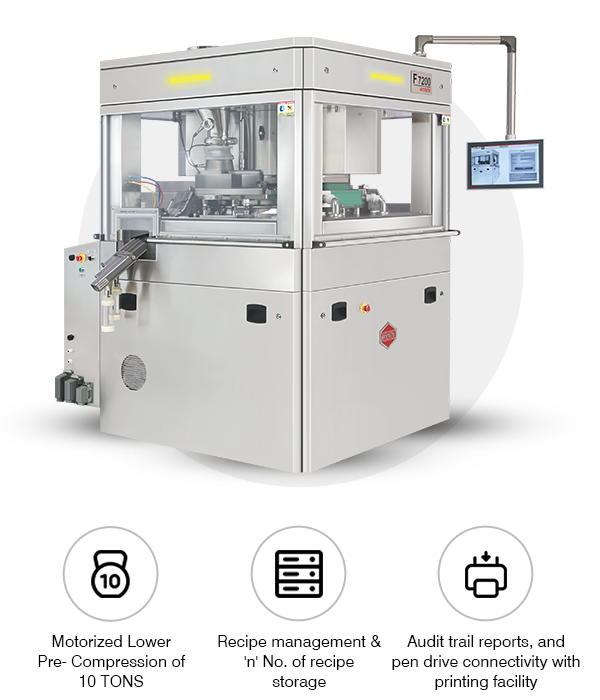
The ACCURA tablet press machine range includes semi-automatic presses, ATX series single rotary high speed presses, and ACT and F series fully computerized presses. Representative examples include the B4 double-sided rotary tablet press and the F210 Bi Layer Mini Tablet Press for development work. Stations, tooling format, fill depth, compression capacity, and output differ by model, so official specifications are matched to each application.
For dry granulation, Fluid Pack roll compactor machines include a Mini Roll Compactor for research and small-scale work and a Roll Compactor for larger production. Both operate upstream of the press. Supporting equipment covers the rest of the line:
- Tablet dedusters and dust extractors from the allied equipment range help manage dust.
- Oscillating granulators and multi mills size granules.
- Vibro sifters screen materials.
- ACCURA punches and dies, in TSM and EU standards, shape each tablet.

Information to Share Before Selecting a Tablet Manufacturing Process and Tablet Press
A useful evaluation starts with data that connects formulation behaviour to machine requirements. Formulation details reveal risks to flow, bonding and uniformity. These include composition where confidentiality permits, active ingredient dose and excipients. Material data guides feeder and fill depth evaluation. This covers particle size distribution, bulk and tapped density, flowability, compressibility, and sensitivity to moisture, heat and lubricant.
Tablet weight, diameter, shape, thickness, hardness, friability, disintegration and dissolution targets define tooling and force requirements. Production details determine configuration and line capacity. These include the proposed method, batch size, output target, changeover frequency, automation and reporting needs, existing equipment, installation space and destination market requirements.
Choosing Between Direct Compression and Granulation
The right route depends on formulation characteristics, flow, compressibility, compactability, stability and segregation risk. Quality and validation requirements, available equipment, production scale and process economics also shape the decision.
Manufacturers can contact Fluid Pack with their formulation properties, proposed manufacturing route, tablet dimensions, tooling requirements, batch size and production target. The suitability of any process or ACCURA model is confirmed through technical evaluation and trials.
Direct Compression and Granulation FAQs
Often, yes, provided the tooling, feeder, fill depth and compression settings suit each blend and changeover is planned.
It may be preferred when a blend flows or bonds poorly, generates dust or segregates, and the active ingredient tolerates moisture and drying.
It may be considered when densification is needed without liquid or drying, and the material remains compactable after compaction.
No. Roller compaction produces ribbons that are milled into granules upstream. The tablet press then compresses the final blend into tablets inside dies.
No. Dense granules may recompact poorly, so hardness depends on granule properties, formulation and compression conditions.
Flow, fill depth, dwell time, ejection behaviour and rejection rate affect sustainable speed. As a result, output rated for one configuration may not apply to another product.