




High Speed 3 Layer Tableting Machine
This article helps buyers and manufacturers understand the purpose, working process, features, and benefits of a 3 Layer Tablet Compression Machine. It explains why this advanced Tablet Press is important for producing complex formulation tablets with multiple ingredients, controlled release profiles, and better layer separation. The article also highlights key selection factors, applications, and the value of choosing the right Tableting Machine Manufacturer. It is designed to support pharmaceutical and nutraceutical businesses looking for reliable, high-performance tableting solutions.
Modern tablet manufacturing is no longer limited to simple single-layer dosage forms. Today’s pharmaceutical and nutraceutical companies often need tablets that can combine multiple active ingredients, separate incompatible materials, improve patient convenience, and support different release patterns within one compact unit. This growing demand has increased the importance of advanced compression technology, especially the 3 Layer Tablet Compression Machine. For manufacturers working with complex formulations, this type of Tablet Press offers a far more practical and technically capable solution than conventional single-layer systems.
A 3 Layer Tablet Compression Machine is designed to compress three individual layers into a single finished tablet. Each layer can contain a different formulation, color, density, or release function. This makes the machine suitable for products that require immediate release in one layer, sustained release in another, and a protective or functional separation layer in between. As formulations become more sophisticated, pharmaceutical producers need equipment that can maintain tight control over fill depth, compression force, and layer consistency. This is where a high-quality Pharmaceutical Tableting Machine becomes essential.
 Call Us Now!
 What is a 3 Layer Tablet Compression Machine?
A 3 Layer Tablet Compression Machine is a specialized Tablet Press used for producing tablets made of three distinct compressed layers. Unlike standard Tableting Machines that compress a single powder blend into one tablet, this machine handles multiple formulations in sequence and combines them into one finished dosage form. The process is more advanced because it must ensure that each layer is filled accurately, compressed properly, and bonded effectively without disturbing the integrity of the other layers.
This type of machine is especially important in pharmaceutical production where manufacturers often need to keep ingredients separate for stability or therapeutic performance. It is also useful in nutraceutical products where different vitamins, minerals, botanicals, or supplements are combined into one premium tablet. Because of its complexity, a 3 layer system is usually developed on a robust and carefully engineered High Speed Tablet Press platform.
Why Complex Formulation Tablets Require Triple-Layer Compression?
Complex formulation tablets are developed for several reasons. Some products contain ingredients that should not directly interact until consumption. Others are designed to provide an immediate effect followed by extended release. In certain formulations, multiple actives are combined into one tablet for dosage convenience and better patient compliance. A traditional Tablet Press may not offer the structural flexibility needed for such products, and even a bi-layer setup may not always be enough.
The 3 Layer Tablet Compression Machine provides an ideal solution because it gives product developers more room to structure the tablet according to formulation goals. Each layer can serve a different role. One may hold the primary active ingredient, another may act as a protective barrier, and the third may contain supporting compounds or delayed-release material. This layered approach allows better functional control while maintaining a single finished tablet format.
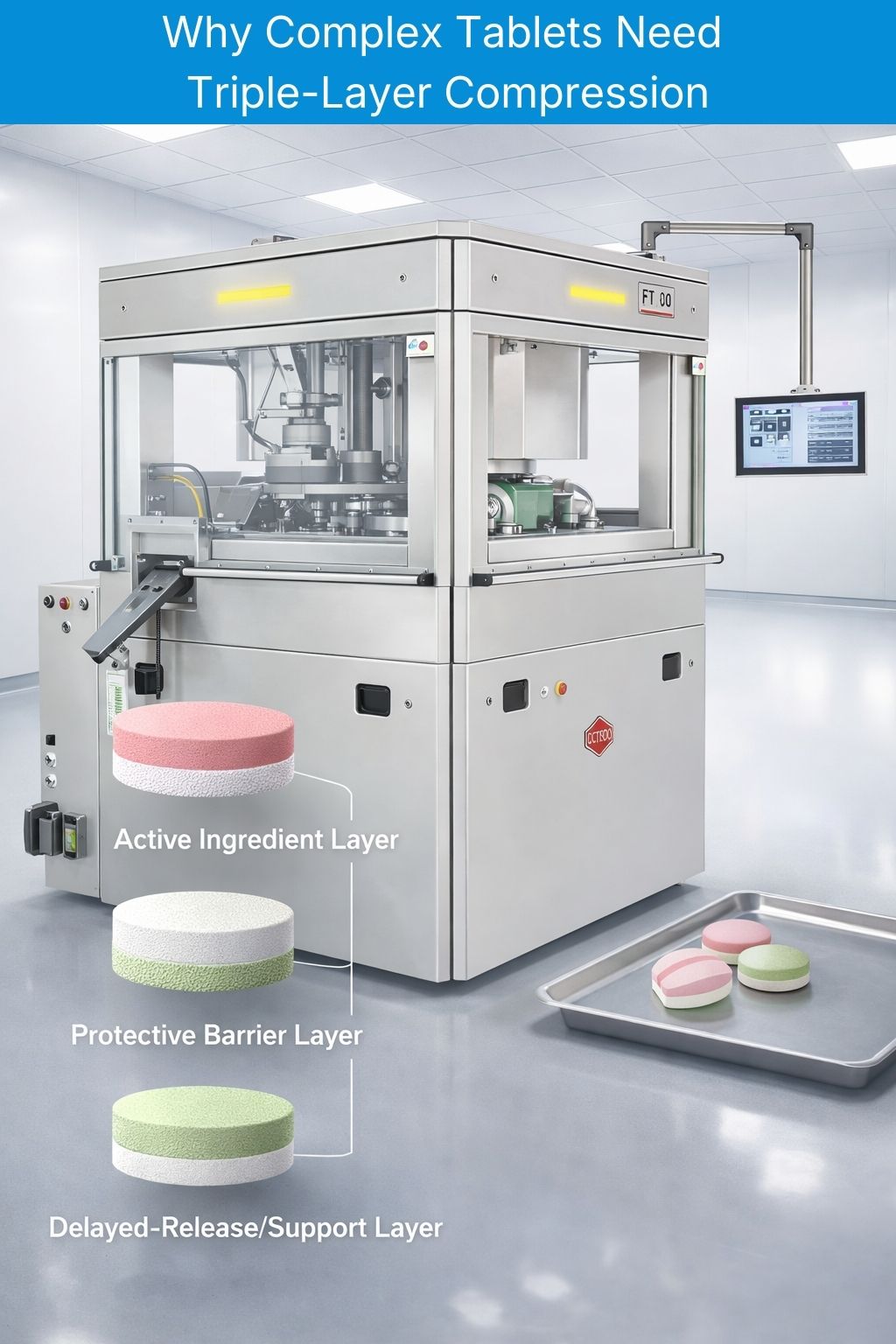
For this reason, the machine has become highly valuable in advanced pharmaceutical and nutraceutical manufacturing. It supports both product innovation and commercial scalability, making it a strategic choice for businesses that need more than standard tableting performance.
How a 3 Layer Tablet Press Works?
The working process begins with the die cavity receiving the first formulation layer. This powder is fed in a measured quantity and lightly compressed or stabilized depending on the machine’s settings. The second layer is then added over the first and compressed in a controlled manner. Finally, the third formulation enters the die cavity, followed by the final compression stage that forms the complete tablet.
This sequence sounds simple, but in actual production it requires extremely precise control. Each layer may have different flow properties, particle sizes, densities, and compression characteristics. If the feeding system is not accurate, one layer may become too thin or too thick. If the compression force is not balanced correctly, the tablet may show problems such as capping, delamination, weak bonding, or hardness variation.
That is why many manufacturers prefer a Fully Automatic Tablet Compression Machine for triple-layer production. Automatic control systems can regulate compression pressure, feeder speed, turret movement, and fill depth more precisely than manual systems. This ensures better consistency throughout long production cycles and reduces the chances of operator-related variation.
Our Other Product
F45 R Tooling Tablet Press Machine3 Layer Tablet Compression Machine Key Features
A high-quality 3 Layer Tablet Compression Machine is built to manage precision, speed, and structural reliability. It is not just a standard press with added feeding stations. It is an advanced Pharmaceutical Tableting Machine developed for multi-stage compression and complex production requirements.
Important features often include accurate layer weight control, advanced feeding arrangements, pre-compression and main compression stages, high-speed rotary design, and digitally controlled operation. In many cases, the machine is equipped with PLC-based controls and HMI screens for easier monitoring and adjustment. A Fully Automatic Tablet Compression Machine may also include recipe storage, process monitoring, overload protection, force control, and safety guarding.
Machine construction is equally important. Stainless steel contact parts, GMP-oriented design, smooth product-contact surfaces, and easy cleaning access are vital in pharmaceutical environments. When evaluating a Tablet Press Machine Manufacturer, buyers should pay close attention not only to speed and output but also to the machine’s ability to maintain consistent layer bonding, tablet appearance, and compression accuracy across production batches.
Benefits of Using a 3 Layer Tablet Press
One of the main benefits of this machine is formulation flexibility. Manufacturers can create complex tablets that combine multiple functions in one dosage form. This is highly useful in products that require ingredient separation, phased release, or strong brand differentiation.
Another benefit is improved patient convenience. Instead of taking multiple tablets, the user can receive several formulation benefits in one unit. This can support better compliance and improve product appeal in both prescription and over-the-counter categories.
From a manufacturing perspective, the machine supports efficiency when compared with producing multiple separate tablets. A properly designed High Speed Tablet Press can deliver consistent output while maintaining strict process control. It also helps manufacturers reduce formulation compromise because the product can be structured according to technical need rather than equipment limitation.
For businesses serving regulated industries, quality consistency is critical. A dependable Tablet Press Machine Supplier should provide machines that support stable performance, repeatable output, and proper service backup. In this sense, the value of a triple-layer press goes beyond the tablet itself. It supports long-term production quality, product development flexibility, and commercial reliability.
3 Layer Tablet Compression Machines Applications
The application range of this machine continues to expand. In pharmaceuticals, it is used for combination therapy tablets, modified release tablets, and products where ingredient compatibility must be carefully controlled. In nutraceutical manufacturing, it supports the creation of premium tablets containing layered vitamins, minerals, botanical extracts, or wellness ingredients. In herbal and specialty products, it helps create differentiated formulations with attractive visual structure and functional layering.
This wide application scope makes the machine valuable for companies that want to move beyond basic tableting formats. A modern Pharmaceutical Tableting Machine must often support not only production output but also product innovation. The 3 layer format meets this need by allowing manufacturers to engineer more sophisticated tablets without sacrificing manufacturing practicality.
Important Factors Buyers Should Compare
Choosing the right 3 Layer Tablet Compression Machine requires a technical evaluation. Output capacity is important, but it should not be the only consideration. Buyers must also compare compression force, tablet size range, fill depth, feeder precision, automation level, tooling compatibility, and control system capability.
Layer weight accuracy is one of the most critical points. In multi-layer tablets, even small variation in one layer can affect the entire product’s performance and appearance. Compression control is equally important because poor settings may lead to weak interlayer bonding or tablet breakage during handling and packaging.
Ease of cleaning and maintenance should also be considered. In regulated production environments, downtime and cleaning challenges can affect overall productivity. A good Tableting Machine Manufacturer will offer not only the machine but also technical consultation, spare part support, and training for smooth implementation.
When reviewing suppliers, buyers should choose a trusted Tablet Press Machine Supplier with strong engineering knowledge and a clear understanding of pharmaceutical production realities. The machine should not be sold only on speed claims. It should be evaluated on performance, consistency, compliance suitability, and long-term service support.
Difference between Single Layer, Bi-Layer, and 3 Layer Tablet Press Machine
| Type of Tablet Press | Structure | Suitable For | Advantages | Limitations |
| Single Layer Tablet Press | Compresses one powder blend into one tablet | Simple and straightforward formulations | Easy to operate, suitable for basic production, efficient for standard tablets | Limited flexibility for advanced product design and ingredient separation |
|---|---|---|---|---|
| Bi-Layer Tablet Press | Compresses two separate layers into one tablet | Formulations requiring dual-function dosage design or partial ingredient separation | Supports two-layer tablet production, better formulation flexibility than single-layer press | Less suitable for highly complex formulations needing more than two distinct layers |
| 3 Layer Tablet Compression Machine | Compresses three distinct layers into one tablet | Complex formulation tablets with multiple ingredients, release profiles, or separation needs | Greater design freedom, supports advanced functionality, better ingredient separation, improved formulation possibilities | Higher complexity in machine control, feeding accuracy, and compression management; requires advanced engineering quality |
Tablet Press Machine Compliance, Tooling, and Maintenance
| Aspect | Details |
| Compliance Requirements | In pharmaceutical production, machine capability must align with GMP and cleanliness expectations. The machine should have a GMP-friendly design, easy-to-clean product contact parts, and stable production performance. |
| Tooling Importance | Proper punches and dies are essential because they affect tablet shape, hardness, thickness, and surface finish. |
| Triple-Layer Tooling Needs | For 3 layer tablet production, tooling precision becomes even more critical because the machine must maintain correct layer registration and uniform compression. |
| Maintenance Focus | Maintenance should include regular inspection of feeders, compression parts, turret movement, lubrication systems, and safety devices. |
| Engineering Support | A robust High Speed Tablet Press requires preventive maintenance and dependable engineering backup to ensure long-term performance. |
| Supplier Value | Working with an experienced Tableting Machine Exporter or machine supplier helps manufacturers maintain machine life, output consistency, and operational confidence in both domestic and international production environments. |
Why the Best 3 Layer Tablet Compression Machine Manufacturer Matters?
A 3 Layer Tablet Compression Machine is not a routine equipment purchase. It is a process-critical investment that directly affects formulation success and production stability. The right manufacturer should understand compression science, powder handling behavior, machine durability, and the technical demands of pharmaceutical production.
A dependable Tablet Press Machine Manufacturer will not only supply the equipment but also help the customer choose the right model, configure the machine properly, and support long-term performance. Businesses should always prefer a supplier with proven experience in Tableting Machines, technical service capability, and a reputation for supporting advanced pharmaceutical requirements.
 WhatsApp Now
 3 Layer Tablet Compression Machine Supplier in India
A 3 Layer Tablet Compression Machine for Complex Formulation Tablets is a highly valuable solution for pharmaceutical and nutraceutical manufacturers looking to achieve better formulation control, ingredient separation, and advanced tablet functionality. It supports the production of tablets that are not possible with standard single-layer systems and gives product developers more freedom to create differentiated, high-performance dosage forms. With the right machine, manufacturers can improve consistency, efficiency, and product quality while meeting the growing demand for more complex tablet formats.
When it comes to choosing a trusted partner in this field, Fluidpack stands out as a strong name in the industry. Recognized as a leader in Tableting Machines Manufacturer & Supplier in India, Fluidpack has built its position by offering reliable, high-performance, and advanced tableting solutions for pharmaceutical production needs. Whether businesses are looking for a Tablet Press, High Speed Tablet Press, Fully Automatic Tablet Compression Machine, or a dependable Pharmaceutical Tableting Machine, Fluidpack represents a reliable choice for quality-driven tablet manufacturing requirements.
Our Other Product
F210 Bi Layer Mini Tablet Press Machine (R & D)3 Layer Tablet Press Machine FAQs
A 3 Layer Tablet Compression Machine is an advanced Tablet Press used to produce tablets with three separate compressed layers in a single dosage form. It is ideal for complex formulations that require ingredient separation or multiple release functions.
It helps manufacturers combine multiple ingredients in one tablet while keeping the layers controlled and distinct. This is useful for incompatible ingredients, phased release profiles, and product innovation.
The machine feeds and compresses each formulation layer in sequence inside the die cavity. After the final compression stage, the finished tablet is formed with all three layers properly bonded together.
The machine offers better formulation flexibility, improved patient convenience, ingredient separation, release profile control, and stronger product differentiation in the market.
These machines are mainly used in pharmaceutical, nutraceutical, herbal, and wellness product manufacturing where advanced multi-layer tablet production is required.
Buyers should compare output capacity, compression force, feeder accuracy, automation level, tooling compatibility, cleaning access, control system capability, and service support.
Yes, many modern systems are available in fully automatic versions with PLC and HMI controls for better accuracy, process monitoring, and consistent production.
A bi-layer press makes tablets with two layers, while a 3 Layer Tablet Press produces tablets with three layers. The triple-layer machine offers more flexibility for complex formulations and multi-stage release designs.
Because the process involves multiple formulations and compression stages, the machine must maintain accurate filling, strong layer bonding, and stable output to avoid defects and inconsistencies.
Fluidpack is known as a leader in Tableting Machines Manufacturer & Supplier in India, offering advanced tableting solutions for pharmaceutical production with a focus on quality, reliability, and performance.