




AI Summary
- Cancer and neurological drug tablets are life-critical medicines where dosing precision, zero-wastage of expensive APIs, and regulatory compliance are non-negotiable, making the tablet press machine a mission-critical piece of equipment.
- The high cost of oncology and neurology APIs means every rejected tablet represents a significant financial loss, and every undocumented deviation is a regulatory risk, requiring automatic rejection, real-time weight monitoring, and end-of-batch reporting.
- Fully automatic tablet press machines with locked controls, 21 CFR Part 11 compliance, and automatic batch report generation are the standard for manufacturers serving FDA and GMP-regulated markets with high-value therapeutics.
- Fluidpack's F7200 is used by pharmaceutical manufacturers across oncology and neurology production for its precision compaction control, complete documentation capability, and high-volume output of up to 7,77,600 tablets per hour.
Introduction: When the Drug Is for Cancer or Neurology, There Is No Margin for Error
Not all pharmaceutical tablets carry the same stakes. A tablet of a standard analgesic or antacid has a relatively wide therapeutic window, the difference between 490mg and 510mg is clinically insignificant. A tablet of an oncology drug or a neurological treatment is different. These medicines have narrow therapeutic windows. Underdose and the treatment fails. Overdose and the side effects become dangerous.
When the drug is for cancer (a chemotherapy agent, a targeted therapy, a hormone treatment) every tablet must be exactly right. When the drug is for neurology (an anticonvulsant, a Parkinson's treatment, a psychiatric medication) consistent dosing is essential for patient safety and treatment efficacy.
This clinical reality drives a very specific set of requirements for the tablet press machine used in these manufacturing environments. This article explains what those requirements are and why a fully automatic machine is the only appropriate choice.

The API Cost Factor: Why Wastage Is Especially Painful in Oncology and Neurology Manufacturing
Active Pharmaceutical Ingredients for cancer and neurological treatments are among the most expensive in the pharmaceutical industry. Some oncology APIs cost tens of thousands of rupees per kilogram. Some neurological APIs are produced in small quantities globally, with long lead times and tight supply constraints.
In this context, material wastage is not an abstract quality metric. It is a direct financial loss that affects the economics of every batch:
- A 1% wastage rate on a 10-kilogram batch of a high-value API could represent lakhs of rupees in lost material.
- Startup and shutdown losses on a semi-automatic machine, where the first and last minutes of production are inherently less controlled, represent disproportionate waste when the material is expensive.
- Out-of-spec tablets that reach the output undetected (as can happen with periodic manual sampling on semi-automatic machines) are a regulatory problem as well as a financial one.
Fully automatic tablet press machines address all three wastage points through real-time compaction force monitoring, automatic rejection, and locked controls that prevent unplanned process changes.
Precision Is Patient Safety: The Dosing Standard for Cancer and Neurology Tablets
The pharmacopoeia specifies acceptable weight variation limits for tablets, but the clinical sensitivity of oncology and neurology drugs means manufacturers must operate at the tightest end of these tolerances.
- Anticonvulsants for epilepsy: Even small dose variations can push patients into sub-therapeutic levels (breakthrough seizures) or toxic levels (adverse neurological effects).
- Chemotherapy tablets: Dosing is calculated precisely based on body surface area or weight. A tablet that deviates from the labelled dose changes the patient's actual dose received.
- Psychiatric medications: Dose consistency is essential for stable therapeutic blood levels in long-term treatment.
A fully automatic tablet press machine that monitors every tablet via compaction force and rejects deviations automatically is the only manufacturing tool that can deliver this level of consistency at commercial production scale.
Regulatory Requirements for High-Value Drug Manufacturing
Manufacturers of oncology and neurology drugs are subject to intense regulatory scrutiny, both because of the patient population they serve and because these drugs are often exported to highly regulated markets.
For FDA export: 21 CFR Part 11 compliance is required for all electronic records, including tablet press batch records. This means a locked control panel, complete audit trail, and automatic batch report generation.
For EU-GMP: Annex 11 requirements for computerised systems apply to any digital data generated by your tablet press.
For WHO-GMP: Complete batch records, process validation data, and documented rejection procedures are required.
A semi-automatic tablet press cannot meet any of these requirements for digital record-keeping. For oncology and neurology drug manufacturers with export ambitions, a fully automatic tablet press machine is not a luxury, it is the regulatory baseline.
The Locked Panel: Non-Negotiable for Life-Critical Drug Manufacturing
In most pharmaceutical manufacturing, the locked control panel is an important compliance feature. In oncology and neurology drug manufacturing, it is a patient safety feature.
If an operator can change compression settings mid-batch (whether intentionally or under production pressure) the tablets produced before and after the change have different characteristics. In a cancer drug, this means some tablets in the batch are not at the intended dose. In an anticonvulsant, this means dosing inconsistency within a single batch.
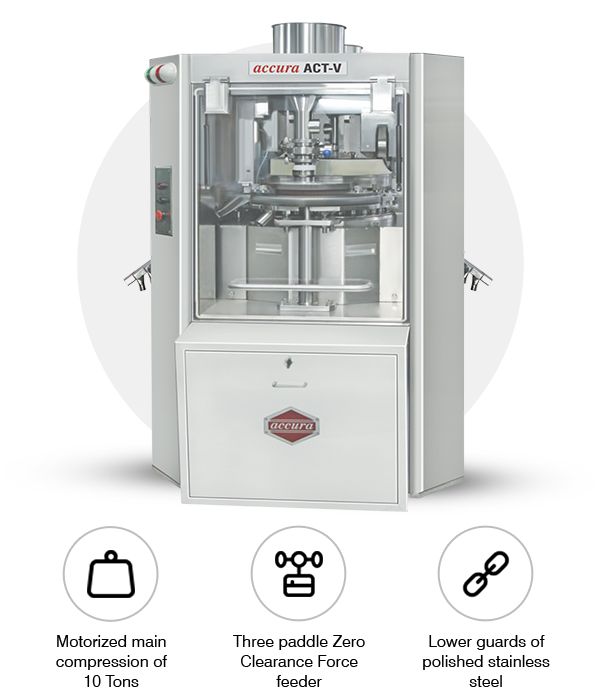
Fluidpack's fully automatic machines lock the control panel once the batch starts. Every parameter is set before production begins, and no change is possible without authorisation and documentation. This is the standard that life-critical drug manufacturing requires.
Auto Rejection and Full Logging: The Quality Net for High-Value Drugs
Even with the best formulation and process control, some tablet weight deviations will occur during a production batch. What matters is whether those deviations are caught, and whether they are documented.
On a semi-automatic machine, rejection is mechanical and not logged. An out-of-spec tablet that gets past the front rejection mechanism (because it is close to the threshold) enters the output with no record of the near-miss.
On Fluidpack's fully automatic machines, every tablet is monitored by compaction force. Every rejection is automatic, immediate, and logged, with the compression force reading, the deviation from target, and the timestamp. This creates a complete quality record for the batch that QA teams and inspectors can review with confidence.
Fluidpack F7200: Chosen by High-Value Drug Manufacturers for Precision, Compliance, and Output
Fluidpack's F7200 High Speed Double Rotary Tablet Compression Machine is well-suited to oncology and neurology drug manufacturing environments for several reasons:
- Precision: Compaction force-based auto weight control on every tablet, not just periodic samples
- Compliance: 21 CFR Part 11 compliant, with locked panel, full audit trail, and auto batch report
- Wastage control: Auto rejection with logging, every out-of-spec tablet removed and recorded
- Output: Up to 7,77,600 tablets per hour, viable for commercial scale oncology and neurology production
- Flexibility: Interchangeable turret for different tablet formats and API types
- GMP design: SS 316L contact parts, cGMP-compliant layout, dust-free compression zone
Fluidpack has been manufacturing pharmaceutical equipment since 1983 and serves over 2,250 pharmaceutical clients across 70+ countries, including manufacturers of specialty and high-value therapeutic categories.

Conclusion: Fully Automatic Tablet Press Machine for Cancer and Neurology Drugs. Precision, Compliance, and Patient Safety in One Machine
The stakes in oncology and neurology drug manufacturing are as high as they get in the pharmaceutical industry. The API is expensive, the patients are vulnerable, the regulators are watching closely, and the export markets are demanding.
A fully automatic tablet press machine (with real-time weight monitoring, locked controls, auto rejection with complete logging, and regulatory-grade batch reporting) is not an advanced option for this category. It is the minimum appropriate standard.
Fluidpack's F7200 is built to that standard. To discuss your specific production requirements for oncology or neurology drug manufacturing, contact Fluidpack at info@accuratabletpress.com or visit www.fluidpack.net.