




AI Summary
- Tablet Press Machines: are crucial for ensuring precision, consistency, and regulatory compliance in nutraceutical manufacturing.
- Types of Machines: Single-Station, Rotary, High-Speed, and Automatic presses cater to different production volumes and needs.
- Key Features: Compression force control, tooling flexibility, and hygienic design ensure high-quality tablet production.
- Quality Control & Compliance: Machines maintain dosage uniformity, tablet hardness, and comply with regulatory standards like GMP and ISO certifications.
- Maintenance: Regular maintenance is vital for minimizing downtime and maximizing production efficiency.
Complete Guide to Tablet Press Machines for Nutraceutical Manufacturing
This article explores the essential role of tablet press machines for nutraceuticals in the manufacturing process, providing insights into their efficiency, quality control, and regulatory compliance. Learn how Fluidpack, a trusted tablet press machine manufacturer, provides cutting-edge solutions for the nutraceutical industry.
The Importance of Tablet Press Machines in Nutraceutical Manufacturing
The global nutraceutical market is expected to surpass USD 700 billion by 2030, driven by rising consumer demand for vitamins, minerals, herbal supplements, and functional foods. Behind every bottle of supplements on a pharmacy shelf is a manufacturing process that demands precision, consistency, and regulatory compliance — and at the heart of that process is the tablet press machine.
Choosing the right tablet press is one of the most consequential decisions a nutraceutical manufacturer makes. The wrong machine means downtime, out-of-spec tablets, costly rework, and failed audits. The right machine means consistent output, audit-ready documentation, and the ability to scale as your product line grows.
At Fluidpack, we have spent over 25 years engineering tablet press solutions for nutraceutical manufacturers across Asia, Europe, North America, and beyond. This guide distills what we have learned — from machine selection and key specifications to quality control, compliance, and maintenance best practices.

Why Tablet Press Machines Are Central to Nutraceutical Manufacturing
Unlike pharmaceutical drugs, nutraceutical tablets must balance bioavailability, palatability, and shelf life — often with complex blends of botanicals, amino acids, enzymes, and minerals that behave very differently under compression. Natural ingredients can be hygroscopic, abrasive, or low-density, presenting significant challenges for material flow and tablet hardness.
A high-quality tablet press machine addresses these challenges directly by providing:
- Uniform compression force to compensate for variable powder densities
- Precise weight control to meet label-declared dosage requirements
- Consistent hardness profiles that determine disintegration and dissolution times
- Tooling flexibility to accommodate tablets of different shapes, sizes, and coatings
- Hygienic design that meets GMP requirements for washdown and cross-contamination prevention
Read Our Article
Tablet Compression Machine Applications & ProcessTypes of Tablet Press Machines: Choosing the Right Platform
Not all tablet presses are equal, and the wrong choice for your production volume or formulation type can create serious bottlenecks. Here is a practical breakdown of the four main platforms.
Single-Station Tablet Press
Best for: R&D, pilot batches, and small-volume specialty runs.
Single-station (or eccentric) presses use one upper and one lower punch to compress tablets one at a time. Output typically ranges from 3,000 to 10,000 tablets per hour, making them well-suited for product development, clinical trial batches, and low-volume nutraceuticals where tooling changeovers are frequent.
Their key advantage is versatility: a single-station press can switch between tablet shapes and sizes quickly, making it ideal for contract manufacturers producing a wide range of SKUs in small quantities.
Rotary Tablet Press (Single and Double)
Best for: Mid-to-large scale nutraceutical production.
Rotary presses use a rotating turret with multiple punch-and-die stations - typically 16 to 75 stations depending on the model - to compress tablets continuously. A single rotary press can produce 50,000 to 300,000 tablets per hour. Double rotary presses effectively double this output by running two compression cycles per rotation, making them the preferred choice for high-volume nutraceutical lines producing vitamins, mineral supplements, and functional food tablets.
Fluidpack’s double rotary presses are engineered for 24/7 operation, with hardened stainless steel turrets, precision-ground cams, and integrated real-time monitoring of tablet weight and hardness on every station.
High-Speed Tablet Press
Best for: Mass-market supplement manufacturers with high SKU volumes.
High-speed presses push output above 400,000 tablets per hour while maintaining tight tolerances on weight (±0.5%) and hardness. They typically feature servo-driven pre-compression and main compression rollers, advanced force feeders for consistent die filling, and fully enclosed designs that minimise dust exposure for operators.
At these speeds, the quality of tooling (punches and dies) becomes critical. Fluidpack supplies TSM- and Euro D-tooling compatible presses with hardened tool steel options for abrasive nutraceutical blends containing silica, calcium, or mineral compounds.
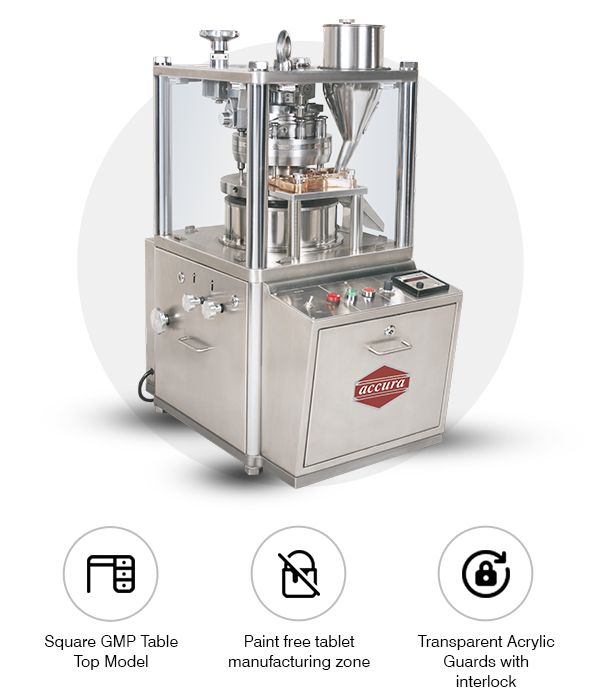
Automatic Tablet Press
Best for: GMP-regulated facilities prioritising documentation and reduced manual intervention.
Automatic tablet presses integrate feeding, compression, weight sampling, hardness testing, and rejection of out-of-spec tablets in a single, closed-loop system. PLC-based control panels with 21 CFR Part 11-compliant audit trails allow full batch documentation from a single interface — essential for manufacturers seeking FDA registration or EU market access.
Our Other Machine
F45 R Tooling Tablet Press MachineKey Features to Evaluate in a Nutraceutical Tablet Press
When specifying a tablet press for a nutraceutical production line, engineers and procurement teams should evaluate five critical parameters.
Compression Force Range and Control
Nutraceutical formulations vary widely in compressibility. Look for machines offering a pre-compression and main compression stage with individually adjustable force (typically 5–80 kN for standard presses, up to 100 kN for high-force applications). Force measurement through strain gauges on each station enables real-time rejection of under- or over-compressed tablets.
Tooling Compatibility and Customisation
Interchangeable punch-and-die tooling enables manufacturers to produce round, oval, oblong, capsule-shaped, and embossed tablets on the same platform. Ensure the machine accepts standard tooling formats (TSM, Euro B, Euro D) to reduce tooling lead times and costs. For branded nutraceuticals, custom embossing dies add product differentiation at minimal incremental cost.
Material Contact Surfaces and Hygiene Design
All product contact surfaces should be 316L stainless steel, with electropolished finishes where possible. GMP-compliant machines feature tool-free disassembly of hoppers, feed frames, and turrets, reducing changeover and cleaning time between batches. Sealed compression zones prevent cross-contamination in multi-product facilities.
Integrated Quality Monitoring
Modern nutraceutical production lines require in-process controls that go beyond manual weight checks. Look for machines with automatic weight control (AWC) systems that sample tablet weight at programmable intervals, hardness testing integration, and rejection chutes that divert out-of-spec tablets to a separate container with documented counts — all captured in the batch record.
Output Capacity and Scalability
Match machine output to your projected annual volume with 20–30% headroom for growth. Undersizing forces split batches and overtime; oversizing ties up capital in unnecessary capacity. Fluidpack offers machines from 10,000 tablets/hour for development labs up to 500,000 tablets/hour for industrial-scale nutraceutical lines, with modular upgrade paths available.
Quality Control: How Tablet Press Machines Protect Your Product
Quality in nutraceutical manufacturing is not just a regulatory requirement — it is a consumer safety obligation. A tablet that delivers 70% of the label-declared vitamin dose is not just non-compliant; it undermines the consumer’s health outcomes and your brand’s credibility.
Tablet press machines contribute to quality control in four primary ways:
- Dosage uniformity: Automatic weight control maintains tablet weight within ±1–2% across the entire batch, ensuring each tablet contains the correct active ingredient dose.
- Hardness consistency: Stable compression force produces consistent hardness, which directly affects disintegration time and nutrient bioavailability.
- Visual quality: Uniform punch and die tooling eliminates capping, lamination, and chipping — the three most common tablet defects in nutraceutical production.
- Traceability: Modern automatic presses generate time-stamped production data, rejection counts, and compression force logs that form part of the batch record for regulatory submissions.
Regulatory Compliance: What Certifications Matter
Nutraceutical manufacturers face a patchwork of regulatory requirements depending on their target markets. Your tablet press machine is a critical piece of equipment that will be scrutinised during GMP audits. Ensure your supplier can provide the following documentation:
- ISO 9001:2015 certification: Demonstrates a quality management system governing design, manufacture, and post-sale support of the machine.
- GMP-compliant design: Machines should meet 21 CFR Part 211 (US FDA) and EU GMP Annex 15 requirements for equipment qualification, including IQ/OQ/PQ documentation packages.
- CE Marking: Required for machines sold or used in the European Economic Area, confirming compliance with EU safety, health, and environmental standards.
- WHO-GMP compliance: Important for manufacturers exporting to developing markets and for procurement by government health programmes.
- 21 CFR Part 11 compliance: Electronic batch records and audit trails on automatic machines must meet FDA electronic records requirements for US-registered facilities.
Fluidpack supplies complete IQ/OQ/PQ documentation packages with every machine, significantly reducing the time and cost of equipment qualification for our customers.

Maintenance Best Practices for Maximum Uptime
A tablet press running at 200,000 tablets per hour represents significant invested capital. Unplanned downtime at that throughput costs not just lost production but also batch failures and potential product shortages. A structured preventive maintenance programme is therefore not optional — it is a production strategy.
Recommended maintenance intervals:
- After each batch: Clean all product contact parts, inspect punches and dies for wear or chipping, verify weight and hardness of last 20 tablets against specification.
- Weekly: Lubricate cam tracks, check turret alignment, inspect compression rollers for surface wear, test force feeder motor torque.
- Monthly: Calibrate weight control system against certified reference weights, inspect electrical connections and PLC I/O modules, replace worn punch seals.
- Annually: Full mechanical overhaul, replace punch and die sets (or inspect for re-use based on wear measurement), recalibrate all sensors.
Fluidpack provides on-site commissioning, operator training, and annual service contracts for all machines supplied. Our spare parts inventory in Ahmedabad ensures critical components — punches, dies, compression rollers, and feed frames — are available for next-day dispatch to customers across India and within 72 hours internationally.
Our Other Machine
F210 Bi Layer Mini Tablet Press Machine (R & D)Conclusion: Enhancing Nutraceutical Tablet Manufacturing with Fluidpack’s Expertise
Choosing the right tablet press machine for nutraceuticals is crucial to ensuring high-quality product output, regulatory compliance, and scalability. Fluidpack, with over 25 years of experience as a tablet press machine manufacturer and exporter, offers the best solutions to optimize production lines for nutraceutical manufacturers globally. Whether you're a small contract manufacturer or a large-scale producer, Fluidpack has the expertise and technology to meet your needs.