




AI Summary
- Nigeria currently imports approximately 70 percent of its pharmaceutical requirements and the government has set a target of achieving 70 percent local production by 2030, creating the largest single wave of pharmaceutical manufacturing investment in sub-Saharan Africa.
- NAFDAC, Nigeria's National Agency for Food and Drug Administration and Control, requires pharmaceutical manufacturers to operate GMP-compliant equipment with documented qualification and batch records, setting a clear standard for tablet press machine selection.
- Nigerian pharmaceutical manufacturers are at different stages of production scale, from startup facilities requiring pilot scale tablet press machines to established manufacturers scaling up with high speed rotary tablet compression equipment for domestic and African export markets.
- Fluidpack has supplied pharmaceutical equipment to manufacturers across Africa for decades and offers the full range of tablet press machines from single punch to high speed double rotary configurations suitable for every production stage in Nigeria.
Introduction: Nigeria's Pharmaceutical Manufacturing Opportunity
Nigeria is at an inflection point in its pharmaceutical industry. The country is Africa's most populous nation with over 200 million people and one of the continent's largest pharmaceutical markets. Yet despite this scale, Nigeria currently imports approximately 70 percent of the medicines its population needs, spending billions of dollars annually on pharmaceutical imports when the same products could be manufactured domestically.
This import dependence is now being addressed with unprecedented government commitment. The Presidential Initiative to Unlock the Healthcare Value Chain, launched in 2023, has set a clear target: achieve at least 70 percent local pharmaceutical production by 2030, targeting 15 percent of the African pharmaceutical market. This translates directly into new pharmaceutical manufacturing facilities being established across Nigeria, existing facilities expanding capacity, and manufacturers at every scale investing in the tablet compression equipment that makes local production possible.
For any pharmaceutical manufacturer in Nigeria, the tablet press machine is the central piece of production equipment for solid dose manufacturing. Getting this choice right determines your production capacity, your NAFDAC regulatory standing, and your ability to compete both in the Nigerian market and in the export markets that Vision 2030 wants Nigerian manufacturers to serve.

Nigeria's Pharmaceutical Manufacturing Landscape
Nigeria has approximately 115 registered pharmaceutical manufacturing companies, but the industry operates at highly varied scales and capability levels. Some established manufacturers, including Emzor Pharmaceuticals, Fidson Healthcare, and May and Baker Nigeria, are well-capitalised and produce a significant range of generic pharmaceuticals for both the domestic market and neighbouring West African countries.
A larger number of manufacturers operate at smaller scale, producing a limited range of products with older equipment and lower production capacity. And a new generation of manufacturers is entering the market specifically in response to the government's local production push, setting up new facilities from scratch and making their first major equipment investments.
This diversity means that different Nigerian pharmaceutical manufacturers need different tablet press machines. A startup facility needs a different machine than an established manufacturer scaling up. A manufacturer producing tablets for the domestic market has different requirements than one targeting regulated export markets. This article addresses all three situations.
NAFDAC Compliance Requirements for Tablet Compression Equipment
The National Agency for Food and Drug Administration and Control is the regulatory body responsible for pharmaceutical manufacturing standards in Nigeria. NAFDAC regulates pharmaceutical manufacturers through a GMP inspection and certification process that aligns with WHO-GMP standards, making WHO-GMP certification the practical benchmark for Nigerian pharmaceutical manufacturers.
For a tablet press machine to support NAFDAC-compliant pharmaceutical manufacturing, it must be capable of producing tablets of consistent weight, hardness, and composition within specified limits. The machine must support equipment qualification through installation qualification, operational qualification, and performance qualification protocols. Batch manufacturing records must document the key process parameters for every production run, and any critical process deviations must be identifiable and documented.
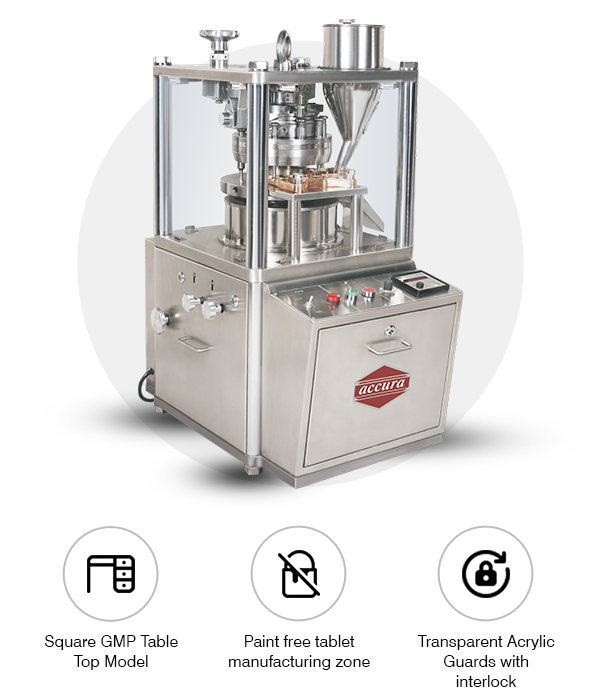
Fully automatic tablet compression machines with digital parameter control, compaction force-based auto weight monitoring, auto rejection of out-of-specification tablets, and automatic batch report generation support all of these requirements. For Nigerian manufacturers targeting NAFDAC certification and WHO-GMP compliance, these features should be treated as requirements rather than options.
The Right Tablet Press Machine for Each Stage of Nigerian Manufacturing
Startup and Small-Scale Manufacturers
For pharmaceutical manufacturers establishing new facilities in Nigeria with limited initial capital, a semi-automatic tablet press machine or a small-scale automatic tablet compression machine provides the appropriate entry point. These machines produce 50,000 to 3,00,000 tablets per hour, sufficient for initial domestic market supply, and they require a lower capital investment while still meeting basic NAFDAC GMP requirements.
At this scale, a single rotary tablet press machine in semi-automatic or basic automatic configuration is the typical choice. It provides mechanical reliability, reasonable output, and compliance with WHO-GMP equipment standards. The FDA standard rejection system included in semi-automatic machines provides basic quality control for domestic production.
Established Manufacturers Scaling Up
For established Nigerian pharmaceutical manufacturers increasing production capacity, a high speed automatic tablet compression machine is the appropriate investment. At this level, output requirements typically justify the investment in a fully automatic machine with compaction force-based auto weight control, locked PLC panel, auto rejection with logging, and complete batch report generation.
This level of equipment also positions the manufacturer for export to West African markets and, with WHO-GMP certification, to markets beyond Nigeria. A double rotary tablet press machine in this configuration can produce 5 lakh to 7 lakh tablets per hour, providing the throughput needed for both domestic and export production.
Our Other Machine
ATX-II High Speed Single Rotary Tablet PressExport-Oriented Manufacturers
Nigerian manufacturers targeting export to regulated markets, including European-standard markets in West Africa or markets requiring specific regulatory documentation, need a fully automatic tablet press with 21 CFR Part 11-aligned features: electronic batch records, audit trail, locked controls, and complete production reporting. This is the same standard applied to export-focused manufacturers globally.
Common Tablet Formats in Nigerian Pharmaceutical Manufacturing
Nigerian pharmaceutical manufacturers produce a wide range of tablet types. Antimalarial tablets, antibiotics, analgesics, antihypertensives, and antidiabetic medications dominate the domestic production landscape, reflecting Nigeria's disease burden profile. Most of these products are standard round or caplet tablets in B tooling configurations.
For antimalarial combination products, which represent one of Nigeria's highest volume production categories, the tablet size and dose requirements typically fall within standard B tooling specifications. For antibiotic tablets at higher doses, D tooling may be required depending on the specific formulation and target dose. Manufacturers producing a range of products benefit from machines with interchangeable turret design.

Roll Compactor and Granulation Equipment: The Upstream Process
A tablet press machine does not operate in isolation. Most pharmaceutical tablet manufacturing requires granulation upstream of the tablet compression step. Nigerian manufacturers investing in tablet compression capacity need to consider their complete production line, including roll compactor machines or wet granulation equipment, oscillating granulators, multi mills, and vibro sifters.
A roll compactor machine performs dry granulation by compacting powder into a ribbon that is then milled into granules suitable for tablet compression. This avoids the need for water-based wet granulation and subsequent drying, reducing process time and energy consumption. For moisture-sensitive active pharmaceutical ingredients, roll compaction is often the preferred granulation method.
Fluidpack manufactures the complete range of equipment needed upstream of tablet compression, including roll compactor machines, oscillating granulators, multi mills, and vibro sifters, making it a single-source supplier for the entire solid dose production line, which simplifies procurement and validation for Nigerian manufacturers.
Conclusion: Investing in the Right Tablet Press Machine for Nigeria's Manufacturing Future
Nigeria's pharmaceutical manufacturing sector is at a generational inflection point. The government's commitment to local production, combined with the scale of Nigeria's domestic market and its geographic position as a gateway to West Africa, creates a genuine opportunity for Nigerian manufacturers to build world-class pharmaceutical production capability.
The tablet press machine at the heart of your solid dose production line is one of the most important investments you will make in this journey. Choose a machine that matches your current production scale, supports your regulatory compliance requirements, and provides a clear upgrade path as your business grows.