




AI Summary
- CDMOs compress products for several clients, so a press must suit varied formulations, tablet formats and batch sizes.
- Flow, compressibility and lubrication sensitivity influence feeder choice, compression settings and realistic speed.
- Tooling availability, changeover and cleaning time directly affect usable capacity.
- Maximum rated output describes one configuration, not what a multiproduct plant will achieve.
- Recipe management, force monitoring and audit trails support records but do not establish compliance alone.
- The Fluid Pack ACCURA range covers development and commercial presses, selected after technical evaluation.
Choosing a Tablet Press Machine for Contract Pharmaceutical Manufacturers
A contract tablet manufacturing site rarely compresses one product for long. One suite may run a development blend, another sponsor's validation batch and then a commercial campaign, each with its own tooling, specifications, cleaning and documentation.
Evaluating a tablet press machine for contract pharmaceutical manufacturers therefore differs from selection at a company with a small, stable portfolio. A dedicated plant can optimise a tablet compression machine around known products. CDMO tablet manufacturing must consider current products, confirmed transfers, the spread of tablet sizes and the frequency of change.
No press should be chosen simply because the buyer is a CDMO. A tablet press machine for CDMOs that suits one organisation may suit another poorly, because products, batch sizes, client commitments, facilities and quality systems differ. Pharmaceutical contract manufacturing equipment must match documented requirements.

Why CDMO Tablet Manufacturing Is Different
A contract manufacturer may handle products from multiple clients with different active ingredients and excipients, supplied as direct compression blends, wet granulated or dry granulated material. Tablet weights, diameters, shapes, tooling formats, production volumes and documentation expectations can all vary.
Not every CDMO handles all of these. A high-volume generics site differs from an early phase development specialist, and equipment requirements follow the contracted portfolio and business model.
Portfolio Mapping for a Tablet Press for Multiple Products
Before comparing any rotary tablet press machine, buyers should map current and confirmed future products, formulation properties, tablet dimensions and weights, batch sizes, annual volumes, tooling formats, changeover frequency, containment requirements and client documentation needs.
A press sized only around the largest, fastest product may be inefficient for small batches, slow to clean or limited in tooling flexibility. Buying capacity for speculative demand without technical and commercial evaluation can commit capital to an unsuitable configuration.
Tablet Manufacturing Scale Up from Development to Commercial Production
Formulation development uses small quantities of costly material. Pilot production and process optimisation establish workable ranges. Exhibit or registration batches, where applicable, and validation batches confirm performance at intended scale before commercial manufacturing demands scheduled, repeatable output.
Many CDMOs therefore operate a compact development press alongside larger commercial machines. Scale up between them should consider tooling, feeder behaviour, fill depth, precompression, main compression, dwell time, turret speed, tablet ejection, weight control and rejection criteria. Settings cannot simply be carried between machines, because punch velocity, dwell time and feeding differ.
Formulation Behaviour and Tablet Press Feeder Selection
Flow, bulk density and particle size distribution determine how consistently dies fill. Segregation tendency affects uniformity during long runs. Compressibility and compactability govern the force needed for acceptable tablet strength, while lubrication-sensitive blends may soften if overworked. Moisture sensitivity, friability, and dust generation influence room conditions and extraction.
Gravity feeding relies on free-flowing material and treats friable granules gently. Force feeding uses rotating paddles to improve die filling for poorly flowing materials or higher speeds, but adds mechanical energy to the blend. Neither suits every CDMO; feeder type and settings should be evaluated with the actual material.
Tooling Flexibility in Contract Tablet Manufacturing
Tooling selection depends on tablet diameter, shape, thickness, target weight, fill depth, embossing, break lines, compression force, output and ejection behaviour. Contract work adds practical questions: tooling availability, storage, inspection, tool change procedures, turret compatibility and product change parts.
Product-specific setup records covering tooling, cam selection, feeder arrangement and approved settings reduce variation when a product returns months later.
Tablet Press Changeover and Cleaning
In a multiproduct plant, changeover time is lost production time. It affects scheduling, machine availability, client delivery commitments, labour, campaign planning and capacity utilisation.
Both activities typically involve residue removal, feeder dismantling, hopper cleaning, turret and compression zone access, tool removal and inspection, dust extraction disconnection, product contact part cleaning, drying, reassembly, line clearance, cleaning verification and documentation.
There is no universal cleaning procedure or cleaning time. Requirements depend on the product, equipment, cross-contamination risk, and the validated facility procedure.
Cross Contamination Control in CDMO Tablet Compression
Shared equipment is common in contract manufacturing, so CDMOs should separately assess potency, toxicological limits, dust generation, operator exposure, product segregation, shared equipment strategy, campaign manufacturing, cleaning validation, facility controls and material transfer. The European Medicines Agency guideline on setting health-based exposure limits describes their use in risk identification where different medicinal products share facilities.
A standard tablet press should not be assumed suitable for potent or hazardous products. Machine enclosure alone does not establish that the complete process is contained; room design, transfer methods, extraction and procedures all contribute.
Tablet Press Automation and Production Records
PLC controls, user access levels, recipe management, compression force monitoring, automatic weight control, tablet rejection, alarm records, batch reports, audit trail functions and data export can support repeatability and product-specific documentation.
Software features, data integrity procedures, equipment qualification, process validation, facility compliance and regulatory approval are separate matters. No control system makes a CDMO compliant by itself.
Practical Capacity Planning for CDMO Tablet Presses
Maximum tablets per hour is a useful comparison figure but a weak sole purchasing criterion. Practical capacity depends on tooling, tablet dimensions, fill depth, flow, compression force, dwell time, turret speed, rejection rate, changeover and cleaning, maintenance, client scheduling and upstream and downstream capacity.
CDMOs should distinguish maximum rated output, validated operating speed, saleable output, campaign output and annual practical capacity, and never apply one configuration's published maximum to every formulation.

Tablet Press Maintenance and Service Support for CDMOs
Because a missed slot can affect several clients, CDMOs should review preventive maintenance, wear parts, spare parts availability, tooling support, operator training, maintenance access, troubleshooting, electrical and software support, service arrangements and documentation before purchase.
Pharmaceutical Technology Transfer for Tablet Compression
A sound transfer package documents formulation details, critical material attributes, critical process parameters, tablet quality requirements, tooling, feeder settings, fill depth, compression settings, machine speed, sampling plan, rejection criteria, cleaning requirements and approved operating ranges.
Transfer is not copying settings from the sponsor's press. Differences in machine design, feeder behaviour, tooling and scale may require evaluation runs before validation batches.
Information CDMOs Should Provide Before Selecting a Tablet Press
A relevant configuration can only be proposed once the application is understood. Portfolio, pharmaceutical or nutraceutical use and formulation properties define machine class and feeding. Tablet dimensions, shapes, tooling, fill depth and compression determine turret choices. Batch sizes, output, product changes, cleaning and containment shape design priorities, reporting expectations define controls, and utilities, space, connected equipment and destination markets confirm integration.
| CDMO requirement | Why it matters | Tablet press feature to evaluate | Information the buyer should provide |
|---|---|---|---|
| Batch size range | Development and commercial batches suit different scales | Machine class, hopper capacity | Smallest and largest batch sizes |
| Product changes | Changeover consumes schedulable capacity | Feeder dismantling, guard access, turret arrangement | Changes per month, campaign pattern |
| Tablet formats | Tooling and fill depth limit what can run | Tooling type, maximum diameter, fill depth | Tablet drawings, weights, tooling standard |
| Formulation flow | Die filling drives weight variation | Feeder type and speed control | Flow and density data, sample material |
| Cleaning and containment | Shared equipment creates exposure and carryover risk | Product contact parts, enclosure, extraction | Potency, exposure and cleaning strategy |
| Documentation | Clients expect traceable records | Recipes, access levels, audit trail reports | Reporting and data integrity requirements |
| Production output | Contracts depend on deliverable volume | Stations, turret speed, single layer or bilayer | Annual volumes, target operating speed |
Fluid Pack Tablet Press Machines for Contract Manufacturers and CDMOs
As a tablet press machine manufacturer, Fluid Pack offers an ACCURA tablet press machine range spanning semi-automatic presses, a single rotary mini tablet press, ATX single rotary high speed presses, D4 and B4 rotary presses, and the fully computerized ACT Series and F Series, including bilayer and tablet in tablet machines.
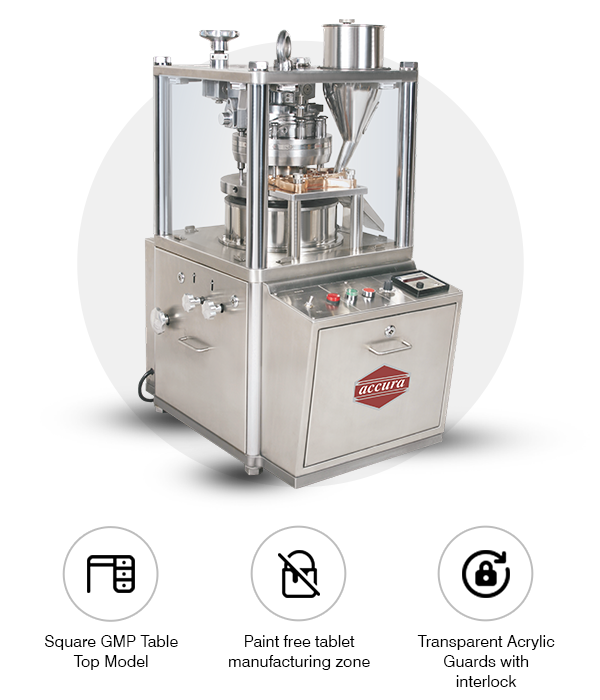
For development and high-value, low-volume work, the ACCURA F210 Bi Layer Mini Tablet Press Machine is a tabletop single rotary press intended for R&D and pilot-scale production. It is available with D tooling, B tooling or a combined D and B configuration, and its load cells display precompression and main compression force for each punch on a PLC-controlled touchscreen. A force feeder is standard, with gravity feeding listed as an option.
For commercial production, the ACCURA F360 R High Speed Double Rotary Tablet Press Machine is available with 49 D, 63 B or 81 BB stations, and its published output and maximum tablet diameter vary by tooling configuration. Actual production capacity depends on the product and operating conditions. Listed features include automatic weight control and single tablet rejection through compaction force control, load cells at precompression and main compression, recipe management, multiple user access rights and audit trail reports with printing and USB pen drive connectivity. An interchangeable turret facility is listed as an option. Qualification and validation remain the responsibility of the CDMO.
About Fluid Pack
Established in 1983, Fluid Pack manufactures pharmaceutical machinery under the ACCURA brand. For contract manufacturers and CDMOs, its tablet press range spans R&D and pilot-scale presses through single rotary, double rotary and fully computerized machines for commercial production, including bilayer and tablet-in-tablet formats. Fluid Pack also manufactures punches and dies for tooling requirements, roll compactor machines used in dry granulation, and allied equipment such as dust extractors and tablet deburring and dedusting machines.
Conclusion: Selecting Flexible Tablet Manufacturing Equipment
A pharmaceutical tablet press machine for contract work must match a portfolio, not one product. Formulation behaviour, tablet formats, tooling, batch sizes, output, changeover frequency, cleaning, containment, automation, documentation and maintenance support all shape the decision.
Contract manufacturers and CDMOs are invited to share their product portfolio, formulation characteristics, tablet specifications, batch sizes, tooling requirements and production targets with Fluid Pack, so ACCURA configurations can be assessed, with trials where appropriate, before any machine is proposed.
Frequently Asked Questions on CDMO Tablet Press Selection
Often, if the products fall within its tooling, fill depth, compression and feeding capabilities and cleaning procedures are validated. Highly potent products may justify dedicated equipment.
Usually these are different machines. Development presses conserve material, while commercial presses deliver throughput. Choosing both with compatible tooling standards and comparable force measurement makes scale-up data easier to interpret.
Sites changing products weekly should give heavy weight to access, feeder dismantling, product contact parts and recipe recall. Sites running long campaigns may prioritise speed and continuous operation.
Rated output assumes a specific tooling set at top turret speed with suitable material. Real formulations, validated speeds, rejects, cleaning, maintenance and scheduling gaps reduce the tablets delivered over a year.
Tablet drawings, weights, tooling standard, flow data, batch and annual volumes, changeover frequency, containment needs, reporting expectations and utilities. Sample material for trials strengthens evaluation.