




AI Summary
- Pharmaceutical tablet manufacturing moves through distinct stages, from early R&D and formulation work to pilot batches, scale-up, and finally full commercial production, and each stage requires a different type of tablet press machine.
- Choosing the wrong machine for your stage wastes capital: an R&D machine cannot handle commercial production volumes, and a high-speed production press is impractical for small formulation development batches.
- Understanding which machine fits which stage helps pharma manufacturers plan their equipment investments across the product development lifecycle, from first formulation to commercial launch.
- Fluidpack manufactures tablet press machines for every stage of this journey, from compact R&D presses to the F7200 high-speed double rotary production machine capable of 7,77,600 tablets per hour.
Introduction: The Tablet Development Journey. From Lab to Market
A new pharmaceutical tablet does not go from a scientist's formulation notes to a commercial production line in one step. It passes through a series of defined manufacturing stages, each with its own batch size requirements, flexibility needs, and equipment specifications.
Choosing the wrong tablet press machine for your stage is expensive in two directions: an over-specified production machine running small R&D batches wastes capital and makes formulation adjustment difficult; an under-specified machine trying to handle commercial production volumes cannot deliver the output or compliance standards required.
This guide maps each stage of the pharmaceutical manufacturing lifecycle to the tablet press machine it requires, and explains what to look for at each step.

Stage 1: R&D Tablet Press Machine. Where Formulations Begin
The first tablet press a formulation team uses is the R&D (Research and Development) machine. At this stage, the goal is not output. It is understanding how the formulation behaves under compression.
What an R&D tablet press machine is used for:
- Testing new API and excipient combinations
- Evaluating how powder blend characteristics affect tablet hardness, friability, and disintegration
- Producing small quantities of tablets for early pre-clinical and clinical studies
- Comparing multiple formulation options side by side
Key features of an R&D tablet press:
- Small footprint, table-top or bench-top design
- Low minimum batch size, can compress as few as a few hundred tablets
- Compatible with B and D tooling used on production machines, ensuring data translates to scale-up
- Easy manual adjustment for rapid formulation iteration
- Pre-compression and main compression arrangement for accurate simulation of production conditions
Stage 2: Pilot Scale Tablet Press Machine. Testing Before You Commit to Full Production
Once a formulation has shown promise in the lab, the next step is a pilot scale batch. Pilot batches are used to validate the formulation at a larger scale before committing to the investment of full commercial production.
What a pilot scale tablet press machine is used for:
- Scale-up trials to identify how formulation behaviour changes at larger batch sizes
- Producing batches for Phase II and Phase III clinical trials
- Process validation, demonstrating that the manufacturing process can consistently produce tablets meeting specification
- Training operators before full commercial production begins
Key features of a pilot scale tablet press:
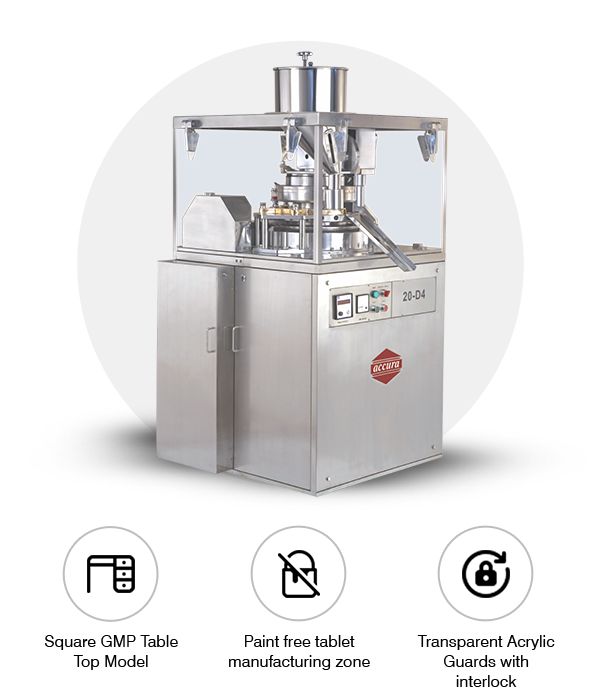
- Mid-range output, typically 10,000 to 1,00,000 tablets per batch
- Compatible with the same tooling as the intended production machine, critical for scale-up data validity
- May include basic data recording for GMP documentation at clinical trial stage
- Compact enough for development-scale facility space
Stage 3: F&D Tablet Press Machine. The Formulation and Development Bridge
The F&D (Formulation and Development) stage sits between pilot scale and full production. At this stage, the formulation is essentially finalised, and the focus shifts to optimising the manufacturing process for commercial production conditions.
What an F&D tablet press machine is used for:
- Process optimisation, finding the ideal compression force, turret speed, and die fill for the final formulation
- Validation batches for regulatory submissions
- Producing exhibit batches required for new drug applications (NDA or ANDA)
- Training the production team on the final process parameters before commercial launch
Key features of an F&D tablet press:
- Closer to production machine in specifications, same tooling type, similar station count
- Data recording capability for regulatory submission batches
- May include IQ/OQ/PQ validation documentation support
- Configurable to match production machine parameters exactly
Stage 4: Production Scale Tablet Press. Commercial Manufacturing at Full Speed
Once the formulation and process are validated and regulatory approval is in place, commercial production begins. At this stage, the tablet press machine's requirements change fundamentally: output, consistency, compliance, and documentation become the primary criteria.
What a production tablet press machine must deliver:
- High and consistent output, measured in lakh tablets per hour
- Full GMP compliance, cGMP design, SS 316L contact parts, dust-free operation
- For export markets: 21 CFR Part 11 compliance, locked controls, auto rejection, batch report generation
- Interchangeable turret for multi-product facilities
- Reliability and uptime, commercial production schedules do not accommodate frequent downtime
Fluidpack's F7200 High Speed Double Rotary Tablet Compression Machine is designed for exactly this stage, up to 7,77,600 tablets per hour, fully computerised, and compliance-ready for FDA and EU-GMP regulated markets.
How to Choose Based on Your Stage
- Early formulation, first trials: R&D tablet press machine, small, flexible, low batch size.
- Clinical trial supply, scale-up validation: Pilot scale tablet press machine, medium batch, same tooling as production.
- Regulatory submission batches, pre-launch optimisation: F&D tablet press machine, production-aligned, data-ready.
- Commercial production for domestic market: Production tablet press, high output, GMP compliant.
- Commercial production for export (FDA, EU-GMP markets): Fully automatic production tablet press with 21 CFR Part 11 compliance. Fluidpack F7200.
The Importance of Tooling Consistency Across Stages
One of the most commonly overlooked aspects of scale-up is tooling consistency. If your R&D machine uses B tooling and your production machine uses D tooling, the formulation data from your development work does not translate directly. Compression force readings, tablet hardness, and disintegration behaviour can all change when tooling changes.
Fluidpack designs their machines to support consistent tooling across scales, so data generated on the R&D or pilot machine can be reliably applied to the F7200 production machine.

Fluidpack: Tablet Press Machines for Every Stage of Your Development and Production Journey
Fluidpack has been manufacturing pharmaceutical tablet press machines since 1983 and supplies machines across every stage of the manufacturing lifecycle:
- R&D and pilot scale machines: Compact, bench-top and floor-standing, single rotary with manual or semi-automatic control.
- F&D machines: Mid-range, configurable, with data recording for validation batches.
- Production scale, single rotary (ATX Series): High-speed, GMP-compliant, available in fully automatic configuration.
- Production scale, double rotary (F7200, F Series): High-speed, fully computerised, 21 CFR Part 11 compliant, up to 7,77,600 tablets per hour.
Conclusion: Pilot Scale to Production. Match Your Tablet Press Machine to Your Stage, Then Plan Ahead
The right tablet press machine at each stage of pharmaceutical development is not just about having the right tool for today. It is about ensuring your data, your tooling, and your process carry forward into the next stage without having to start over.
Fluidpack's range covers every stage, and their team can help you plan your machine selection across the full development-to-production pathway. Contact Fluidpack at info@accuratabletpress.com or visit www.fluidpack.net.