





AI Summary
- IQ OQ PQ validation, standing for Installation Qualification, Operational Qualification, and Performance Qualification, is the internationally recognised framework for demonstrating that a tablet press machine is installed correctly, operates within specification, and consistently produces tablets meeting quality requirements.
- Regulatory bodies including the FDA, EU-GMP authority, and WHO-GMP framework all require pharmaceutical manufacturers to validate critical production equipment before commercial use, making IQ OQ PQ not a quality option but a regulatory requirement for tablet compression equipment in GMP-certified facilities.
- The validation process for a tablet press machine covers mechanical installation, utility connections, software verification, operational parameter testing, compaction force calibration, and production performance across multiple batches with statistical analysis of tablet quality results.
- Fluidpack provides IQ and OQ documentation support for all ACCURA tablet press machines, simplifying the qualification process for pharmaceutical manufacturers and reducing the time and resource burden of bringing new compression equipment into validated production service.
Introduction: Why Equipment Validation Is Non-Negotiable in Pharmaceutical Manufacturing
In pharmaceutical manufacturing, the quality of every tablet produced depends on the reliable and consistent performance of the equipment used to make it. A tablet compression machine that performs differently from batch to batch, or that drifts from its validated operating parameters over time, cannot be trusted to produce tablets of consistent quality and dosing.
This is why regulatory bodies around the world require pharmaceutical manufacturers to validate their critical equipment before it is used for commercial production. Validation means demonstrating, through documented testing, that the equipment is installed correctly, operates within specification, and consistently produces output that meets the required quality standards.
IQ OQ PQ is the validation framework used for this purpose in pharmaceutical manufacturing globally. It is required by the FDA under 21 CFR Part 211, by EU-GMP under Annex 15, by WHO-GMP guidance, and by virtually every other international pharmaceutical regulatory framework. For any pharmaceutical manufacturer bringing a new tablet press machine into production service, understanding and executing IQ OQ PQ correctly is a non-negotiable part of the process.

What Is IQ Installation Qualification?
Installation Qualification is the first stage of the equipment validation process. Its purpose is to verify and document that the tablet compression machine has been delivered as specified, installed correctly in the production environment, and connected to all required utilities in a way that meets the manufacturer's specifications and the facility's GMP requirements.
The IQ for a tablet press machine covers a comprehensive set of checks. These include verification that the machine model, serial number, and configuration match the purchase specification. Physical inspection of all major components including the turret, compression rollers, force feeder, control panel, and dust extraction connections confirms delivery condition. Dimensional checks of the installation area including clearances, floor loading, and ventilation confirm the machine is installed in a location that meets its operational requirements.
Utility connections including electrical supply voltage and amperage, compressed air supply pressure and quality, and cooling water connections where applicable are verified against the machine specification. All instrumentation including compression force sensors, weight measurement devices, and speed sensors are identified and their calibration status documented. The software version installed on the PLC control system is recorded and verified against the approved version.
The IQ is completed with a signed protocol that documents every check performed, the result obtained, and the acceptance criteria against which the result was evaluated. Any deviations found during IQ are documented and resolved before the qualification proceeds to OQ.
What Is OQ Operational Qualification?
Operational Qualification is the second stage of the validation process. Where IQ confirms the machine is installed correctly, OQ tests that the machine operates correctly across its specified operating range. OQ demonstrates that the machine's functions, controls, and safety systems all work as designed.
For a tablet press machine, OQ testing covers several critical areas. Control system verification confirms that all PLC functions operate correctly, including parameter setting and recall, alarm generation and response, panel locking after batch start, and audit trail recording of all system events. This is particularly important for fully automatic tablet compression machines with 21 CFR Part 11 compliance requirements, where the control system's data integrity functions must be thoroughly verified.
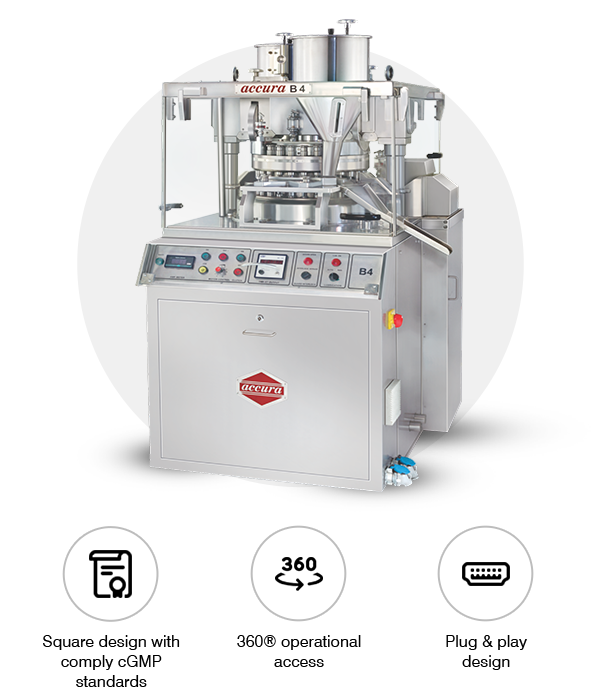
Mechanical function testing verifies turret rotation at all specified speeds, compression roller operation at the specified pre-compression and main compression force ranges, force feeder operation and speed control, and tablet ejection system function. All machine interlocks and safety systems are tested to confirm they operate correctly under the conditions they are designed to address.
Compaction force calibration is one of the most critical OQ tests for a tablet press machine. The force sensors that drive auto weight control must be calibrated to accurately measure the compression force applied to each tablet and correctly correlate that force with tablet weight for the formulation being produced. Calibration is performed with traceable reference standards and documented in the OQ protocol.
The OQ is completed when all specified tests have been performed and documented, all results have been compared to acceptance criteria, and any deviations have been documented, investigated, and resolved. A signed OQ protocol constitutes the formal evidence that the machine operates as intended across its specified operating range.
What Is PQ Performance Qualification?
Performance Qualification is the third and final stage of the equipment validation process, and in many respects it is the most important. Where IQ and OQ are primarily about the machine itself, PQ is about the machine's actual performance in producing tablets that meet quality specifications under real production conditions.
PQ for a tablet press machine requires producing multiple batches of product under the target process parameters and demonstrating through statistical analysis of the results that the machine consistently produces tablets within the specified quality limits. The number of batches required for PQ is typically three consecutive batches, although this may vary based on regulatory requirements and risk assessment.
The tablet quality parameters tested during PQ include tablet weight and weight uniformity across all stations of the turret, tablet hardness and its distribution across stations and across the batch, tablet thickness, friability, and disintegration time where relevant, and content uniformity of the active ingredient. The results from all three PQ batches are statistically analysed to demonstrate that the process is capable and consistent.
Any performance issues identified during PQ must be investigated and resolved before the PQ can be considered successful. A failed PQ batch is a significant event that requires root cause analysis, corrective action, and typically repetition of the PQ process from the beginning.
The Validation Master Plan and Its Role in Tablet Press Qualification
Individual IQ OQ PQ protocols for a tablet press machine do not exist in isolation. They are part of a broader site Validation Master Plan that establishes the validation policy, the risk-based approach to determining which equipment requires what level of qualification, the document control framework, and the responsibilities for executing and approving validation activities.
For pharmaceutical manufacturers establishing a new facility or bringing in a new tablet compression machine, the Validation Master Plan provides the framework within which the IQ OQ PQ is planned, executed, and documented. Regulatory inspectors reviewing a facility's validation status will examine the Validation Master Plan as well as the individual qualification documents to assess whether the overall approach is scientifically sound and compliant.
Change Control After Initial Validation
Equipment qualification does not end with the successful completion of PQ. Any significant change to the tablet press machine after initial validation, including major component replacement, software upgrades, relocation of the machine, or changes to utility connections, may require requalification of some or all of the IQ OQ PQ stages.
The change control process determines which changes require requalification and to what extent. For example, replacing a worn turret with an identical specification turret typically requires mechanical verification and repeat of compaction force calibration, but may not require a full PQ repeat. Upgrading the PLC software to a new version requires verification of all control system functions in OQ, and may require PQ confirmation depending on what the upgrade changed.
A well-designed change control process protects the validated state of the tablet press machine by ensuring that every change is assessed for its potential impact on machine performance and that appropriate requalification is performed when needed.
How Fluidpack Supports Tablet Press Machine Validation
Fluidpack provides comprehensive documentation support for the qualification of all ACCURA tablet press machines. The standard documentation package includes the machine manual with full technical specifications, design qualification evidence demonstrating the machine was designed to GMP requirements, factory acceptance test records, and template IQ and OQ protocols that can be adapted to the specific requirements of the customer's facility.
The IQ and OQ templates provided by Fluidpack cover all the standard checks and tests described above and are structured to align with the requirements of FDA 21 CFR Part 211, EU-GMP Annex 15, and WHO-GMP guidance. For pharmaceutical manufacturers without extensive in-house validation expertise, these templates significantly reduce the time and effort required to complete the qualification process.
Fluidpack's service engineers can also support on-site during IQ and OQ execution, providing technical expertise on machine-specific aspects of the qualification and ensuring that any issues encountered are resolved quickly and documented correctly. This support is particularly valuable for manufacturers running their first tablet press validation or for those working with a new machine model.

Conclusion: IQ OQ PQ Is the Foundation of Trustworthy Tablet Production
The investment in IQ OQ PQ validation for your tablet press machine is an investment in the trustworthiness of every tablet your machine produces. A validated machine, operating within its qualified parameters with a complete qualification documentation trail, provides the foundation for regulatory compliance, consistent product quality, and batch release confidence.
Pharmaceutical manufacturers who treat IQ OQ PQ as a bureaucratic requirement rather than a genuine quality tool miss its value. Done properly, validation tells you exactly what your machine can do, establishes the parameters within which it performs consistently, and creates the documentation framework that protects both your product quality and your regulatory standing throughout the machine's operational life.