





AI Summary
- India is the world's leading supplier of pharmaceutical equipment including tablet press machines, with manufacturers ranging from established names with decades of export experience to newer suppliers offering lower prices with limited support capability.
- Choosing the wrong tablet press machine manufacturer creates risks that go far beyond the purchase price: inadequate after-sales support, non-compliant machines failing regulatory inspections, and spare parts shortages causing unplanned production downtime that costs multiples of the original machine cost.
- Pharmaceutical manufacturers evaluating tablet compression equipment suppliers should assess seven specific dimensions before making a purchase decision: technical capability, compliance credentials, after-sales infrastructure, client references, spare parts availability, machine range, and total cost of ownership.
- Fluidpack, operating since 1983 from GIDC Vatva Ahmedabad under the ACCURA brand, is among India's most established tablet press manufacturers with over 2,250 clients across 70 plus countries and a full product range from single punch tablet press machines to high speed double rotary compression machines.
Introduction: Why Manufacturer Selection Matters as Much as Machine Selection
When pharmaceutical companies evaluate tablet press machines, the technical specifications of the machine dominate the conversation: output, compression force, tooling configuration, automation level, compliance features. These are important. But the manufacturer behind the machine matters just as much, and sometimes more.
A tablet compression machine is not a one-time transaction. It is a relationship that extends across the entire operational life of the equipment, which may be 15 to 25 years for a well-maintained machine. During that time, you will need spare parts, technical support, operator training, software updates, and potentially machine upgrades or reconfigurations. The manufacturer's capability and commitment in all of these areas determines whether your machine investment pays off or becomes a long-term operational burden.
This article gives pharmaceutical manufacturers a practical framework for evaluating Indian tablet press machine manufacturers, structured around seven questions that reveal the things you genuinely need to know before you sign a purchase order.

Question 1: How Long Have They Been Manufacturing Tablet Press Machines?
Manufacturing experience in pharmaceutical equipment is not easily substituted by good marketing. A tablet press machine manufacturer with decades of production history has resolved the engineering challenges that newer manufacturers are still encountering. Their machines have been through cycles of field feedback, design refinement, and improvement that result in more reliable, more maintainable, and better-performing equipment.
Experience also means the manufacturer has developed relationships with the raw material and component suppliers that determine machine quality. The quality of the turret steel, the precision of the punch bores, the reliability of the PLC components, and the durability of the compression rollers all depend on long-term supplier relationships and manufacturing knowledge that takes years to develop.
When evaluating a tablet press machine manufacturer, ask specifically how long they have been manufacturing tablet compression equipment, not just how long the company has existed. Companies that pivoted to pharma equipment recently may have general engineering capability but lack the specific manufacturing knowledge that pharmaceutical tablet press machines require.
Question 2: Do Their Machines Meet Your Regulatory Compliance Requirements?
Regulatory compliance is not a binary feature. A tablet press machine can be GMP-compliant at a WHO-GMP level, at an EU-GMP level, or at a 21 CFR Part 11 level, and these are meaningfully different standards. Before you engage with a tablet press machine manufacturer, establish clearly which regulatory standard your facility needs to meet and verify that the manufacturer's machines actually support that standard.
For pharmaceutical manufacturers exporting to the United States, 21 CFR Part 11 compliance is not optional. The machine must provide electronic batch records with audit trail, locked parameter controls, and data integrity protection. For EU export, similar requirements apply under EU-GMP Annex 11. For WHO-GMP certified facilities, documented equipment qualification and batch record generation are required.
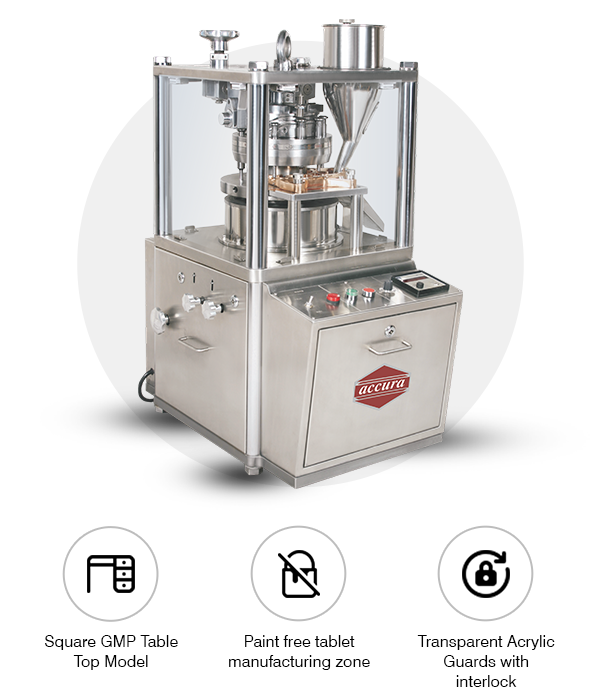
Ask the manufacturer to specify exactly which regulatory standards their machines support and to provide reference customers who have used the machines in facilities that have passed inspections under those standards. Claimed compliance and demonstrated compliance are different things.
Question 3: What Is Their After-Sales Service and Spare Parts Infrastructure?
A tablet compression machine that runs without problem for years is a productive asset. A machine that stops production while you wait weeks for spare parts or an engineer is a very expensive problem. The quality of a manufacturer's after-sales service and spare parts availability often determines the true return on your machine investment far more than the purchase price.
Establish the following before you commit to a purchase: How quickly can the manufacturer dispatch a service engineer to your facility? Do they hold critical spare parts in stock, or are spare parts made to order? What is the typical lead time for punches and dies in your required tooling configuration? Does the manufacturer provide machine operator training as part of the installation package? Is there a warranty, and what does it cover?
For manufacturers outside India purchasing from Indian suppliers, the international service capability matters additionally. Can the manufacturer support a service visit to your country? Do they have regional agents or distributors who carry spare parts and provide first-line technical support? These questions reveal whether the manufacturer can actually support you through the operational life of the machine.
Question 4: What Is Their Client Reference Base?
A manufacturer's client list is one of the most informative data points available when evaluating tablet press suppliers. Specifically, you want to know whether they have supplied machines to companies that are comparable to yours in terms of scale, product type, and regulatory environment.
A manufacturer who has supplied high speed double rotary tablet compression machines to major Indian pharmaceutical exporters has demonstrated their machines perform at commercial scale in a regulated environment. A manufacturer whose references are primarily smaller domestic producers has not necessarily demonstrated this, even if they claim the same technical specifications.
Ask for specific client references in your industry segment and, where possible, contact those references directly. Ask them about machine performance over time, spare parts availability, service response quality, and whether they would purchase from the same manufacturer again. These conversations will tell you more than any brochure.
Our Other Machine
B4 - Double Sided Rotary Tablet Press MachineQuestion 5: Do They Offer the Full Range of Machines You Need?
Your tablet press machine requirement today may be different from your requirement in five years. If you are setting up a new facility, you may start with a pilot scale tablet press for formulation development and clinical supply, then scale to a production machine. If you are expanding an existing facility, you may need additional machines at different output levels for different products.
A manufacturer who offers the complete range from single punch tablet press machines through single rotary and double rotary tablet compression machines, and who also supplies allied equipment including roll compactor machines, oscillating granulators, multi mills, and punches and dies, simplifies your procurement significantly. You deal with one supplier, one set of service engineers, one spare parts relationship, and one qualification documentation package.
Manufacturers who only offer a narrow range of machines may serve your immediate need but will not be your growth partner as your production requirements evolve.
Question 6: What Are the Total Lifetime Costs, Not Just the Purchase Price?
The purchase price of a tablet press machine is the smallest component of its total cost of ownership over its operational life. Energy consumption, spare parts costs, tooling replacement frequency, maintenance labour, and production downtime from machine failures all add up to a number that can easily exceed the purchase price multiple times over the machine's life.
A cheaper machine that consumes more energy, requires more frequent punch and die replacement due to inferior tooling quality, and requires more frequent service visits costs more over ten years than a more expensive machine that runs reliably with lower operating costs. This is not theoretical: the economics of high volume pharmaceutical production make even small differences in per-tablet production cost significant at scale.
When comparing tablet press machines from different Indian manufacturers, ask for energy consumption data at rated output, typical punch and die life expectancy for your formulation type, recommended preventive maintenance schedule and associated costs, and mean time between failures for critical components. This information gives you the data to calculate real total cost of ownership rather than making decisions based on purchase price alone.
Read Our Article
The Role of Tablet Press Machines in the Nutraceutical IndustryQuestion 7: Can You See the Machine Running Before You Buy?
For a capital equipment purchase of the scale of a commercial tablet press machine, a factory acceptance test where you see the machine running at rated output before delivery should be a standard part of your procurement process. A reputable manufacturer will offer this as a matter of course. A manufacturer who cannot or will not show you the machine running under load before delivery is a manufacturer you should approach with significant caution.
A factory acceptance test also gives you the opportunity to review the machine's documentation package, verify that the batch report output meets your requirements, confirm that the control panel and software meet your operator training needs, and ensure that the machine is exactly as specified before it leaves the factory.

Conclusion: Seven Questions That Separate the Right Manufacturer from the Wrong One
Choosing a tablet press machine manufacturer in India is a decision that will affect your production capability, regulatory standing, and operational costs for the next decade or more. The seven questions in this article give you a structured framework for evaluation that goes beyond specifications and price to the factors that actually determine whether your machine investment delivers its expected return.
Take the time to get satisfactory answers to all seven before you commit to any supplier.