




AI Summary
- In pharmaceutical manufacturing, even 0.1% material wastage becomes a significant financial loss when the Active Pharmaceutical Ingredient (API) is expensive, as is the case with oncology, neurology, and specialty drugs.
- Fully automatic tablet press machines solve this through real-time compaction force monitoring, auto weight control, and automatic rejection of out-of-spec tablets, all without operator intervention.
- Unlike semi-automatic machines, fully automatic machines like Fluidpack's F7200 generate a complete end-of-batch wastage report: total rejections, rejection reasons, and batch yield percentage.
- The locked control panel ensures no operator can alter compression settings mid-batch, protecting both material integrity and the validity of your regulatory documentation.
Introduction: Why Wastage Is the Most Expensive Problem in High-Value Drug Manufacturing
Not all tablets are equal. When you are manufacturing paracetamol or a common antacid, material wastage is an operational inconvenience. When you are manufacturing a cancer drug, a neurological treatment, or any tablet where the API costs thousands of rupees per kilogram, wastage is a financial crisis.
For pharma manufacturers working with costly Active Pharmaceutical Ingredients, the tolerance for out-of-spec tablets is almost zero, both from a business standpoint and a regulatory one. A tablet that is 510mg when it should be 500mg is not just wasted material. It is a regulatory deviation that must be documented, investigated, and explained.
This is exactly the problem that a fully automatic tablet press machine solves, and the reason why manufacturers of high-value drugs almost universally choose automatic over semi-automatic.
What Wastage Actually Looks Like in Tablet Manufacturing
Wastage in a tablet press operation comes from three main sources:
- Weight deviations: Tablets that are over or under the target weight and must be rejected.
- Startup and shutdown losses: Material that is compressed during the initial machine calibration phase before optimal settings are reached.
- Undetected deviations: In manual or semi-automatic operations, some out-of-spec tablets pass through because the rejection system did not catch them in time.
In API-intensive manufacturing, the third type is particularly damaging, because a tablet that is 490mg instead of 500mg reaching a patient is not just a wastage issue. It is a dosing issue. And a tablet that passes QC but is out of spec is a liability your documentation cannot protect you from.
Read Our Article
Tablet Pressing Machine Application In Food & Cosmetic IndustriesAuto Weight Control Through Compaction Force: The Core Technology
The key technology that separates a fully automatic tablet press from a semi-automatic one is compaction force monitoring.
Here is how it works:
- As the punches compress the powder in each die, the machine continuously measures the compression force applied.
- Since the relationship between compression force and tablet weight is consistent for a given formulation, the machine can calculate whether the tablet is within the acceptable weight range in real time, without physically weighing each tablet.
- If a tablet's compression force falls outside the set range (indicating it is too heavy or too light) the machine automatically rejects it before it reaches the output.
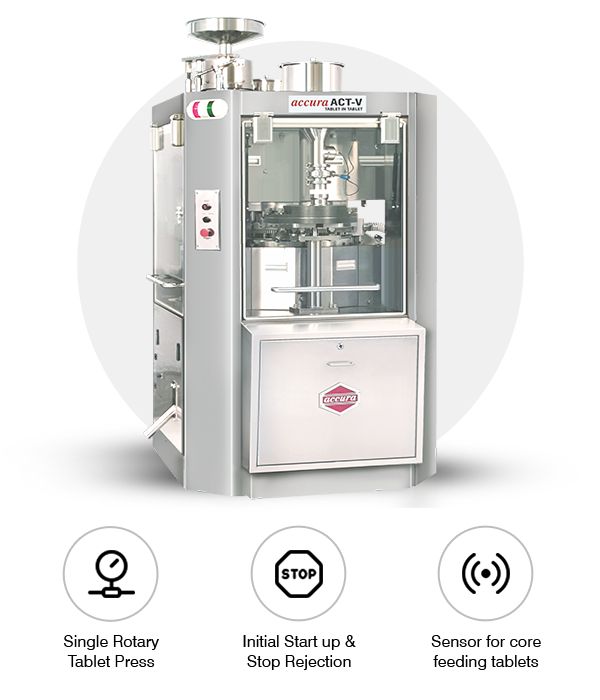
This happens at full production speed, for every single tablet, without operator intervention. At 7,77,600 tablets per hour on a machine like Fluidpack's F7200, that is a real-time quality check running continuously throughout the entire batch.
Precision Tablet Compression: Setting 500mg and Actually Getting 500mg
When you set a target weight of 500mg on a fully automatic tablet press, the compaction force control system works to maintain that target throughout the batch. Here is what that means in practice:
- The machine will produce tablets at or very close to 500mg consistently.
- Tablets that deviate (say, 499mg or 510mg) are automatically rejected.
- The rejection is logged: tablet number, compression force recorded, weight deviation, timestamp.
- At batch end, the report shows exactly how many tablets were 499mg and how many were 510mg, and whether the batch yield is within acceptable limits.
This level of precision is not achievable with a semi-automatic machine, where weight checking is done by periodic manual sampling. Between samples, out-of-spec tablets can pass through undetected.
Our Other Machine
Roll Compactor MachinesThe Wastage Report: What You Get at the End of Every Batch
One of the most valuable outputs of a fully automatic tablet press machine is the end-of-batch wastage report. For manufacturers of costly APIs, this document serves three critical functions:
- Financial tracking: You can see exactly how much material was lost to rejections, and calculate the API cost of those rejections.
- Process optimisation: If rejections are consistently happening at a particular stage of the batch, the report helps identify the root cause.
- Regulatory compliance: The report is part of your batch record and is required for FDA and GMP documentation.
A typical wastage report from Fluidpack's F7200 includes:
- Total tablets produced
- Total tablets rejected and percentage of batch
- Rejection reason for each event (force too high, force too low)
- Batch yield percentage
- Start and end time of production
- Process parameters as set and as recorded
The Locked Panel: Why It Matters for Wastage Control
Here is a situation that happens more often than manufacturers admit: an operator, trying to reduce rejections and hit output targets, adjusts the compression force setting mid-batch to bring more tablets within the acceptable range. The result? More tablets pass, but the batch data is now unreliable, and potentially the tablets themselves are out of specification.
Fluidpack's fully automatic machines prevent this by locking the control panel once the batch begins. Operators cannot change settings without authorisation. If a change is genuinely needed, it goes through a supervisor approval process and is logged in the audit trail.
This protects your API material from being wasted on a compromised batch, and protects your batch record from being invalidated by undocumented process changes.
Read Our Article
Improvement In Tablet Pressing Machine Over The YearsSemi-Automatic vs Fully Automatic: The Wastage Comparison
- Detection speed: Semi-auto detects issues through periodic manual sampling. Fully automatic monitors every tablet in real time.
- Rejection accuracy: Semi-auto uses mechanical rejection at the machine front. Fully automatic uses compaction force-based rejection, more precise, logged every time.
- End-of-batch visibility: Semi-auto provides no digital wastage report. Fully automatic generates a complete report automatically.
- Operator influence: Semi-auto settings can be changed at any time. Fully automatic panel is locked, settings are protected.

Fluidpack F7200: Precision Tablet Press Machine for High-Value API Manufacturing
The Fluidpack F7200 High Speed Double Rotary Tablet Compression Machine is the right choice for manufacturers of oncology drugs, neurology treatments, and any formulation where API cost makes wastage control critical.
- Output: Up to 7,77,600 tablets per hour
- Compaction force-based auto weight control, every tablet monitored
- Auto rejection with full logging, every rejection recorded with reason
- Locked PLC panel, settings protected throughout the batch
- End-of-batch wastage and production report, generated automatically
- 21 CFR Part 11 compliant, regulatory-ready documentation
- Interchangeable turret, flexibility across tablet formats and API types
Our Other Machine
Tablet Punches & DiesConclusion: When API Cost Is High, a Fully Automatic Tablet Press with Wastage Reporting Is Not Optional
For standard commodity drugs, wastage is a nuisance. For high-value API drugs (cancer treatments, neurology medicines, specialty formulations) it is a business-critical problem that demands a precision solution.
A fully automatic tablet press machine with compaction force monitoring, auto rejection, locked controls, and end-of-batch wastage reporting is the only manufacturing tool that gives you the control and the documentation to manage expensive APIs properly.
Fluidpack's F7200 is that machine. Contact Fluidpack at info@accuratabletpress.com or visit www.fluidpack.net to learn more.