




AI Summary
- Single rotary tablet press machines are ideal for medium-scale production, R&D, and operations where production volumes are between 50,000 and 3,00,000 tablets per hour.
- Double rotary tablet press machines compress tablets simultaneously from two sides, effectively doubling output in the same footprint, making them the preferred choice for high-volume pharmaceutical manufacturing.
- The choice between single and double rotary depends on your required output, batch size, tooling requirements, and whether you need to justify the higher capital investment of a double rotary machine.
- Fluidpack's F7200 High Speed Double Rotary Tablet Press delivers up to 7,77,600 tablets per hour (the highest output available from an Indian tablet press manufacturer) with full 21 CFR Part 11 compliance.
Introduction: The Output Question That Drives Machine Selection
When pharmaceutical manufacturers evaluate tablet press machines, output capacity is usually the first question. How many tablets per hour do you need, and which machine type gets you there reliably?
The answer for high-volume production almost always comes down to the same comparison: single rotary or double rotary tablet press? Both are widely used. Both can be made fully automatic and GMP-compliant. But they work differently, produce different output levels, and suit different production profiles.
This article explains the difference in practical terms (with a focus on output, tooling, compliance, and cost) so you can choose the right machine for your production line.

How a Single Rotary Tablet Press Works
A single rotary tablet press has one turret with one set of stations. As the turret rotates, powder fills the dies, upper and lower punches compress the material into tablets, and the tablets are ejected. This cycle repeats continuously as the turret turns.
Output depends on the number of stations in the turret and the rotation speed. A high-speed single rotary machine can produce between 1,00,000 and 3,00,000 tablets per hour, depending on the model and tooling configuration.
When single rotary is the right choice:
- Medium-scale production requirements (1 to 3 lakh tablets per hour)
- Products that require frequent changeover between tablet formats
- Operations where a smaller machine footprint is important
- Manufacturers entering high-volume production for the first time
Read Our Article
B4-Double Sided Rotary Tablet Press – Features and ApplicationsHow a Double Rotary Tablet Press Works
A double rotary (also called a double-sided rotary) tablet press has the same basic mechanism as a single rotary, but with two sets of compression stations: one on each side of the turret. As the turret rotates, both sets of stations operate simultaneously, compressing tablets on both sides in parallel.
The result: output is roughly doubled compared to a single rotary machine of the same turret size, without significantly increasing the machine footprint.
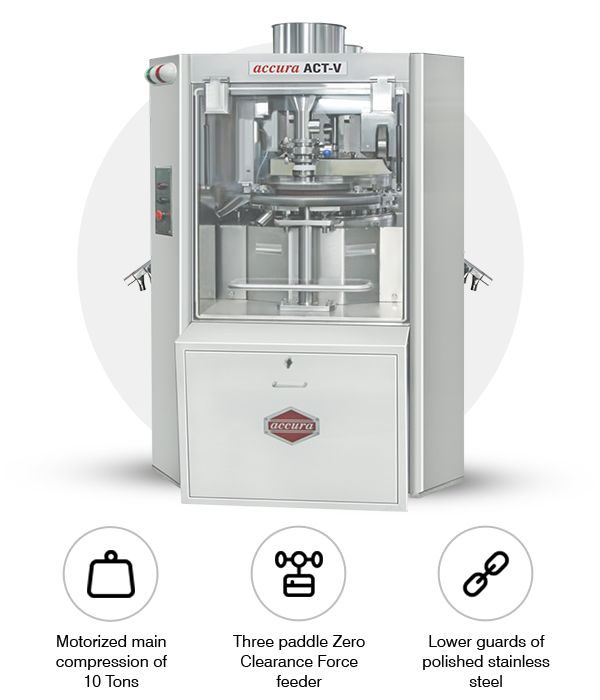
Fluidpack's F7200 is a double rotary machine capable of 7,77,600 tablets per hour, one of the highest outputs available from an Indian tablet press manufacturer.
When double rotary is the right choice:
- High-volume production requirements (3 lakh+ tablets per hour)
- Large batch sizes where continuous high-speed output matters
- Contract manufacturers with high overall production volumes
- Manufacturers of high-demand generics or OTC tablets
- Export-focused plants where maximising throughput per square metre of factory floor is critical
Our Other Machine
F3000 Single Rotary Tablet PressOutput Comparison: Single Rotary vs Double Rotary
- Single rotary (typical): 1,00,000 to 3,00,000 tablets per hour, depending on stations and RPM
- Double rotary (F7200): Up to 7,77,600 tablets per hour with B tooling configuration
- In the same factory floor space, a double rotary machine can produce more than twice the output of a single rotary
For manufacturers searching for a tablet press machine that produces 2 lakh, 3 lakh, or 5 lakh tablets per hour, the double rotary is typically the more efficient solution, delivering required output at lower RPM stress on the machine.
Tooling Options: B, D, Bb, and Bbs
Both single and double rotary machines use standard tooling types. The tooling choice affects the tablet size and shape you can produce, as well as the number of stations and therefore the output rate.
- B tooling: Standard size. Common for most pharmaceutical tablets. 65 stations available on F7200.
- D tooling: Larger tablets. Used for bolus, veterinary, and larger-format pharmaceuticals. 51 stations on F7200.
- Bb tooling: Smaller than B. Higher station count for small tablets. 77 stations on F7200.
- Bbs tooling: Even smaller tablet format. Highest station count. 81 stations on F7200.
The interchangeable turret on the F7200 means you can switch between tooling types for different products, giving you flexibility within a single machine investment.
Compliance: Are Both Machine Types Available as Fully Automatic?
Yes, both single rotary and double rotary tablet press machines can be configured as fully automatic, with PLC touch screen control, auto weight monitoring, auto rejection, locked panel, and batch report generation.
Fluidpack's F7200 (double rotary) is fully computerised and 21 CFR Part 11 compliant. Their single rotary ATX series machines are also available in fully automatic configurations for FDA and GMP-regulated production.
Read Our Article
Rotary Tablet Compression Machine in the Pharmaceutical IndustryCapital Investment: The Double Rotary Is Higher, but So Is the Return
A double rotary tablet press costs more than a single rotary machine. This is a straightforward fact. However, for manufacturers who need high output, the economics often favour the double rotary:
- One double rotary replaces two single rotary machines to achieve similar output, saving floor space, utilities, and operator cost.
- Higher output per batch cycle means lower cost per tablet as volumes scale.
- For export-grade production, a single fully automatic double rotary machine with 21 CFR Part 11 compliance is simpler to validate and maintain than two separate machines.

Fluidpack's Range: From Single to Double Rotary Tablet Press
Fluidpack manufactures both single and double rotary tablet press machines under the ACCURA brand, with over 40 years of manufacturing experience and a global install base across 70+ countries.
- ATX Series: High-speed single rotary tablet press machines for medium to large production
- F7200: High-speed double rotary tablet compression machine, up to 7,77,600 tablets per hour
- F Series: Full range of computerised tablet press machines for compliance-driven production
- ACT Series: Fully computerised with advanced automation for FDA-export facilities
Our Other Machine
F7200 High Speed Double Rotary Tablet Compression MachineConclusion: Choose Based on Output, Not Convention, and Get the Right Double Rotary Tablet Press for Your Scale
If your production requirement is below 2-3 lakh tablets per hour, a single rotary machine will serve you well. If you are at 3 lakh and above (especially for export production where every minute of downtime matters) a double rotary tablet press like the Fluidpack F7200 is the better investment.
Contact Fluidpack at info@accuratabletpress.com or visit www.fluidpack.net to discuss your output requirements and find the right machine.